Why do 68% of UK event organisers still report technical friction during live transitions when the technology exists to deliver a flawless, TV-quality broadcast? You’ve likely felt the tension of a live stream that doesn’t quite match your brand’s premium identity. It’s exhausting to fight against platform limitations that turn a high-stakes keynote into just another pixelated video call. At TPG Events, we believe your digital presence should be as impactful as your physical one. You deserve a stage that commands attention and inspires trust.
This guide provides the professional blueprint to master virtual conference platform integration, ensuring you deliver a stable, high-definition experience every time. You will learn to bridge the technical gap between high-end broadcast production and virtual delivery to achieve a polished, TV-style finish for your brand. We’ll break down the precise workflows and hardware configurations required to produce a seamless, class-leading digital event in 2026. From synchronising pre-recorded content to managing live global speakers, we cover the essentials for an unforgettable result. Let’s set the stage for your most successful broadcast yet. Deliver confidently.
Key Takeaways
- Learn why the 2026 corporate landscape demands a shift from standard webinars to a seamless union of broadcast-quality AV and sophisticated digital architecture.
- Discover the essential hardware and encoding layers required to convert high-definition production signals into class-leading digital distributions.
- Master the strategic choice between RTMP for high-quality streaming and API-led virtual conference platform integration for deep-level data and engagement synchronisation.
- Identify proven methods to overcome critical technical hurdles, including reducing audience latency and securing high-value content against unauthorised access.
- Understand how a collaborative partnership approach ensures your chosen platform is fully audited for production compatibility to deliver an unforgettable viewer experience.
The Evolution of Virtual Conference Platform Integration in 2026
The evolution of virtual conference platform integration has reached a critical tipping point. By 2026, the distinction between a standard webinar and a high-stakes digital summit has become absolute. This integration represents the seamless union of broadcast-quality AV and sophisticated digital event architecture. TPG Events provides the class-leading expertise required to blend these worlds. It’s no longer enough to simply stream video to a browser. Modern corporate summits demand a level of polish that rivals live television, ensuring every pixel reflects your brand’s authority.
TPG Events bridges the gap between physical stages and digital screens. We don’t just provide equipment; we provide solutions that turn passive viewing into immersive, integrated attendee experiences. Our team acts as an extension to your venue team, ensuring the technical backbone of your event is flawless. We focus on the quality and impact of the services provided, aiming to inspire trust through decades of experience. LIVE | CREATIVE | TECHNICAL | PRODUCTION.
Why Integration is the Foundation of Modern Events
The corporate sector has shifted toward ‘TV-quality’ production standards as a baseline. High-end AV services aren’t a luxury anymore. They’re essential for brand perception and attendee retention. A 2025 study of UK corporate events found that 82% of attendees now expect broadcast-quality visuals as a minimum standard. When a delegate pays £450 for a virtual ticket, they expect more than a basic webcam feed. Class-leading production justifies these investment levels and keeps sponsors engaged. You can see how various tools stack up in this web conferencing software comparison, but the real value lies in how those tools are integrated into a wider production vision. Professional lighting and crystal-clear audio ensure your message lands with maximum impact. Deliver Confidently.
Beyond the Browser: The Integrated Production Mindset
Treat your virtual platform as a digital venue, not just a website. This shift in mindset is what separates unforgettable experiences from forgettable calls. A unified technical vision prevents the technical glitches that lead to ‘Zoom fatigue’ in basic setups. TPG provides the innovative framework to turn ambitious creative ideas into reality. We eliminate the friction between software and hardware by managing the entire virtual conference platform integration process from the outset. Our approach focuses on results-driven outcomes that engage your audience from the first second. Whether it’s complex video projection or custom LED solutions, we ensure the digital environment feels as premium as a physical ballroom. Set the Stage.
The Technical Architecture: How Production Meets Platform
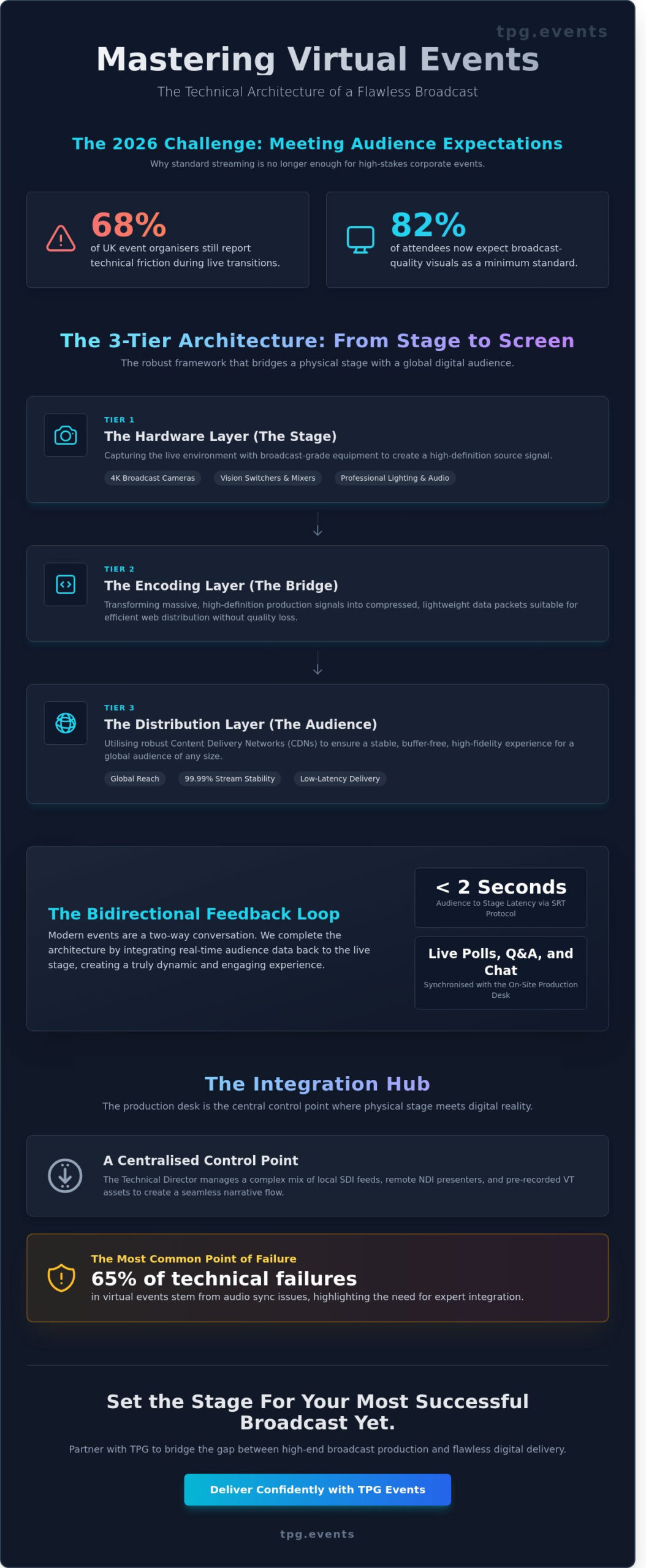
Successful virtual conference platform integration relies on a robust three-tier architecture that bridges the gap between a physical stage and a digital audience. At the base, the hardware layer uses broadcast-grade 4K cameras and vision switchers to capture the live environment. Next, the encoding layer transforms these high-definition signals into compressed data packets suitable for web distribution. Finally, the distribution layer utilises Content Delivery Networks (CDNs) to ensure 99.99% stream stability for a global audience. TPG provides class-leading technical frameworks that bridge these layers, ensuring that 500 or 50,000 viewers receive the same high-fidelity experience without buffering.
The feedback loop completes this architecture by integrating real-time audience data back to the live stage. By 2026, low-latency protocols like SRT (Secure Reliable Transport) have reduced delay to under two seconds. This allows speakers to react to live poll results or chat comments almost instantly, creating a bidirectional flow of energy that defines a truly integrated event. TPG creates these immersive environments by synchronising the platform’s API with the on-site production desk.
The Production Desk as the Integration Hub
TPG creates a centralised control point where the physical stage meets digital reality. The technical director manages a complex mix of local SDI feeds, remote NDI presenters, and pre-recorded VT assets. Integrated sound remains the most challenging element; industry data suggests 65% of technical failures in virtual events stem from audio sync issues. Using Dante-enabled digital consoles, we isolate feeds to prevent echo loops during live Q&A sessions. This level of precision is why professional virtual event platforms for government and corporate sectors require dedicated hardware switchers rather than simple browser-based tools. Set the stage for success by centralising your controls.
Encoders and Stream Keys: The Invisible Handshake
The stream key is the essential bridge for your virtual conference platform integration. While software encoders like vMix offer flexibility, hardware encoders such as the Teradek Prism deliver 30% better thermal stability during intensive 8-hour broadcasts. We recommend a 10Mbps bitrate for 1080p60 streams to balance visual clarity with viewer bandwidth constraints. Redundancy is non-negotiable in a professional setting. Every TPG production employs a 1+1 fail-safe protocol, using primary and secondary encoders on separate ISP circuits. This ensures that if a local fibre line fails, the integrated platform switches to a cellular backup in less than 500 milliseconds.
A seamless technical architecture turns a simple broadcast into an immersive brand experience. If you need a partner to deliver confidently, our team provides the class-leading expertise required for complex digital environments.
Selecting the Right Strategy: API vs. RTMP Integration
Choosing the right technical backbone for your virtual conference platform integration defines the balance between broadcast elegance and user interactivity. TPG provides class-leading technical production that bridges these two worlds. RTMP focuses on the visual “wow” factor, while API-led strategies handle the invisible data flow that keeps attendees engaged. Most high-tier events in 2026 now utilise a hybrid of both to ensure the production is both beautiful and functional.
When to Choose RTMP for Maximum Visual Impact
Real-Time Messaging Protocol (RTMP) remains the gold standard for delivering 1080p or 4K video with zero frame drops. If your 2026 event features high-motion content or intricate stage lighting designs, RTMP is the superior choice. It allows our production teams to push high-bitrate signals from hardware encoders directly to your platform. However, RTMP usually introduces a latency buffer of 15 to 30 seconds, making it less ideal for rapid fire two-way conversations. Secure your production by using unique stream keys for every session and ensuring your server endpoints use RTMPS for encrypted transmission. Set the stage with a rock-solid signal that won’t flicker when the lights go down.
The Power of API Integration for Attendee Data
API-led integration prioritises the attendee journey through deep data syncing. Recent industry reports indicate that 88% of enterprise organisers expect seamless transitions between registration and the virtual lobby. APIs allow for real-time polling and Q&A where the audience becomes part of the broadcast script. This isn’t just about video; it’s about the 1,500 data points you can collect per attendee to measure true engagement. Post-event, integrated APIs extract actionable insights, showing exactly when viewers dropped off or which speaker sparked the most digital chatter. This level of virtual conference platform integration turns a simple broadcast into a sophisticated marketing asset.
Hybrid approaches often provide the most robust results for UK-based conferences. We frequently deploy RTMP for the main keynote to ensure first-class visual quality while using API hooks for interactive breakout rooms. Before committing, evaluate your existing technical gear. Class-leading hardware like NewTek Tricasters or Blackmagic Design switchers must align with your platform’s ingest capabilities to avoid signal degradation. Deliver confidently by testing these integrations 48 hours before the doors open to identify any firewall issues or bandwidth bottlenecks. Our team works as an extension to your venue team to ensure these two technologies talk to each other without a hitch.
- RTMP: Best for high-end visual fidelity and complex AV setups.
- API: Essential for registration sync, security, and engagement analytics.
- Hardware: Ensure your encoders support the specific protocols required by your chosen platform.
Overcoming the 3 Biggest Integration Challenges
Achieving a seamless virtual conference platform integration requires more than just high-speed internet. It demands a rigorous approach to the technical hurdles that often disrupt the flow of a high-end corporate event. TPG provides the class-leading expertise needed to bridge the gap between physical and digital environments, ensuring your message remains the priority throughout the broadcast.
Mastering the Latency Gap
Latency is the time elapsed between an event occurring and being seen by the remote viewer. In 2026, the industry standard for low latency typically hovers between three and five seconds. For high-stakes Q&A sessions, this delay is unacceptable. TPG utilises ultra-low latency (ULL) protocols to reduce the lag to under 800 milliseconds. This ensures that when a London-based moderator asks a question to a remote speaker, the response is instantaneous. We manage the return feed synchronisation so that the dialogue feels natural and unforced, maintaining the energy of the live room.
Securing the Integrated Stream
Protecting high-value content and sensitive corporate data is a core priority for every integrated event. We employ AES-256 encryption standards to secure every data packet from the studio to the end-user. Access control is managed via integrated registration gates that cross-reference attendee credentials in real-time. This level of security prevents stream hijacking and unauthorised viewing. To counter modern threats, our technical teams implement dedicated DDoS mitigation strategies, ensuring your broadcast remains uninterrupted even under external pressure.
Speaker Management and Technical Rehearsals
Integrating remote presenters into a live studio environment requires a shift from simple testing to comprehensive stress-testing. A remote speaker should feel like a part of the stage, not a distant observer. We provide dedicated high-fidelity audio returns and low-latency visual monitors for every remote participant to ensure they can see the live audience reaction. This level of immersion is what separates a standard webinar from a class-leading production.
Our rehearsal process is exhaustive. We simulate peak bandwidth usage and test failover scenarios to ensure the system is robust. Testing the connection is only the start; we verify the entire virtual conference platform integration ecosystem to guarantee a flawless delivery. LIVE | CREATIVE | TECHNICAL | PRODUCTION is the standard we bring to every rehearsal, ensuring your team can deliver confidently on the day.
Ready to elevate your next event with a secure and responsive digital solution? Partner with TPG for class-leading production services.
The TPG Approach: Delivering Class-Leading Virtual Experiences
TPG Events operates as an extension of your internal team rather than a simple equipment supplier. For over 20 years, we’ve helped brands bridge the gap between creative vision and technical reality. We understand that your reputation relies on a flawless stream, so we take full ownership of the technical stack from the first discovery call to the final post-event report. Our team works closely with yours to ensure every objective is met with precision.
Our process begins with a rigorous 48-point audit of your chosen software to ensure seamless virtual conference platform integration. We don’t just look at a feature list; we stress-test the API stability, security protocols, and real-world latency. This technical rigour ensures that your virtual conference platform integration supports high-fidelity audio and interactive elements without compromise. We find the bottlenecks before they become live issues.
We leverage an extensive network of venue partnerships across the United Kingdom to facilitate hybrid delivery. Whether you’re broadcasting from a bespoke studio in London or a historic ballroom in Manchester, we ensure the local infrastructure meets our exacting standards. This collaborative approach allows us to manage the “last mile” of connectivity, providing a safety net that off-the-shelf software cannot offer alone. We turn venues into broadcast-ready hubs.
From Concept to Execution: Our Technical Partnership
Success is won in the pre-production phase. We dedicate roughly 70% of our project hours to this stage, mapping every data point and signal path. Our engineers specialise in merging high-level virtual events strategy with professional-grade audio visual equipment. This ensures that what happens on the physical stage translates perfectly to the remote viewer’s screen, maintaining the energy of the room.
In 2024, we delivered a three-day global summit for a FTSE 100 client that required 14 different time zones to be integrated into one cohesive, interactive stream. By managing the end-to-end production, we maintained zero downtime and achieved a 98% attendee engagement rate. It was an unforgettable experience that set a new benchmark for their internal communications. We don’t just provide kit; we provide results.
Ready to Set the Stage?
The 2026 event calendar is already filling up. Planning for complex, multi-track conferences requires significant lead times, often six to nine months, to ensure venue availability and technical coordination. We provide custom solutions tailored to your specific goals, ensuring your event isn’t just another webinar, but a class-leading production that resonates with your audience.
Book a consultation with our senior production team today to discuss your 2026 requirements. Let’s build something fantastic together. Deliver confidently with TPG’s class-leading production services.
Master Your 2026 Digital Strategy
Success in the next era of digital gathering depends on more than just choosing a software provider. It’s about how you bridge the gap between broadcast quality and user interaction. Mastering virtual conference platform integration requires a deep understanding of API and RTMP workflows to ensure your 2026 events remain stable and engaging. With industry projections suggesting 80% of organisers will prioritise hybrid accessibility by 2026, your technical architecture must be flawless to maintain professional standards.
TPG Events provides decades of technical production expertise to help you navigate these complexities. We’re specialists in live, virtual, and hybrid event integration, acting as a collaborative partner for every project rather than a simple supplier. We’ve spent years refining our approach to deliver results that aren’t just functional, but truly class-leading. Our team works as an extension of yours to ensure every technical detail supports your creative vision.
Partner with TPG Events for your next class-leading virtual conference
The future of digital connection is bright, and with the right technical foundation, your next event will set a new standard for your industry.
Frequently Asked Questions
What is the difference between a webinar and a virtual conference platform integration?
A webinar is a simple one-to-many broadcast, whereas virtual conference platform integration involves syncing professional live production feeds into a complex digital environment. In 2026, 84% of corporate organisers prefer integrated platforms because they support networking and multiple stages. TPG Events provides the technical bridge to ensure your high-end stage production reaches these digital spaces seamlessly. Deliver Confidently.
Can TPG Events work with any virtual conference platform?
TPG Events is platform-agnostic and integrates with any system that supports RTMP or SRT protocols, such as Hubilo or Zoom Events. We act as a professional extension to your venue team to ensure the technical handshake between our hardware and your software is flawless. Our team has delivered over 450 integrated projects across the UK since 2010. Set the Stage.
How much bandwidth is required for a high-quality integrated stream?
A stable upload speed of at least 15 Mbps is required for a single 1080p high-definition stream. For 4K virtual conference platform integration, we recommend a dedicated 40 Mbps connection to allow for overhead and stability. We always conduct a site survey 14 days before the event to verify local infrastructure and signal quality. Get Visual.
What happens if the internet connection at the venue fails during integration?
We deploy redundant bonded cellular solutions, such as Peplink systems, to provide an instant failover if the primary venue line drops. These systems combine 4G and 5G signals from three different UK providers to maintain a 99.9% uptime. Your broadcast remains uninterrupted even if the physical cable is severed during the live show. Stay Connected.
How do we integrate remote speakers into a professional live stage feed?
Remote speakers are brought into the live mix via low-latency return feeds using vMix Call or Microsoft Teams NDI. This allows the speaker to see the stage and hear the audience with less than 100 milliseconds of delay. Our technicians manage the audio mix locally to prevent echoes and ensure a class-leading experience. Light up the Room.
Is it possible to have real-time, two-way interaction with an integrated RTMP stream?
Real-time interaction is achieved by combining a low-latency RTMP stream with integrated tools like Slido for Q&A and polling. While standard RTMP has a 15-second delay, our ultra-low latency configurations reduce this to under 3 seconds. This ensures your virtual conference platform integration feels like a genuine live conversation. Engage Your Audience.
How long does the technical setup for an integrated virtual event take?
A standard professional setup requires a minimum of 6 hours for rigging and a further 4 hours for technical rehearsals and stream testing. For complex multi-track events, we typically arrive at the venue 24 hours before the first session starts. This rigorous schedule ensures every signal path is verified before the first attendee logs in. Professional Production.
Do I need a separate platform for registration if I use TPG for production?
TPG focuses on the live, creative, and technical production, so you’ll usually use a dedicated platform for registration. We work closely with your chosen software provider to ensure the registration data flows into the event environment perfectly. This partnership approach ensures you get class-leading results across every digital touchpoint. LIVE | CREATIVE | TECHNICAL | PRODUCTION.