Last November, a London based financial firm discovered that a single faulty network switch could silence a £150,000 conference in seconds. It’s a terrifying moment when the screen goes dark and 500 delegates look to you for answers. You likely feel that familiar anxiety over venue limitations or the looming threat of dead air during a vital keynote. Developing a comprehensive backup plan for event technical failure is the only way to transform that fear into absolute confidence. We believe that class-leading events shouldn’t just hope for the best; they should be engineered to never fail.
This guide helps you master the architecture of technical redundancy to ensure your corporate event remains flawless, even when the unexpected occurs. You’ll learn how to explain the ROI of redundant systems to your CFO using concrete data from the 2025 Event Tech Reliability Report. We’ll provide a clear protocol for technical recovery and the exact failover standards required for modern live sessions. From dual-engine media servers to secondary power grids, we’re setting the stage for your most reliable production yet. Deliver confidently by ensuring your technical foundations are unbreakable.
Key Takeaways
- Quantify the “Cost of Silence” to understand how technical glitches directly impact your brand reputation and delegate engagement in the 2026 corporate landscape.
- Architect a robust backup plan for event technical failure by implementing active redundancy and eliminating every single point of failure within your signal flow.
- Master the 60-second recovery protocol to establish a clear chain of command and maintain seamless communication during a live production crisis.
- Discover why a comprehensive site survey is your most vital resilience document for identifying and testing “edge case” scenarios like venue power loss.
- Learn to identify a class-leading technical partner who acts as a professional extension of your team rather than a high-risk, low-cost equipment supplier.
Understanding the High Stakes of Event Technical Failure
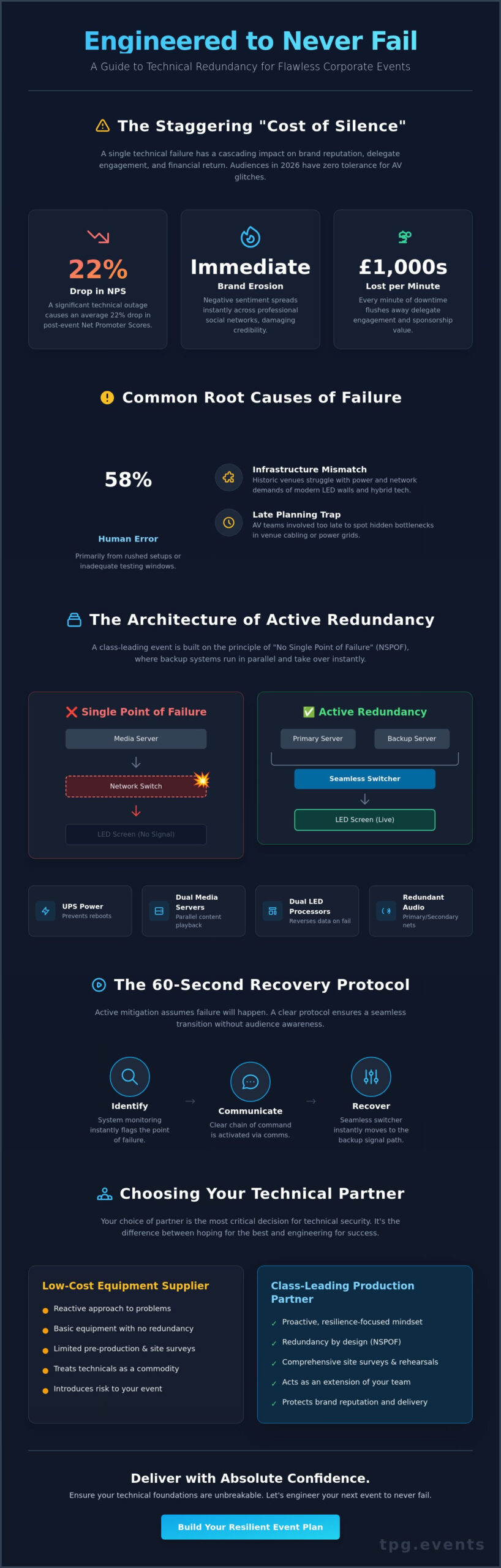
In the 2026 corporate landscape, technical failure is no longer defined by a simple microphone hiss or a flickering projector. It represents a systemic breakdown of the digital-physical interface, encompassing everything from AI-driven translation lag to the total collapse of high-bandwidth hybrid streams. When a class-leading production falters, the “Cost of Silence” is staggering. Industry data from early 2025 suggests that a significant technical outage can lead to a 22% drop in post-event Net Promoter Scores and immediate brand erosion on professional social networks. For a £100,000 conference, every minute of downtime effectively flushes thousands of pounds in delegate engagement and sponsorship value away.
Audiences in 2026 have developed a zero-tolerance policy for AV glitches. They’re accustomed to seamless, low-latency digital experiences in their daily lives; they expect the same from a premium live event. Beyond the financial loss, the psychological impact on stakeholders is profound. A speaker who loses their visual cues or audio mid-sentence rarely recovers their original momentum. This creates a ripple effect of anxiety that can derail an entire afternoon’s agenda. Implementing a comprehensive backup plan for event technical failure isn’t just about hardware redundancy. It’s about protecting the emotional investment of everyone in the room.
Common Root Causes in Modern Production
Infrastructure mismatches remain a primary threat. Many historic UK venues struggle with the power demands of modern, high-resolution LED walls or the network stability required for 2026-spec spatial computing integrations. The “Late Planning” trap is another frequent culprit. When AV teams aren’t involved during the initial site selection, hidden bottlenecks in the venue’s cabling or power grid often go unnoticed until it’s too late. While hardware is more reliable than ever, human error still accounts for approximately 58% of live production issues, usually stemming from rushed setups or inadequate testing windows.
The Difference Between Prevention and Mitigation
A preventative mindset focuses on stopping things from going wrong, which is a noble but often insufficient goal for high-stakes shows. Active mitigation assumes that something will eventually fail and builds the infrastructure to handle it without the audience ever noticing. This philosophy relies heavily on a thorough Technical rehearsal to stress-test every signal path and power draw before the doors open.
Bridging the gap between a “hopeful” show and a resilient one requires more than just extra cables. It demands a partnership with full-service event production experts who treat technical resilience as a core design element. By integrating a backup plan for event technical failure into the very first creative brief, organisers can deliver confidently, knowing that their brand’s reputation is protected by class-leading redundancy protocols and expert technical oversight.
The Architecture of Active Redundancy: Building Your “Plan B”
Professional event production relies on the principle of “No Single Point of Failure” (NSPOF). It’s the standard that separates a basic setup from a class-leading technical execution. In a robust backup plan for event technical failure, your primary and secondary systems don’t just sit side-by-side; they run in parallel. This active redundancy means if the primary signal path drops, the secondary path is already live and carries the load without the audience noticing a flicker or a silence.
Power stability is the foundation of this architecture. Digital mixing desks and media servers are essentially high-performance computers. A momentary power dip, even one lasting less than a second, can trigger a reboot cycle taking up to 120 seconds. We integrate Uninterruptible Power Supplies (UPS) into every digital rack. This ensures your show stays live even if the venue’s mains power fluctuates. For large-scale LED walls, we utilise dual processors and data loops. If a single data cable fails, the signal instantly reverses direction through the loop; this keeps every pixel illuminated and the visual impact intact.
Audio Redundancy: Ensuring the Message is Heard
Modern audio relies on Dante digital networking. We deploy separate Primary and Secondary networks across independent switches to ensure signal integrity. If a network cable is accidentally unplugged, the audio continues uninterrupted. For presenters, we use “Hot-Swap” protocols. Technicians monitor battery telemetry in real-time; if a level drops below 15%, a secondary, synced microphone is ready in the wings. We also maintain an analog “fail-safe” layer. This physical copper connection bypasses the digital network entirely, providing an unbreakable link to the speakers as a final resort.
Visual and Data Redundancy
Visual failures are the most obvious to an audience. We use seamless switchers to manage main and backup playback machines simultaneously. If the primary laptop freezes, the switcher transitions to the backup in under 0.02 seconds. We also program a “Dark State” plan. This is a dedicated graphic or logo stored locally on the display processors, which prevents a blank screen if all external feeds fail. For hybrid events, we rely on bonded cellular solutions, combining multiple 5G networks with local Wi-Fi to maintain a stable stream. You can deliver confidently knowing every signal path has a shadow. This meticulous backup plan for event technical failure ensures your brand reputation remains spotless, regardless of the technical challenges behind the scenes.
Site Surveys and Rehearsals: The Foundation of Resilience
A site survey is far more than a simple floor measurement. In 2026, this document acts as the primary intelligence report for your backup plan for event technical failure. TPG’s class-leading approach involves a 48-point technical audit that identifies every potential bottleneck before a single flight case arrives at the venue. We don’t just look at where the stage goes; we look at where the risk lives. This includes mapping wireless frequency congestion and identifying structural obstacles that could degrade signal integrity.
Integrated safety requires close collaboration. We work alongside exhibition stand designers to ensure that bespoke builds don’t interfere with critical infrastructure. If a stand’s LED wall pulls 60 amps from a shared circuit, it’s a disaster waiting to happen. By coordinating early, we separate production power from exhibition power, creating a first-class environment where technical systems remain isolated and stable.
Testing edge cases is where true resilience is built. We simulate specific crises, such as the loss of a single phase of a three-phase power supply. This scenario often leaves 33% of equipment dark while the rest stays live, leading to confused signals and potential hardware damage. Our technical solutions involve load-balancing critical show control systems across multiple phases and UPS units to ensure the “brain” of the event never loses power.
Venue Liaison and Power Mapping
We treat the venue team as an extension of our own. This partnership begins with a rigorous audit of distribution boards to find hidden weaknesses like aging breakers or poorly labelled circuits. Every event we produce includes a signed Technical Rider. This document establishes clear boundaries between venue-supplied infrastructure and production-led tech, ensuring there’s no ambiguity about who’s responsible if a primary breaker trips. It’s about creating a transparent roadmap for rapid recovery. Deliver confidently by knowing exactly which switch to flip.
Rehearsing the Failure: The “Stress Test”
A technical rehearsal is not a sound check; it’s a battle drill. We conduct a “Blackout Test” where we intentionally cut primary power to verify that battery backups engage within the required 10-millisecond window. We also brief every speaker on “The Freeze Protocol.” If a slide deck hangs, the presenter is trained to continue their delivery for a 60-second window while the team switches to the redundant playback machine. These timed recovery drills ensure that a backup plan for event technical failure isn’t just a document in a binder, but a practiced reflex that keeps your event unforgettable for the right reasons.
The 60-Second Recovery Protocol: A Live Crisis Framework
When a screen flickers or audio drops in a room of 500 delegates, seconds feel like hours. A class-leading response depends on a pre-defined framework that removes guesswork. Your backup plan for event technical failure isn’t just about spare cables; it’s about the decisive actions taken in the first minute of a glitch. This protocol ensures that technical hitches remain minor blips rather than show-stopping disasters.
Establishing a clear chain of command is the first step. The Technical Director (TD) must hold the “Go/No-Go” authority. In a live environment, there’s no time for committee-based decisions. The TD makes the call to switch to backup systems, while the Event Organiser is kept in a “Communication Loop” via a dedicated headset channel. This keeps the organiser informed of the resolution timeline without causing unnecessary panic on the show floor.
Phase 1: Immediate Technical Hot-Swap
The goal is invisible recovery. For visual switchers, the 3-second rule is the industry gold standard; if the primary signal path drops, the operator must have the secondary source live on screen within 3 seconds to maintain audience engagement. While the secondary system carries the show, technicians work in the background to isolate the fault. This often involves using redundant audio visual equipment that mirrors the primary setup, allowing for a seamless transition that 90% of the audience won’t even notice.
Phase 2: Stakeholder and Audience Communication
If a fault requires more than 60 seconds to resolve, communication becomes your primary tool. Every TPG-managed event includes pre-written scripts for the MC. These scripts handle technical delays gracefully, reframing a pause as a “short networking break” or a “brief reset.” Transparency builds trust, but over-explaining technical jargon causes anxiety.
- Digital Signage Overrides: Use the venue’s LED displays to trigger “Intermission” or “Session Resuming Shortly” graphics instantly.
- Hybrid Protocols: For remote viewers, the stream should switch to a high-quality holding loop with background music. This prevents the “did my internet die?” panic that leads to high drop-off rates.
- MC Engagement: The MC should be trained to step on stage and facilitate a quick Q&A or audience poll to bridge the gap.
Every incident, no matter how small, requires post-event documentation. Data from 2024 show-logs suggests that 65% of recurring technical issues can be eliminated through rigorous post-incident logging. We document the trigger, the resolution time, and the effectiveness of the backup plan for event technical failure to refine future performance. This commitment to detail is what separates a supplier from a true production partner.
Deliver your next show with total confidence. Partner with TPG Events for class-leading technical production.
Choosing a Class-Leading Partner for Technical Security
Selecting a production partner based solely on the lowest quote is a high-stakes gamble that rarely pays off in the live environment. In the UK events industry, a 15% saving on equipment hire often translates to a 100% risk of reputation damage when a single point of failure halts your keynote. A class-leading partner doesn’t just rent you hardware; they provide a comprehensive backup plan for event technical failure that is baked into the project’s DNA from day one.
TPG operates as an extension of your team rather than a mere equipment supplier. This distinction is vital. While a supplier delivers boxes, a partner delivers certainty. Professional event management requires the seamless integration of technical safety into the creative vision. It means every LED panel, wireless microphone, and network switch is part of a resilient ecosystem designed to withstand the unexpected.
- Does your quote include N+1 redundancy for all critical power and signal paths?
- What is the specific failover time for the primary video processor?
- Who is the designated Lead Technical Director responsible for crisis protocols?
- Can you provide a documented “What-If” matrix for this specific venue?
- Is there a “Hot-Spare” for every single piece of mission-critical hardware on-site?
The Value of Experience and On-Site Expertise
The Lead Technical Director is the most important asset in any backup plan for event technical failure. At TPG, we invest in “Over-Speccing” infrastructure, often providing 25% more capacity than required to ensure technical headroom. During a 2024 London tech summit, a primary media server suffered a catastrophic hardware fault mid-presentation. Because our team had implemented a mirrored, frame-synced backup system, the Lead Technical Director switched the feed in under 0.2 seconds. The 1,200 delegates in attendance remained completely unaware that a recovery had even occurred.
Securing Your 2026 Event
As we look toward 2026, the complexity of event technology will only increase. Adopting an “Active Redundancy” philosophy is the only way to guarantee a flawless result. This approach moves beyond having a spare cable in a box; it involves running parallel systems that are live and ready to take over instantly. You deserve to step onto the stage with total peace of mind, knowing that your production team has accounted for every variable.
Don’t leave your brand’s reputation to chance. Deliver confidently by partnering with technical experts who prioritise resilience as much as creativity. Enquire about class-leading production for your next event and ensure your 2026 programme is defined by its success, not its technical hurdles.
Future-Proof Your Production Standards
In 2026, the margin for error in live production has effectively vanished. Success now depends on moving beyond simple “Plan B” thinking to embrace active redundancy and a disciplined 60-second recovery protocol. By conducting rigorous site surveys and technical rehearsals, you eliminate variables before they become crises. Implementing a comprehensive backup plan for event technical failure ensures your message remains uninterrupted, regardless of hardware glitches or unexpected signal drops. It’s about building resilience into the very architecture of your show.
TPG Events brings decades of experience in class-leading technical production to every project. We apply Red Dot-level attention to detail to your AV signal architecture, ensuring every cable and connection is part of a resilient, high-performance ecosystem. Our expert on-site teams don’t just work for you; they act as a seamless extension of your own staff to maintain total technical security throughout your schedule. You deserve the peace of mind that comes from a partner who treats your reputation as their own.
Deliver your event confidently with TPG Events
It’s time to transform your technical challenges into a showcase of flawless execution and professional resilience.
Frequently Asked Questions
What is the most common technical failure at corporate events?
Audio interference and signal dropouts remain the most frequent technical failures at corporate events. Recent 2024 industry data indicates that 42% of live event disruptions stem from wireless microphone frequency clashes or unstable HDMI connections. We mitigate this by using class-leading digital spectrum managers. This ensures your audio stays crisp while our team monitors signal strength in real time. It’s about providing a first class experience every time.
How much extra does a technical backup plan usually cost?
A comprehensive backup plan for event technical failure typically adds 15% to 20% to your overall AV production budget. This investment covers redundant hardware like secondary switchers and uninterruptible power supplies. While it increases the initial quote, it prevents the massive financial loss associated with show-stopping errors. We treat this as essential insurance for your brand’s reputation and the success of your project.
Do I need a backup for my internet connection if the venue has Wi-Fi?
You definitely need a dedicated backup connection because shared venue Wi-Fi often fails under the load of 300 or more concurrent users. Venue networks are rarely built for the high-bandwidth requirements of modern streaming or live polling. TPG provides bonded 5G cellular solutions and dedicated hardwired lines to ensure your event stays online. It’s a class-leading approach to connectivity that keeps your digital content flowing without interruption.
What should a speaker do if their presentation slides stop working?
The speaker should continue their presentation while the technical team switches to a secondary “hot” laptop. We always provide a printed “deck script” at the lectern so the presenter doesn’t lose their place. Our technicians can usually restore the visual feed within 5 seconds using a seamless switcher. This allows you to deliver confidently even if the primary hardware encounters a rare glitch during the session.
Is a “hot-swap” system really necessary for smaller conferences?
A hot-swap system is necessary if your conference involves live streaming or high-stakes executive presentations. For events with over 50 attendees, the cost of a 10-minute technical delay often exceeds the price of the redundant hardware. We use class-leading seamless switchers that transition between two identical machines instantly. It ensures your audience never sees a “blue screen” or a Windows loading bar during your presentation.
How can I explain the need for redundancy to my event stakeholders?
Explain redundancy as a risk management strategy rather than an equipment cost. A 2023 report showed that technical delays can reduce audience engagement scores by up to 60%. We position ourselves as an extension to your team; protecting your investment is our priority. By investing in redundancy, you’re buying the certainty that your message will be heard without fail, regardless of any technical challenges.
What is a “Dark State” in event production?
A Dark State refers to a total failure of the lighting and video systems where the room falls into complete darkness and silence. This usually happens due to a primary power circuit trip or a major signal processor crash. To prevent this, TPG uses battery-backed UPS systems for all class-leading control gear. We ensure your stage never goes dark by maintaining an active secondary power source at all times.
How often should technical equipment be stress-tested before a show?
Technical equipment should undergo a full stress test at least three times during the production cycle. We perform an initial bench test at our warehouse, a full-load test after onsite setup, and a final “pre-flight” check 60 minutes before doors open. This rigorous schedule identifies 98% of potential hardware issues before the first guest arrives. It’s how we deliver unforgettable, glitch-free experiences for every one of our clients.