The stage is the focal point of any truly unforgettable event, the platform where key moments are made. Yet, navigating the world of professional stage hire can feel overwhelming. From determining the correct size and load-bearing capacity to ensuring full compliance with UK safety standards and integrating complex AV solutions, the details can quickly become a significant source of stress for even the most seasoned event planner.
This is where clarity and expertise make all the difference. This ultimate guide is designed to empower you, transforming uncertainty into confidence. We will demystify the entire process, from selecting the ideal platform for your conference or festival to understanding the critical technical considerations that guarantee a flawless execution. Discover how to create a visually impressive focal point, understand the costs involved, and partner with a team that delivers a class-leading, safe, and spectacular result every time.
Beyond the Platform: Why Professional Stage Hire is Crucial for Your Event
A stage is never just a raised platform; it is the command centre of your event. It’s where your message is amplified, your brand comes to life, and your audience’s attention is captured and held. A professionally designed and constructed stage elevates a speaker’s presence, commands respect, and fosters genuine engagement. In contrast, an inadequate or DIY setup-or a poor in-house venue option-can undermine your credibility before a single word is spoken, detracting from your core message and creating a forgettable experience.
Investing in professional stage hire is an investment in the overall impact and success of your event. It transforms a simple space into an immersive environment, reinforcing your theme and brand messaging with a class-leading, polished finish that speaks volumes about your commitment to quality.
Matching the Stage to Your Event Type
The optimal stage design is dictated entirely by your event’s objectives. Understanding the different types of staging systems allows for a bespoke solution that enhances the specific experience you aim to create. A one-size-fits-all approach simply doesn’t deliver the required impact.
- Conference & Corporate Meetings: The focus here is on clear communication. Staging must guarantee perfect sightlines for all attendees, integrate seamlessly with AV equipment like screens and lecterns, and feature prominent, professional branding.
- Awards Ceremonies & Gala Dinners: These events demand a sense of prestige. The stage becomes a theatrical centrepiece, designed to create an atmosphere of celebration and importance, often with dramatic lighting and multi-level designs.
- Product Launches: Impact is everything. Staging for a launch must be innovative and memorable, often incorporating custom structures, LED video walls, and reveal mechanics to generate maximum excitement.
- Outdoor Festivals & Concerts: Durability and scale are paramount. Professional outdoor stages are engineered for weather resistance, structural safety, and supporting heavy lighting and sound rigs for large audiences.
The Difference Between Dry Hire and Full-Service Production
When considering stage hire, you typically have two options. Dry hire involves renting the stage decking and components only, leaving you responsible for design, transport, construction, and safety compliance. This is only suitable for organisations with an experienced in-house technical team.
A full-service production partner, however, provides an end-to-end solution. This is more than just equipment rental; it’s a collaborative partnership where a dedicated team handles creative design, logistics, build, and safe de-rig. Working with a production partner significantly reduces risk, ensures all health and safety regulations are met, and guarantees a cohesive, technically flawless result that aligns perfectly with your creative vision.
Your Pre-Hire Checklist: Key Factors to Consider
The foundation of an unforgettable event is a stage that perfectly serves its purpose. Before you begin your search for professional stage hire, a detailed plan is your most powerful tool. Thinking through the specifics of your event at this early stage prevents costly, last-minute adjustments and ensures the final result is seamless. This checklist acts as your practical workbook, empowering you to approach suppliers with a clear, confident vision.
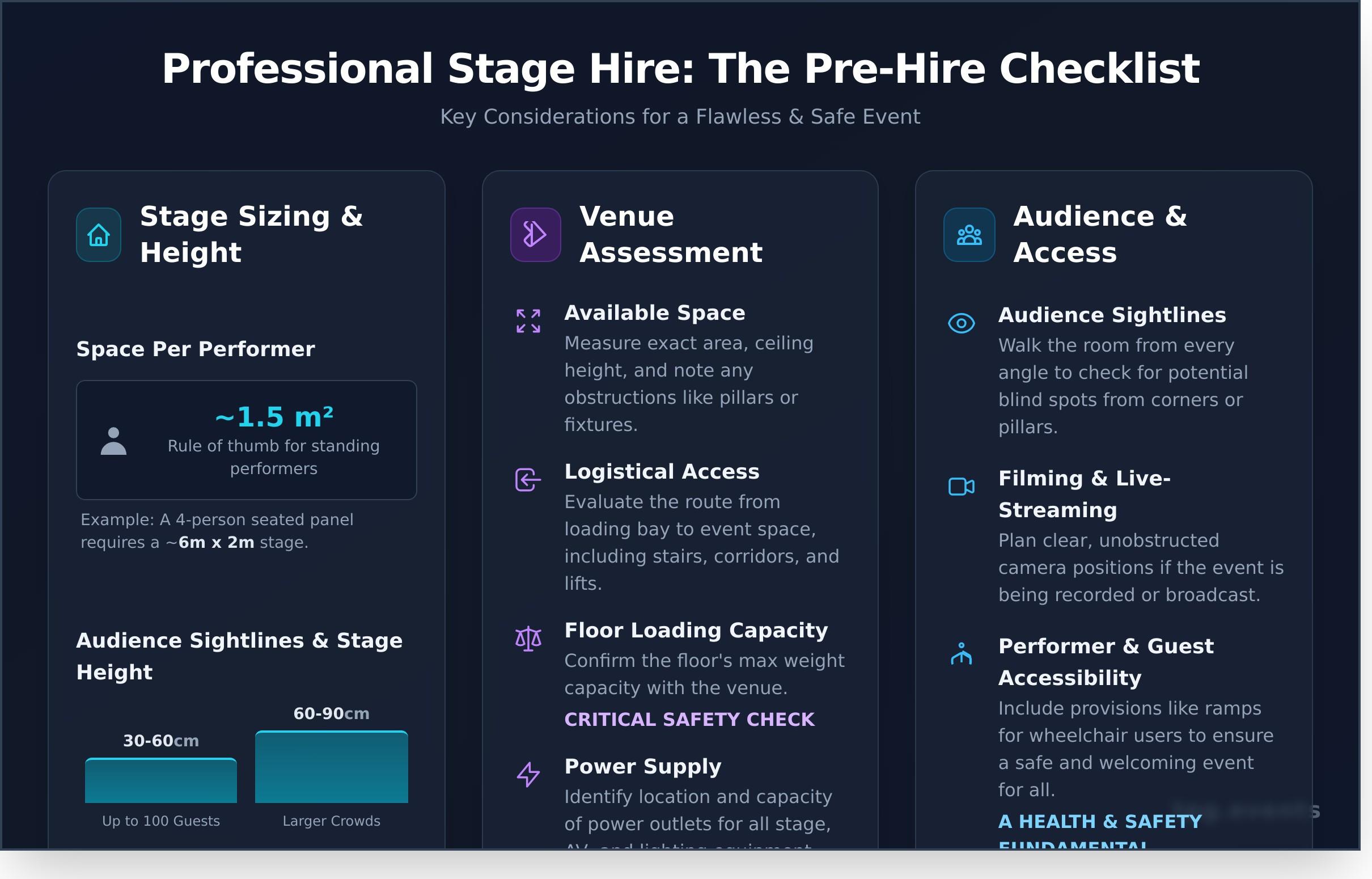
Calculating Stage Size and Height
Your stage must be fit for purpose. Begin by asking what, and who, it needs to accommodate. A solo presenter at a lectern has vastly different spatial requirements from a five-piece band with a full backline. As a rule of thumb, allow approximately 1.5 square metres per person for standing performers. For a seated panel of four, a 6m x 2m stage is a good starting point. Stage height is determined by audience size and sightlines; for smaller events of up to 100 guests, a 30-60cm height is often sufficient, while larger crowds will require 60-90cm to ensure clear views from the back of the room.
Venue Assessment: Space, Access, and Floor Loading
A successful installation depends entirely on understanding your venue’s capabilities and limitations. A thorough site assessment is non-negotiable. You must consider:
- Available Space: Measure the exact area, paying close attention to ceiling height, hanging fixtures like chandeliers, and any obstructions such as pillars.
- Logistical Access: How will the equipment get in? Evaluate the route from the loading bay to the event space, noting any stairs, narrow corridors, or service lift restrictions.
- Floor Loading Capacity: It is crucial to confirm the floor’s maximum weight-bearing capacity with the venue manager. This is a critical safety check, especially in older or non-purpose-built venues.
- Power Supply: Identify the location and capacity of power outlets required for stage lighting, audio, and any integrated AV solutions.
Audience Sightlines and Accessibility
An effective stage must be visible to every guest and accessible to every performer. Walk the room and check for potential blind spots from corners or behind pillars. If your event is being filmed or live-streamed, plan clear camera positions that won’t be obstructed. Furthermore, creating an inclusive event is paramount. Your stage hire plan must include provisions for accessibility, such as ramps for wheelchair users. These considerations are a fundamental part of your event’s overall health and safety arrangements, ensuring a safe and welcoming experience for everyone involved.
Types of Staging Systems: From Modular Decks to Custom Sets
Selecting the right platform is a foundational decision in your event’s design. The world of stage hire offers a spectrum of solutions, each engineered for different environments, budgets, and creative ambitions. Understanding the core differences between these systems ensures your message is delivered from a platform that not only supports your speakers but actively enhances your event’s impact. From versatile industry-standard decks to fully immersive brand environments, let’s explore the primary options available.
Modular Staging (Steeldeck / Litedeck)
Modular staging is the undisputed workhorse of the indoor events industry. Systems like Steeldeck and Litedeck consist of robust steel or aluminium frames with plywood tops, which connect together like building blocks. This versatility allows our technical teams to construct stages of almost any size and shape, including multi-level platforms, conference stage sets, tiered seating blocks, and elegant catwalks for fashion shows.
- Pros: Highly customisable for size and shape, incredibly strong and stable, ideal for creating complex, multi-level structures indoors.
- Cons: More labour-intensive to build than mobile stages, best suited to flat, solid ground.
Mobile Trailer Stages
When speed of deployment is critical for an outdoor event, mobile trailer stages are the class-leading solution. These ingenious systems are built onto an articulated trailer, unfolding hydraulically in a matter of hours. Most come complete with an integrated roof, PA wings, and rigging points for lighting and sound, making them a perfect all-in-one package for festivals, community events, and roadshows where time is of the essence.
- Pros: Exceptionally fast setup and breakdown, weather protection from the integrated roof, cost-effective for short-term outdoor events.
- Cons: Limited options for size and shape, less scope for creative customisation.
Custom-Built Stages and Sets
For brands looking to make an unforgettable impact, a standard platform is just the beginning. TPG specialises in creating custom-built stages and sets that transform a space into a fully branded, immersive environment. We move beyond a simple deck to design and build unique structures incorporating bespoke shapes, premium materials, printed graphics, and seamlessly integrated LED video walls. This is the ultimate solution for product launches, awards ceremonies, and conferences where the stage itself becomes a centrepiece of the brand story. See how we create unforgettable custom sets.
Safety and Logistics: The Non-Negotiables of Stage Hire
Beyond the creative design and technical specifications, the true foundation of a successful event is safety. This is a critical area where professionalism is non-negotiable. A class-leading production partner doesn’t just provide equipment; they deliver a comprehensive solution built on rigorous safety protocols and logistical precision. This commitment to safety is what protects your performers, your audience, and your reputation.
Essential Safety Components
Every element of a professional stage setup is designed with safety in mind. While these components may seem like minor details, they are essential for a secure and seamless event:
- Handrails and Guardrails: An absolute must for any raised platform, providing crucial protection along exposed edges and stairways to ensure performer safety.
- Secure Steps: Access steps must be firmly secured, featuring non-slip tread and high-visibility nosing, especially for events in low-light conditions.
- Stage Skirting and Finishes: More than just an aesthetic touch, professional skirting conceals cabling to prevent trip hazards and creates a clean, polished look.
Structural Integrity and Regulations
A stage is a temporary structure that must be engineered to withstand significant force. Understanding its load-bearing capacity is vital, whether you plan to feature heavy equipment, a vehicle, or a large choir. Our technical teams ensure every structure is built on a level surface with appropriate bracing for complete stability. Every professional stage hire service must adhere to strict UK health and safety regulations, including LOLER and PUWER, ensuring every component is inspected, certified, and fit for purpose.
The Importance of RAMS (Risk Assessment Method Statements)
If you’ve never heard of RAMS, it’s a term you should get to know. This document is a key indicator of a reliable and professional production company. A Risk Assessment Method Statement is a comprehensive plan that outlines the entire process-from load-in and construction to operation and breakdown-identifying potential hazards and detailing the safety measures in place to mitigate them. Your venue will almost certainly require this document, and any reputable partner will provide it as a standard part of their service. It’s your assurance that every angle has been covered. At TPG Events, these detailed safety considerations are integral to delivering an unforgettable and secure experience.
Integrated Production: Bringing Your Stage to Life
A stage is the focal point of your event, but it’s the integrated production that transforms it from a simple platform into an unforgettable experience. Effective stage hire is about more than just the physical structure; it’s the foundation for a seamless fusion of lighting, sound, and visuals. Managing multiple suppliers for each of these elements can be complex and time-consuming. At TPG, we provide a class-leading, full-service solution, acting as a single, expert partner to bring your vision to life cohesively and without the hassle.
Lighting, Rigging, and Atmosphere
Lighting is the paintbrush of live events, directing audience focus, creating immersive atmospheres, and reinforcing your brand identity. Our technical experts design and implement sophisticated lighting plots, using professional trusses and rigging to position fixtures for maximum impact. From dramatic spotlights on a keynote speaker to dynamic colour washes that match your brand palette, we ensure your stage is visually stunning and emotionally engaging.
Crystal-Clear Audio Solutions
An impactful message is lost without flawless audio. TPG provides complete audio solutions engineered for clarity and coverage. We strategically position speakers to ensure every attendee hears perfectly, whether they are in the front row or the back of the room. Our commitment to professionalism extends to meticulous cable management for a clean, safe stage, and the seamless integration of all necessary equipment, including microphones, on-stage monitors, and playback systems.
Visuals: Backdrops, Screens, and Branded Sets
Capture attention and drive your message home with powerful, integrated visuals. TPG transforms stages with dynamic backdrops, from high-resolution LED video walls displaying custom content to crisp projection screens for presentations. We complete the look with bespoke set elements that elevate your brand, including custom-built stage sets, branded lecterns, and carefully selected stage furniture that aligns perfectly with your event’s aesthetic.
By unifying your stage hire with a complete technical production package, you ensure every element works in perfect harmony to create a first-class event. Let’s design your complete event experience together.
Set the Stage for an Unforgettable Event
As we’ve explored, selecting the right stage goes far beyond the physical platform. It’s about creating a safe, engaging, and technically seamless foundation that elevates a good event into an unforgettable one. From understanding the nuances of different staging systems to meticulously planning logistics, the right choices are crucial for success.
This is where professional stage hire becomes a strategic partnership. At TPG Events, we bring decades of live event production experience to every project. We deliver class-leading creative and technical solutions, acting as your full-service partner for staging, AV, and lighting to ensure every element works in perfect harmony.
Don’t just hire a stage-invest in a flawless production that achieves your goals. Let’s build an experience that captivates your audience from the moment the lights go up.
Set the Stage for Success: Talk to a TPG Production Expert Today
Frequently Asked Questions About Stage Hire
How much does it cost to hire a stage?
The cost of hiring a stage in the UK varies based on your event’s scale and complexity. A simple indoor conference stage might start from around £500, while a larger outdoor festival stage can cost several thousand pounds. Key factors influencing the price include the stage’s size, height, location, and any custom features like branding, backdrops, or complex AV integration. TPG provides a detailed, transparent quote tailored to your exact specifications to deliver a first-class solution within your budget.
What is the difference between dry hire and full-service stage production?
Dry hire provides you with only the physical stage components, leaving you responsible for transport, construction, and safety. In contrast, TPG specialises in full-service stage production-a complete, end-to-end solution. We manage everything from initial design and risk assessments to professional build, technical integration, and post-event dismantling. This class-leading approach guarantees a seamless, safe, and professionally executed event, allowing you to focus on creating an unforgettable experience for your audience.
How long does it take to build and dismantle a typical conference stage?
The build and dismantle time depends entirely on the stage’s complexity. A standard 6m x 4m conference stage can typically be built by our expert crew in 2-4 hours and dismantled in a similar timeframe. However, more intricate designs that incorporate large-format LED screens, custom set elements, and advanced lighting will require a longer, carefully scheduled installation period. We always provide a detailed production timeline to ensure a timely and efficient build for your event.
Can a stage be built on uneven or sloped ground?
Absolutely. Building on uneven or sloped ground is a common requirement that our class-leading modular staging systems are designed to handle. Using professional equipment with adjustable legs, our certified technicians create a perfectly level, stable, and secure platform in almost any environment, from a grassy field to a sloped venue floor. Safety is paramount, and we conduct thorough site assessments to engineer the perfect structural solution for your chosen location, ensuring total stability.
Do I need a special permit or license for an outdoor stage?
For many outdoor public events in the UK, you will likely need to consult with the local council regarding temporary structures, public safety, and noise levels. While the event organiser is ultimately responsible for securing licenses, TPG acts as an expert partner. We provide all necessary structural calculations, risk assessments, and public liability insurance documentation to support your application, ensuring your event fully complies with all local authority regulations and safety standards.
What information should I provide to get an accurate quote for stage hire?
To provide an accurate quote for your stage hire, we require a few key details. Please share the event date(s), venue address, and whether the setup is indoors or outdoors. We also need the desired stage dimensions (width, depth, and height) and any specific requirements like access ramps, handrails, or branded backdrops. Finally, outlining your needs for integrated audio-visual equipment or lighting will allow us to design a complete, creative, and immersive technical solution for your event.