
In the competitive world of corporate events, creating a genuine ‘wow’ moment is the ultimate goal. You know a powerful virtual reality experience holds immense potential, but the path from concept to execution can seem daunting. Concerns over technical complexity, logistical hurdles, and proving a clear return on investment often stop even the most innovative ideas in their tracks.
But what if you had a clear roadmap? Imagine transforming your exhibition stand into the main attraction, delivering corporate training that’s genuinely memorable, or generating unparalleled social media buzz. A strategically designed VR activation is more than just a novelty; it’s a class-leading solution for achieving tangible business outcomes and creating an unforgettable impression on your audience.
This definitive guide is designed to demystify the process. We are here to act as an extension of your team, providing the creative and technical expertise to move beyond simple games. You will learn precisely how to plan, design, and execute a powerful VR activation that captivates attendees, delivers on your objectives, and makes your next event a landmark success.
What is a Corporate VR Experience (and Why It’s More Than a Game)
In a business context, a virtual reality experience is not an escape; it’s a class-leading tool for deep immersion and engagement. While a technical overview of what is virtual reality often highlights its gaming origins, its corporate application is far more strategic. Unlike consumer entertainment, corporate VR is meticulously designed to achieve specific business outcomes, transforming passive audiences into active participants. This shift from gimmick to goal-oriented solution is what delivers tangible ROI.
The power of a professional virtual reality experience lies in its ability to create powerful, lasting memories. By engaging multiple senses in a controlled, simulated environment, VR bypasses short-term recall and encodes information directly into long-term memory. This makes it an unforgettable medium for training, brand storytelling, and creating genuine emotional connections that drive action.
Business Objectives You Can Achieve with VR
TPG Events designs immersive solutions to meet concrete business goals. With VR, you can:
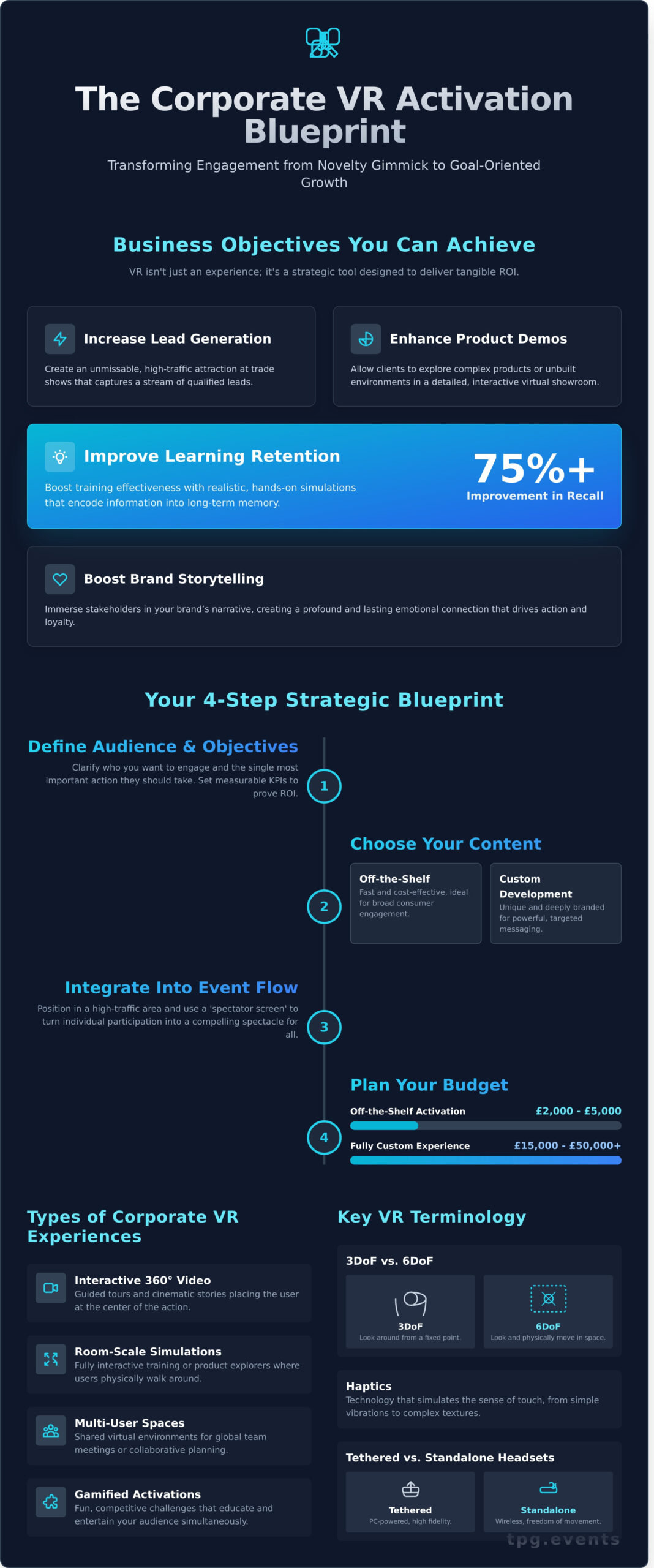
- Increase Lead Generation: Create an unmissable, high-traffic attraction at trade shows and exhibitions that captures qualified leads.
- Enhance Product Demonstrations: Allow clients to explore complex products or unbuilt environments in a detailed virtual showroom.
- Improve Learning Retention: Boost training effectiveness with realistic, hands-on simulations that improve recall by over 75%.
- Boost Brand Storytelling: Immerse stakeholders in your brand’s narrative, creating a profound and lasting emotional connection.
Types of Corporate VR Experiences
From simple activations to complex simulations, we deliver the right solution for your objective:
- Interactive 360-Degree Video: Guided tours and cinematic stories that place the user at the centre of the action.
- Room-Scale Simulations: Fully interactive training modules or product explorers where users can physically walk around and interact with virtual objects.
- Multi-User Collaborative Spaces: Shared virtual environments for global team meetings, design reviews, or collaborative planning sessions.
- Gamified Brand Activations: Fun, competitive, and memorable challenges that educate and entertain your audience simultaneously.
Key VR Terminology for Event Planners
Our team handles the technical details, but understanding these core concepts will help you envision the possibilities:
- Degrees of Freedom (3DoF vs. 6DoF): 3DoF allows you to look around from a fixed point (like a swivel chair). 6DoF allows you to look around and physically move within the virtual space, offering true immersion.
- Haptics: Technology, often in controllers or bodysuits, that simulates the sense of touch, from a simple vibration to complex textures.
- Tethered vs. Standalone Headsets: Tethered headsets connect to a powerful PC for high-fidelity graphics. Standalone headsets are wireless and self-contained, offering greater freedom of movement.
- Field of View (FOV): The extent of the virtual world you can see at any given moment. A wider FOV enhances immersion by filling your peripheral vision, making the experience feel more natural.
The Strategic Blueprint: How to Plan Your VR Experience
A truly unforgettable virtual reality experience doesn’t happen by accident. It is the result of a meticulous strategic plan that aligns technology with tangible business objectives. Before a single headset is deployed, a successful activation is built on a foundation of clear goals, audience understanding, and seamless integration into your wider event narrative. This blueprint ensures your investment delivers maximum impact.
Step 1: Define Your Audience and Objectives
First, clarify your “why.” Who are you trying to engage-C-level executives, technical engineers, or the general public? Your audience will dictate the complexity and tone of the content. Next, define the single most important action you want them to take post-experience. Whether your goal is product education, lead generation, or sophisticated corporate training-similar to the powerful applications of VR in business education-you must set measurable KPIs like lead scans, user dwell time, or social media shares to prove ROI.
Step 2: Content is King: Custom vs. Off-the-Shelf
Your content choice is critical. Off-the-shelf solutions are fast and cost-effective but may lack brand alignment. In contrast, custom development offers a unique, deeply branded activation that resonates powerfully with your message, though it requires a greater investment in time and budget. The right approach depends entirely on your objectives; a simple, fun game may suit a broad consumer audience, while a bespoke product simulation is essential for a technical B2B demonstration.
Step 3: Integrating VR into Your Event Flow
Logistics can make or break the user experience. Position your VR station in a high-traffic area to attract attention, but with enough space to manage queues effectively. Use clear branding and on-site staff to draw people in. To keep those waiting engaged and build anticipation, TPG always recommends a ‘spectator screen’ that mirrors the in-headset view. This turns individual participation into a shared, compelling spectacle for everyone.
Step 4: Budgeting for a High-Impact VR Activation
A clear budget is essential. Costs typically include hardware rental, software licensing or development, professional staffing, and logistics. In the UK, a simple off-the-shelf activation might range from £2,000 – £5,000. A fully custom-built virtual reality experience designed for class-leading brand impact can range from £15,000 to over £50,000, depending on complexity. We provide transparent, detailed proposals to match your ambition and financial plan.
Need a detailed quote? Let’s discuss your project.
The Technology Stack: Choosing the Right Hardware and Software
A truly unforgettable virtual reality experience is built on a foundation of meticulously selected technology. For corporate events, where reliability and user comfort are paramount, consumer-grade equipment is simply not an option. Professional-grade solutions are vital to guarantee a seamless, impressive, and safe activation. The key is to create a harmonious technology stack where the hardware, software, and physical environment work in concert to serve your unique content and objectives.
Selecting the Right VR Headsets
The headset is your guest’s window into the virtual world, and the choice directly impacts the quality of their immersion. We typically deploy two class-leading categories:
- Standalone Headsets: Devices like the Meta Quest 3 offer incredible flexibility and ease of use. With no tethering cables or external PCs, they are perfect for large-scale events, allowing for quick setup and free-roaming experiences.
- PC-Powered Headsets: For maximum graphical fidelity, headsets such as the Valve Index are unmatched. Powered by high-specification PCs, they deliver breathtaking visual detail, making them the premier choice for high-end simulations and cinematic content.
Our selection process always prioritises resolution for visual clarity, ergonomic comfort for extended use, and flawless tracking to eliminate motion sickness.
Software Platforms and Development
While hardware provides the canvas, software creates the masterpiece. Most bespoke virtual worlds are built using powerful game engines like Unity or Unreal Engine, which enable the creation of complex and interactive environments. For more accessible activations, WebXR allows experiences to run directly in a web browser, removing the barrier of application installation. The choice of platform directly impacts the scope of the project, enabling the diverse real-world applications of virtual reality we see in training and marketing. As your technical partner, TPG guides you to the right platform or manages the entire custom content creation process for a truly unique experience.
Logistics: Space, Power, and Internet Requirements
Flawless execution depends on mastering the on-site logistics. A safe and immersive VR activation requires careful planning of the physical space, typically a minimum footprint of 3m x 3m per user to allow for movement. A stable and sufficient power supply is non-negotiable, particularly for running multiple power-hungry PC VR stations. While many experiences can run offline, a hardwired internet connection is best practice for any multi-user or data-streaming applications. Finally, we manage environmental factors like lighting to ensure that no direct sunlight or infrared interference disrupts the headset’s tracking sensors.
Execution Excellence: On-Site Management for a Flawless Experience
Meticulous planning lays the groundwork, but on-site execution is where an ambitious concept transforms into an unforgettable virtual reality experience. The day of the event demands a level of technical and logistical precision that leaves no room for error. Professional on-site management is non-negotiable, ensuring every attendee interaction is seamless, safe, and reinforces your brand’s commitment to quality from the moment they join the queue to the second they remove the headset.
The Critical Role of Trained On-Site Staff
Your on-site team is the human interface for your technology. TPG provides trained staff who do more than just hand out equipment; they are brand ambassadors. They expertly guide users, ensure comfortable and correct headset fitting, provide clear instructions, and create a welcoming environment that builds anticipation and puts even first-time VR users at ease.
Managing Guest Throughput and Hygiene
A long, slow-moving queue can diminish excitement. We implement class-leading strategies to manage guest flow efficiently, using timed entries or multiple stations to keep wait times minimal. Hygiene is paramount; our protocol includes rigorous sanitation of all headsets and controllers between uses and offering disposable face covers to guarantee user comfort and confidence.
Technical Support and Troubleshooting
Even the most reliable technology requires expert oversight. Having a dedicated AV technician on standby is crucial for immediate problem-solving. Our process includes rigorous pre-event testing and calibration, but we are always prepared for common issues, including:
- Controller Drift: Quick recalibration to restore accurate tracking.
- Tracking Loss: Adjusting sensor placement or environmental lighting.
- Software Crashes: Immediate system reboots with minimal disruption.
Measuring Success: Data Capture and Analytics
A powerful virtual reality experience should deliver measurable results. We can integrate lead capture forms directly within the VR environment or use sophisticated analytics to track user engagement, dwell time, and interactions. This data, combined with qualitative feedback gathered post-experience, provides invaluable insight into your activation’s ROI and impact.
Creating a flawless live activation requires a fusion of creative vision and technical mastery. Leave the technical execution to us. Discover TPG’s production services.
Inspiring Use Cases: Corporate VR Experiences in Action
The theoretical potential of VR is vast, but its true power is revealed in its practical application. Forward-thinking companies across the UK are already leveraging this innovative technology to create unforgettable moments that drive engagement and deliver tangible results. From bustling exhibition halls to focused corporate training rooms, a well-designed virtual reality experience demonstrates remarkable versatility and impact.
These real-world examples move beyond abstract concepts to showcase how VR can become a class-leading solution for your next project.
Exhibitions: Immersive Product Demos
At a crowded trade show, space is at a premium and capturing attention is paramount. VR demolishes these limitations. Imagine allowing attendees to explore a full-scale virtual model of heavy machinery or configure a new vehicle in an infinite digital showroom. This technology enables safe, interactive product demonstrations that give your brand a powerful competitive edge and leave a lasting impression on potential clients.
Conferences: Brand Storytelling & Experiential Marketing
Go beyond the standard presentation and transport your audience directly into your brand’s narrative. Experiential marketing at conferences is about forging a genuine emotional connection. A 360-degree film showcasing your company’s sustainability initiatives or a virtual journey through your product’s design process creates a deeply personal interaction that a slide deck could never achieve, transforming passive attendees into active participants in your story.
Corporate Training: High-Stakes Simulations
For high-stakes professions, practice is essential, but real-world training can be costly or dangerous. VR offers a revolutionary solution. Medical professionals can perform complex surgical simulations in a risk-free environment, while corporate teams can develop essential soft skills like public speaking or crisis management. This immersive approach accelerates learning, improves knowledge retention, and ensures your team is prepared for any challenge.
These examples are just the beginning. As creative and technical production partners, we work closely with clients to transform ambitious concepts into reality. To discover how we can design an immersive solution for your next event or training programme, explore our work at tpg.events.
From Vision to Reality: Your Partner in Immersive Events
As we’ve explored, a truly impactful virtual reality experience is far more than a technological novelty; it’s a powerful tool for engagement, meticulously planned and flawlessly executed. Success hinges on a clear strategic blueprint that aligns with your objectives and the seamless integration of the right technology. When these elements converge, you create more than just an activity-you deliver an unforgettable brand moment.
Bringing this vision to life requires a true partner, not just a supplier. At TPG, we pride ourselves on becoming an extension of your team. We combine decades of experience in live and virtual events with the comprehensive power of full-service creative and technical production. From initial concept to on-site management, we provide the class-leading solutions and collaborative support needed to deliver excellence every time.
Ready to captivate your audience? Bring your vision to life with a class-leading VR experience. Contact TPG today. Let’s create something unforgettable together.
Frequently Asked Questions
How much does a custom VR experience for an event typically cost?
The cost for a bespoke VR activation varies significantly based on complexity and scale. A simple setup using existing software and hired headsets might start from £2,500 to £5,000. For a fully custom-developed, branded virtual reality experience with multiple stations and dedicated technical support, budgets typically range from £10,000 to £30,000+. We work closely with our clients to design a class-leading solution that aligns with their specific event goals and budget, ensuring a first-class return on investment.
How much physical space do I need for a VR activation?
The required space depends on the type of VR experience. For a seated or standing-only activation, a minimum of 2m x 2m per user is recommended to ensure safety and comfort. For more interactive, ‘room-scale’ experiences that allow movement, a space of at least 3m x 3m per station is ideal. TPG Events provides full technical schematics and floor plans to seamlessly integrate the activation into your event layout, guaranteeing an optimal and safe user journey for all attendees.
Can people who wear glasses use modern VR headsets comfortably?
Absolutely. The vast majority of modern, professional-grade VR headsets are designed to accommodate users who wear glasses. Many feature adjustable lens distances and have enough internal space to comfortably fit most frame sizes. For maximum inclusivity, our on-site technicians are trained to assist guests in achieving a perfect fit, ensuring every participant can enjoy the immersive experience without discomfort. We prioritise a seamless and accessible experience for all your attendees.
What is the difference between Virtual Reality (VR), Augmented Reality (AR), and Mixed Reality (MR)?
Virtual Reality (VR) immerses a user in a completely artificial, computer-generated world, blocking out external stimuli. Augmented Reality (AR) overlays digital information or graphics onto the user’s view of the real world, typically via a smartphone. Mixed Reality (MR) is more advanced, allowing digital objects to not only exist in the real world but also interact with it in real-time. TPG can advise on which technology provides the most impactful solution for your event objectives.
How do you ensure VR equipment is kept hygienic for many users at an event?
Hygiene is a paramount concern for us. TPG Events adheres to a strict, multi-step sanitation protocol for all VR equipment. Each headset is thoroughly cleaned between uses with professional-grade, non-abrasive disinfectant wipes. We also provide single-use, disposable hygienic face covers for every participant. Our trained on-site staff manage this entire process diligently, guaranteeing a safe, clean, and comfortable experience for every one of your guests, reflecting our commitment to first-class event delivery.
What is the ideal length for a VR experience at a busy conference or trade show?
For a high-traffic environment like a trade show, the optimal duration for a virtual reality experience is typically between three to five minutes. This length is long enough to be genuinely immersive and deliver a powerful brand message, yet short enough to maximise guest throughput and minimise queue times. This ensures a high volume of attendees can participate, generating maximum engagement and impact for your activation. We design content to deliver a complete, unforgettable narrative within this ideal timeframe.