A world-class event isn’t built by a collection of vendors; it’s delivered by a precision-engineered ecosystem of integrated specialists. When you’re planning a high-stakes corporate gathering, the technical jargon and overlapping job titles often create more confusion than clarity. You might worry about having too many cooks in the kitchen or, conversely, missing a critical specialist who could save your show from a technical failure. Understanding the key roles in an event production team is the first step toward transforming that anxiety into total confidence.
We know that 85% of meeting professionals are optimistic about the industry in 2026, yet many still struggle to define the exact hierarchy needed for flawless execution. You deserve a production partner that functions as an extension of your own staff rather than just an equipment provider. This guide will help you discover the essential roles that power world-class event production and show you how a collaborative team structure ensures every cue is met with perfection. We’ll break down the production hierarchy and give you the tools to brief a production company with the authority of a seasoned expert.
Key Takeaways
- Understand the distinct responsibilities of the Production Manager and Technical Director to ensure your event’s technical backbone is secure.
- Identify the key roles in an event production team, from audio engineers to lighting designers, that transform creative concepts into sensory reality.
- Learn how a structured “Show Flow” and professional cue calling by a Stage Manager eliminate the risk of technical errors during live performances.
- Master the ability to brief production specialists effectively by speaking their language and understanding the production hierarchy.
- Discover why choosing an integrated production partner over a simple equipment vendor reduces risk and delivers superior value for complex events.
The Anatomy of a High-Performance Event Production Team
Excellence in live events isn’t a happy accident. It’s the result of a precision-engineered ecosystem. The technical backbone of any live or hybrid experience isn’t just the gear; it’s the people who operate it. While 70% of event planners expect in-person meetings to increase through 2026, the complexity of these gatherings has reached a new peak. High-performance events require more than a few speakers and a projector. They demand a specialized crew capable of managing complex visual technology and production hardware under immense pressure. Identifying the key roles in an event production team allows you to build a structure that supports your creative ambitions without the fear of technical failure.
A clear hierarchy is the only way to manage a live environment where there are no second takes. Whether you’re hosting an intimate corporate seminar or a massive international exhibition design and build, the team structure must scale accordingly. For smaller events, one person might wear multiple hats. For large-scale productions, you need a granular division of labor to ensure every pixel and decibel is perfect. This structure ensures that every specialist knows exactly when to lead and when to support, creating a seamless flow from the first load-in to the final strike.
Production vs. Planning: Clearing the Confusion
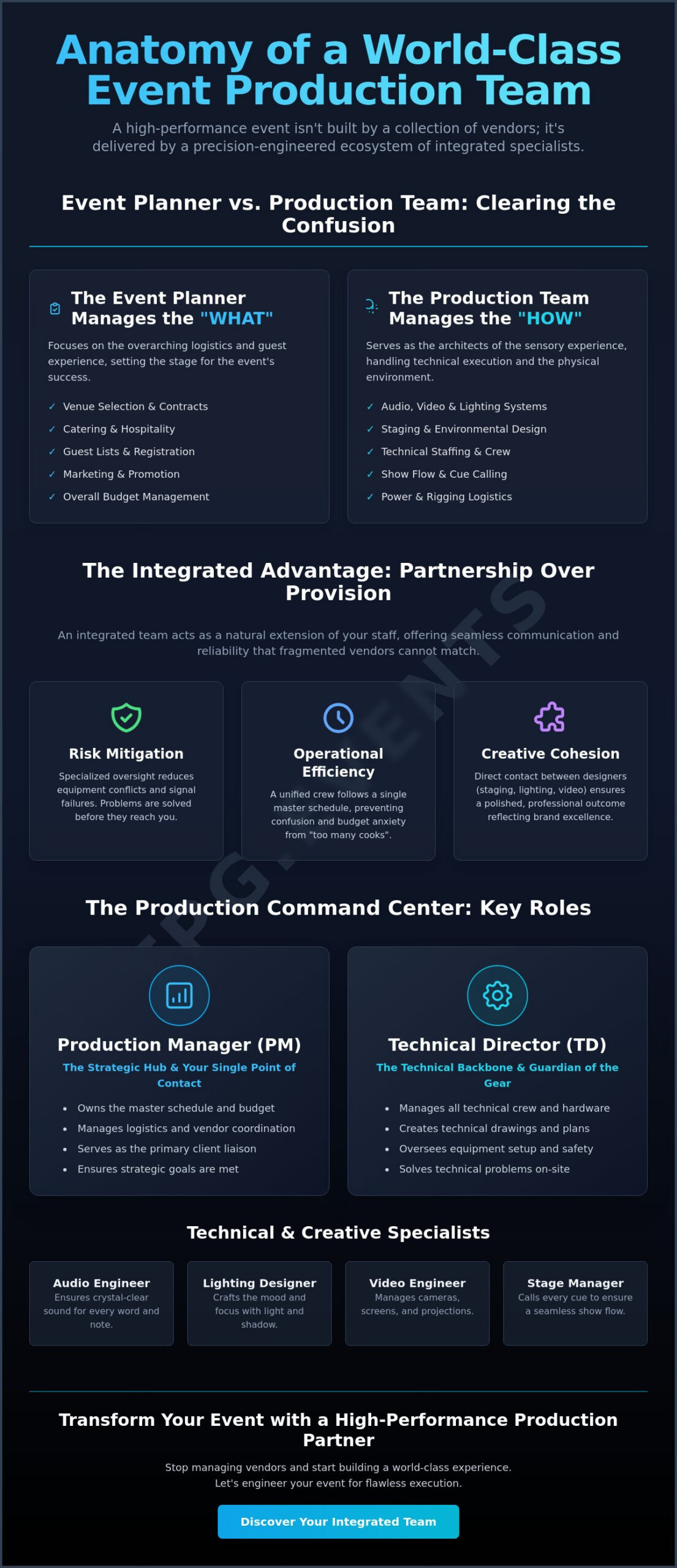
Confusion often arises because the line between event planning and event production seems blurry. It shouldn’t be. Event planners manage the “what,” focusing on the venue, catering, and guest lists. In contrast, the production team manages the “how,” focusing on the technical execution and physical environment. We operate at the intersection of technical hardware and creative vision. The production team serves as the architects of the sensory experience.
The Benefits of an Integrated Technical Team
Working with an integrated team provides a level of security that a fragmented group of individual vendors simply cannot match. When your audio, video, and lighting departments share a unified leadership structure, communication becomes seamless. This isn’t just about convenience; it’s about reliability. An integrated team acts as a natural extension of your internal staff, working as a collaborative partner rather than a mere vendor. This approach offers several distinct advantages:
- Risk Mitigation: Specialized oversight reduces the chance of equipment conflicts or signal failures that often occur when disparate systems are forced together.
- Operational Efficiency: A unified crew follows a single master schedule, preventing the confusion and budget anxiety associated with “too many cooks” in the production booth.
- Creative Cohesion: When the person designing the custom staging is in direct contact with the lighting designer, the end result is a polished, professional outcome that reflects your brand’s excellence.
This collaborative ethos ensures that your technical team isn’t just providing equipment hire; they’re solving problems before they even reach your radar. Confidence in this structure allows you to focus on your attendees while we handle the technical precision of the show.
Strategic Leadership: The Architects of the Event
Every world-class event requires a command center. While the technical crew operates the consoles, the leadership team ensures the creative vision remains intact from the initial brief to the final load-out. These strategic leaders are the primary key roles in an event production team that safeguard your investment and manage the complex logistics of the live environment. They don’t just provide equipment; they provide the certainty that your event will run without a hitch, regardless of venue constraints or technical challenges.
Leadership in production isn’t just about giving orders. It’s about managing the delicate balance between stakeholder expectations and the laws of physics. Whether you’re coordinating with an internal marketing department or a venue’s facility manager, these roles act as the bridge that ensures everyone is working toward the same polished outcome. Partnering with a seasoned team like TPG Events ensures that these leadership positions are filled by experts who treat your project as a partnership rather than a transaction.
The Production Manager: The Strategic Hub
The Production Manager (PM) acts as your single point of contact for all technical execution. They own the master schedule and the budget, ensuring that every dollar spent contributes directly to the event’s impact. During the high-pressure “bump-in” and “bump-out” phases, the PM coordinates labor and logistics to ensure the venue is ready on time. Their oversight is essential for full-service event production, where they must balance health and safety compliance with the creative demands of the show flow. If a piece of equipment doesn’t arrive or a schedule shift occurs, the PM is the problem-solver who keeps the production on track.
The Technical Director: Mastering the Complexity
While the PM handles the “when” and “how much,” the Technical Director (TD) handles the “how.” They bridge the gap between ambitious design and physical reality. The TD oversees complex audio visual equipment setups, translating creative concepts into precise technical CAD drawings. They calculate power requirements, identify structural rigging points, and manage the signal flow between audio, video, and lighting departments. During the live show, the TD is often the one solving technical conflicts in real-time, ensuring that the audience never sees the complexity happening behind the scenes.
Finally, the role of Account Management cannot be overlooked. While the PM and TD focus on the physical build, the Account Manager ensures the project stays on brief and within the financial parameters set during the planning phase. They act as the advocate for your brand’s standards, ensuring that every technical decision aligns with your overarching goals. This multi-layered leadership structure is what separates a standard vendor from a professional production partner.
Technical & Creative Specialists: Bringing the Vision to Life
While strategic leadership sets the course, the technical and creative specialists are the ones who transform blueprints into immersive experiences. These key roles in an event production team represent the perfect marriage of artistic vision and technical mastery. Unlike general labor crews who simply move equipment, these specialists are responsible for the sensory impact of your event. They ensure that every note is heard, every highlight is seen, and every physical structure reinforces your brand’s excellence.
The complexity of modern events means that these roles are increasingly specialized. With 68% of event professionals now including hybrid and virtual elements in their programs, the technical requirements for a successful show have shifted. You don’t just need someone to “run the sound”; you need a team that understands how to balance a live room while simultaneously managing a high-fidelity digital broadcast.
Sound and Vision: The AV Powerhouse
Audio is often the most critical, yet overlooked, component of a successful event. The Front of House (FOH) Engineer is responsible for crafting a perfect acoustic environment, ensuring that a keynote speaker’s message carries the same weight in the back row as it does in the front. For complex virtual events and hybrid feeds, Vision Mixers and LED Technicians work in tandem to manage high-impact visual content. They handle the seamless transition between live stage cameras, pre-recorded videos, and remote presenters, ensuring crystal-clear communication for both live and remote audiences.
Lighting and Staging: The Creative Canvas
Lighting is the primary tool used to direct audience focus and set the emotional tone of a room. Expert lighting designers don’t just illuminate a stage; they use technology to reinforce a brand activation through color theory and dynamic movement. This creative precision extends to the physical environment as well. Professional exhibition stand designers and builders create the physical “wow factor” that defines an event’s aesthetic. This work is supported by rigging specialists, the unsung heroes of production who manage overhead safety and the structural integrity of lighting grids and sound arrays. Their expertise ensures that ambitious creative designs remain physically grounded and safe for every attendee.
By engaging a team that treats these positions as creative disciplines rather than just technical tasks, you ensure a polished, professional outcome. This collaborative approach allows the specialists to act as an integral part of your internal staff, dedicated to bringing your most ambitious ideas to life with unwavering reliability.
Seamless Integration: How Roles Collaborate for Flawless Execution
A world-class production is a symphony of moving parts. Individual excellence from specialists means very little if their efforts aren’t perfectly synchronized. The true strength of the key roles in an event production team lies in their ability to function as a single, cohesive unit. This integration is managed through a document known as the “Show Flow,” a minute-by-minute production schedule that dictates every transition, lighting change, and audio cue. When your team operates with this level of precision, the audience experiences a polished, effortless journey from the opening remarks to the final applause.
Internal communication is the nervous system of this operation. Technical crews rely on “Comms” headsets and digital production tools to maintain constant contact. This silent dialogue allows for real-time adjustments without the audience ever sensing a shift. It’s this backstage coordination that prevents the “too many cooks” scenario, ensuring that every specialist knows exactly when to step forward and when to hold their position. To see how this level of coordination can elevate your next project, contact our production experts today.
The Show Caller: The Rhythm of the Event
The Show Caller, often the Stage Manager, acts as the conductor of the technical orchestra. They are responsible for calling every cue in real-time, synchronizing audio, video, and lighting transitions with split-second accuracy. For high-stakes corporate conferences, a dedicated caller is vital. They manage the relationship between the technical booth and the on-stage presenters, providing cues that help speakers feel confident and supported. If a presenter moves through their slides faster than expected, the caller adjusts the entire team’s rhythm instantly, ensuring the visual technology stays perfectly aligned with the spoken word.
Collaborative Problem-Solving in Real-Time
Live events are unpredictable by nature. A specialized team doesn’t just follow a plan; they execute contingency strategies with unwavering reliability. This requires cross-training and multi-disciplinary awareness. If a technician notices a potential issue, they communicate it through the headset, and the team resolves it before it impacts the show.
Consider a scenario in a complex hybrid setting where a remote presenter’s video feed suddenly drops. In a fragmented team, this could lead to a panicked blackout. In an integrated team, the vision mixer immediately switches to a “technical difficulty” graphic or a backup slide while the audio engineer keeps the live host’s microphone active. Behind the scenes, the technical director works with the remote lead to restore the link. The audience sees a professional transition rather than a technical failure. This level of collaborative problem-solving is what defines a leader in the field.
Partnership vs. Provision: Building Your Team in 2026
Choosing the right team for a high-stakes event isn’t about finding the lowest quote for equipment hire. It’s about securing a collaborative partner that understands the nuance of your brand. In the current market, where 85% of professionals are optimistic yet cautious about rising costs, the distinction between a vendor and a production partner has never been more critical. A vendor delivers boxes of hardware and leaves the risk with you. A production partner delivers a result, assuming full responsibility for the technical precision and creative impact of the show.
An integrated team provides significantly better value by eliminating the inefficiencies of fragmented communication. When the key roles in an event production team operate under a single, unified leadership structure, you reduce the risk of technical failure and budget creep. At TPG Events, we don’t just work for you; we work with you. We act as an integral part of your internal staff, ensuring that our technical expertise aligns perfectly with your strategic goals. This supportive and integrated approach is what allows us to create lasting impressions that a mere equipment provider simply cannot achieve.
The Value of a Long-Term Production Partner
Building a relationship with a seasoned production partner ensures consistency across multiple events, whether you’re hosting a series of roadshows across the UK or a single massive international exhibition. A partner develops a deep understanding of your brand’s technical requirements and aesthetic preferences over time. This familiarity allows for faster briefings and more intuitive execution. When you face complex event management challenges, a dedicated partner provides the creative agility needed to adapt without compromising quality. They know your “must-haves” and your “never-agains,” providing a level of reliability that only comes from a history of successful outcomes.
Making the Right Choice for Your Next Project
Evaluating a potential team requires looking beyond their equipment list. In 2026, tech-fluency and creative agility are the most valuable currencies in production. You should ask specific questions about their experience with hybrid latency, their process for real-time troubleshooting, and how they manage power requirements for complex LED installations. Always request to see technical portfolios and CAD drawings from previous projects. This evidence of expertise projects the confidence you need to trust them with your brand’s reputation.
The right team will be innovative and results-focused, dedicated to bringing your most ambitious ideas to life. They should offer a structured and efficient rhythm that guides you logically from concept to completion. If you’re ready to move beyond transactional equipment hire and experience the power of a true technical partnership, it’s time to elevate your standards. Partner with TPG Events for your next world-class production and ensure your event is remembered for all the right reasons.
Elevating Your Production Strategy for 2026
Delivering a world-class event in a high-stakes environment requires more than just high-end hardware; it demands a precision-engineered team structure. Understanding the key roles in an event production team is essential for any professional looking to eliminate technical anxiety and ensure a polished outcome. By distinguishing between strategic leadership and creative specialists, you can build a hierarchy that supports your most ambitious goals without the risk of operational friction.
TPG Events brings over 30 years of technical production expertise to every partnership. We provide full-service creative and technical solutions, backed by a proven track record of success with global corporate brands. Our approach moves beyond simple equipment hire to offer a truly integrated experience where our team functions as an extension of your own staff. This collaborative ethos ensures that every cue is met with perfection and every brand message resonates with clarity. We don’t just act as a vendor; we serve as a dedicated partner focused on your success.
Discover how TPG Events becomes an integrated part of your team to help you navigate the complexities of the modern event landscape. We’re ready to transform your creative vision into a sensory reality with unwavering reliability and professional excellence.
Frequently Asked Questions
What is the difference between an event planner and an event production manager?
An event planner manages the logistical “what” of an event, such as venue selection, catering, and guest registration. In contrast, an event production manager oversees the technical “how,” focusing on the hardware, crew, and physical execution of the show. The production manager is responsible for the technical backbone of the experience, ensuring that creative concepts are physically possible and safely executed within the venue.
Do I need a dedicated lighting designer for a corporate conference?
A dedicated lighting designer is essential for events that require strong brand activation and precise audience focus. They don’t just provide illumination; they use color theory and dynamic movement to set the professional tone of the room. For high-stakes conferences, this creative expertise ensures that the stage environment supports the speaker’s message and creates a polished, high-end feel that reflects your brand’s excellence.
How many AV technicians are typically required for a 500-person event?
Staffing levels depend on the complexity of your technical requirements rather than just the attendee count. For a standard 500-person conference, the key roles in an event production team usually include an audio engineer, a vision mixer, and a lighting technician. If your program includes hybrid components or complex LED installations, you’ll likely need additional specialists to manage the digital broadcast and content feeds without failure.
What role does a technical director play in the planning phase?
The technical director acts as the bridge between ambitious creative design and physical reality before the event begins. They produce precise CAD drawings, calculate power requirements, and identify structural rigging points to ensure the venue can support the planned equipment. By involving a technical director early, you eliminate the risk of last-minute technical conflicts and ensure that all systems are perfectly integrated for a seamless load-in.
Can a small event production team handle virtual and hybrid components?
A small, highly specialized team can manage virtual and hybrid components if they possess the necessary tech-fluency and creative agility. In these scenarios, the team focuses on multi-disciplinary expertise where one specialist might manage both the live vision mix and the remote stream. However, for large-scale productions, we recommend dedicated engineers for each department to maintain the highest standard of quality and provide a redundant safety net.
How does an event production team manage health and safety on-site?
Health and safety is managed through rigorous oversight by the production manager and specialized rigging technicians during the bump-in and bump-out phases. They conduct detailed risk assessments and ensure all structural installations meet official safety standards and electrical compliance. This professional oversight protects your brand’s reputation and ensures that the event environment is secure for every attendee, speaker, and staff member on-site.
What should I look for when hiring an exhibition stand build team?
You should prioritize a team with a proven track record in custom staging and set design that understands how to integrate technical hardware into physical structures. Look for a partner that provides a comprehensive portfolio of past projects and demonstrates a clear understanding of your brand’s aesthetic. The best teams act as a collaborative partner, working as an extension of your internal staff to deliver a result that is both innovative and reliable.
Why is a show caller necessary for live corporate events?
A show caller is necessary to synchronize the key roles in an event production team with split-second accuracy during the live performance. They call every audio, video, and lighting cue in real-time, ensuring that transitions are perfectly aligned with the presenter’s speech. This role is vital for maintaining the rhythm of the event and providing the on-stage speakers with the confidence that their technical support is flawlessly coordinated.