What if a single overlooked circuit could dismantle months of meticulous high-end production planning? You’ve likely felt that spike of adrenaline when a heavy bass drop or a massive LED wall activation makes the lights flicker, signaling that your power distribution for events is pushed to its absolute limit. It’s a valid concern for any producer who refuses to compromise on creative impact but fears the technical instability of a complex, temporary setup.
We believe that reliable infrastructure is the integrated partner of every successful show. You deserve the confidence that comes from a perfectly balanced load and total safety compliance. This strategic guide empowers you to master the technical foundation of modern production, ensuring your next project is safe, efficient, and scalable. We’ll walk through the essential NEC 2026 updates, including new arc-flash labeling and GFCI requirements for HVAC units. You’ll also discover how to calculate loads for high-draw equipment like LED walls, allowing you to achieve a flicker-free event that integrates power seamlessly with your most ambitious creative designs.
Key Takeaways
- Understand why professional production requires specialized electrical infrastructure that far exceeds the capacity of standard venue sockets.
- Identify the three-tier anatomy of a reliable power system and the vital role Distribution Boards play in managing high-demand loads.
- Master the calculations needed for power distribution for events by auditing technical riders and converting total wattage into actionable circuit requirements.
- Ensure your project meets rigorous safety standards, focusing on BS 7671 compliance and the necessity of expert electrical sign-off.
- Discover the benefits of an integrated production partner who manages the technical interface between power, audio, and visual design.
Understanding Event Power Distribution: The Invisible Foundation
Power distribution for events is the silent architecture supporting every visual masterpiece. It isn’t just about plugging in cables; it’s about engineering a temporary grid that mirrors permanent industrial standards. Most venues offer standard wall sockets, but these are designed for low-wattage office equipment, not a 4K LED wall or a high-output line array. Relying on existing building circuits without a dedicated production distribution system is a gamble that risks the integrity of your audio visual equipment. Professional production demands a scalable, isolated system that can handle massive surges without flinching.
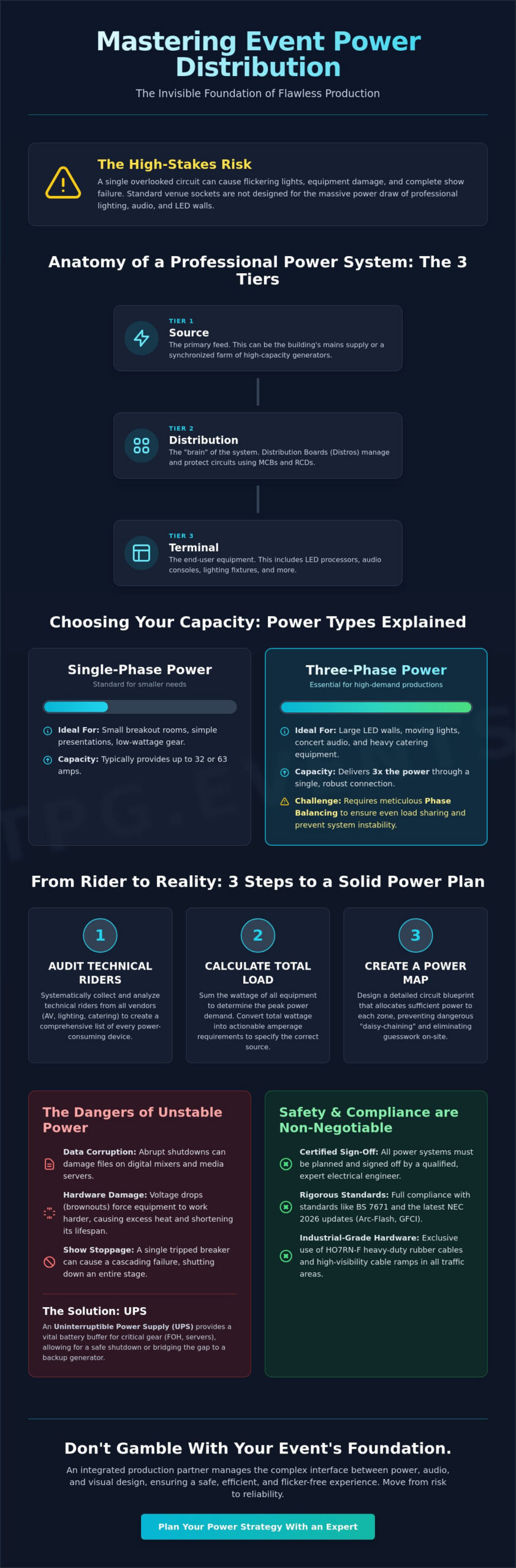
Every successful production starts with a Power Map. This technical blueprint tracks every amp from the source to the terminal point. It ensures that electric power distribution principles are applied correctly, preventing the dangerous “daisy-chain” effect that leads to heat buildup and circuit failure. By mapping out the requirements early, we eliminate the guesswork that often leads to onsite emergencies. This proactive approach transforms power from a hidden risk into a reliable asset.
Single-Phase vs. Three-Phase Power
Capacity defines the choice. Single-phase power is standard for small breakout rooms or simple presentation setups where total draw stays below 32 or 63 amps. However, when your technical rider includes moving lights, large-scale video processing, or heavy catering equipment, you graduate to three-phase power. This system delivers three times the capacity through a single connection. The challenge here is phase balancing. If one “leg” of the power is overloaded while others sit idle, the system becomes unstable. Our team manages this distribution meticulously to ensure even load sharing across the entire grid, preventing localized overloads that can trip main breakers.
The Production Impact of Power Failure
A sudden loss of current is more than an inconvenience; it’s a hardware threat. Sensitive digital mixing consoles and LED processors can suffer data corruption or motherboard damage from abrupt shutdowns. Voltage drops, often called brownouts, are equally dangerous. They force equipment to work harder, generating excess heat that shortens the lifespan of high-end technical rigs. To mitigate this, we integrate Uninterruptible Power Supplies (UPS) in critical zones like the front-of-house (FOH) position. This provides a vital buffer, allowing for safe shutdowns or bridging the gap until a backup generator engages. Protecting your investment requires more than just a cable; it requires a managed environment that respects the delicate nature of modern event technology.
The Anatomy of an Event Power System: Key Components
A high-end production relies on a rigid hierarchy of components to maintain stability. We view the architecture of power distribution for events through three distinct tiers: Source, Distribution, and Terminal. The source is your primary feed, whether it’s a building’s mains supply or a synchronized generator farm. The distribution layer consists of the boards and breakers that manage the current, while the terminal points are the end-user devices like your LED processors or moving head fixtures. Engineering these tiers correctly prevents the “cascading failure” effect where one minor fault shuts down an entire stage.
The physical hardware used to bridge these tiers must meet industrial specifications. We exclusively use HO7RN-F heavy-duty rubber cable because it’s designed to withstand the mechanical stresses of a busy event site. It’s flexible, oil-resistant, and flame-retardant. Beyond the cables themselves, public safety dictates the use of high-visibility cable ramps in all pedestrian and vehicle traffic areas. Adhering to OSHA safety standards ensures that every component, from the primary feeder to the final receptacle, is installed to prevent electrical hazards in high-traffic spaces. Partnering with a team that provides Full-Service Event Production ensures these components are not just hired, but strategically integrated into your show’s design.
Distribution Boards (Distros) and Circuit Protection
Distribution boards act as the brain of your electrical setup. They don’t just split power; they protect your equipment through Miniature Circuit Breakers (MCBs) and Residual Current Devices (RCDs). As of the 2026 NEC updates, all commercial distribution equipment must now feature arc-flash hazard labels, regardless of amperage rating. This includes clear markings for nominal system voltage and the required Personal Protective Equipment (PPE) for technicians. When selecting a distro, we match the unit to the load. A 125A three-phase unit might feed the main stage lighting, while smaller 16A or 32A units provide localized power for front-of-house consoles or backstage production offices.
Cabling and Connectors: The Arteries of the Event
In the professional world, domestic 13A plugs are a rarity. We rely on CEEform (Commando) connectors, which offer a locking mechanism and superior weather resistance. For large-scale exhibitions, cable length becomes a critical factor. Long cable runs introduce voltage drop, which can cause digital equipment to reboot or perform inconsistently. To streamline lighting rigs, we use Socapex multicore cables. This industry-standard connector allows us to run six independent circuits through a single heavy-duty cable, reducing the “cable spaghetti” that often plagues complex stage designs. This level of organization isn’t just about aesthetics; it’s about creating a manageable, transparent system where faults can be identified and cleared in seconds.
Strategic Power Planning: How to Calculate Load and Capacity
Strategic planning is the pivot point where technical theory meets operational reality. It’s not enough to have the right hardware; you need a calculated map of how those components will perform under peak pressure. Effective power distribution for events requires a rigorous five-step methodology to ensure the lights stay on and the audio stays crisp. This process begins with a comprehensive audit of every technical rider, from the headline act’s lighting rig to the catering team’s convection ovens. We don’t guess. We calculate.
Once the inventory is clear, we convert total wattage into amperage to determine the draw per circuit. This math is non-negotiable. We then apply a demand factor, typically between 0.65 and 0.80 of the total connected load, to account for the fact that not every device will draw maximum power simultaneously. The fourth step involves designing a physical layout that minimizes cable runs. This reduces voltage drop and eliminates trip hazards in high-traffic zones. Finally, we verify the source capacity. Whether we’re tapping into venue mains or deploying synchronized generators, we ensure the “headroom” exists to handle unexpected surges without triggering a blackout.
The Load Audit: More Than Just AV
A common pitfall is focusing solely on the stage while ignoring “invisible” loads. Coffee machines, laptop charging stations, and backstage HVAC units can easily pull 20 or 30 amps, enough to trip a shared circuit. We meticulously read the nameplate power ratings on all production gear. Following the 2026 technical standards, we estimate audio amplifiers at 33 to 50 percent of their nameplate rating and LED walls at 40 to 60 percent of their maximum draw. This precision allows us to work closely with exhibition stand designers to integrate power directly into custom builds, ensuring the infrastructure is as beautiful as the design.
Source Selection: Mains vs. Generators
Choosing between venue power and independent generators depends on scale and risk. Venue “power drops” are convenient but often lack the redundancy required for high-stakes corporate sessions. For mission-critical events, we often deploy “sync-sets.” These are two or more generators running in parallel. If one unit fails, the others pick up the load instantly without a flicker. During our initial site visit, we evaluate the venue’s existing infrastructure for compliance with the 2026 NEC standards, checking for proper grounding and the presence of required Surge Protective Devices (SPDs). If the house power doesn’t meet our standard of excellence, we bring our own.
Safety Standards and Sustainability: Powering Events Responsibly
Safety and sustainability are no longer optional extras in high-end production. They’re the twin pillars of a responsible technical strategy. For any large-scale installation, compliance with BS 7671 (IET Wiring Regulations) is the baseline. However, the true mark of professionalism is the BS 7909 sign-off. This certification, issued by a qualified production electrician, confirms that the temporary system is safe, balanced, and fit for purpose. It’s the final seal of approval that protects both the crew and the audience. In the 2026 landscape, this also means adhering to the latest NEC standards, such as the mandatory arc-flash hazard labeling on all distribution equipment regardless of its amperage rating.
The environmental impact of power distribution for events has undergone a radical transformation. We’ve moved beyond the era of idling diesel generators. Hydrotreated Vegetable Oil (HVO) has emerged as the 2026 fuel standard, offering a significant reduction in net CO2 emissions without requiring hardware modifications. To further enhance efficiency, we integrate large-scale battery storage systems. These units act as a silent buffer, handling peak loads while allowing generators to be switched off during low-demand periods. This hybrid approach doesn’t just lower your carbon footprint; it virtually eliminates noise pollution in sensitive environments.
Electrical Testing and Certification
A pre-event electrical inspection is a rigorous process. It involves testing every circuit for earth continuity and insulation resistance. We also ensure that all hired equipment carries a valid Portable Appliance Testing (PAT) sticker, verifying that every moving light and processor is electrically sound. This obsessive attention to detail is why TPG prioritizes safety as a core component of our event management services. We don’t just build stages; we engineer secure environments. Following the 2026 NEC updates, we also implement Ground Fault Circuit Interrupter (GFCI) protection for all HVAC units, ensuring total compliance with the latest safety mandates.
The Shift to Green Power Solutions
Sustainable power is a strategic investment. Hybrid systems provide a measurable Return on Investment (ROI) by significantly reducing fuel consumption and engine wear. For corporate clients, this data is invaluable for meeting CSR goals and ESG reporting requirements. Looking ahead, hydrogen fuel cells are beginning to power the largest activations, providing zero-emission energy with the reliability of traditional mains. If you’re ready to modernize your infrastructure, our team can help you plan a sustainable power strategy that matches your creative ambition.
Why a Production Partner Trumps a Hardware Vendor
Success in high-stakes production isn’t found in a rental catalog. While a hardware vendor can provide the boxes and cables required for power distribution for events, they rarely offer the strategic oversight needed to integrate those components into a complex creative vision. The “dry hire” model places the entire technical burden on your shoulders, leaving you to manage the delicate interface between current, frequency, and signal. TPG operates differently. We don’t just supply equipment; we provide comprehensive event production services that treat power as the vital, silent partner of your creative design.
Choosing a partner over a vendor means gaining an expert who understands how a voltage dip might affect a specific media server or how a poorly placed generator could introduce ground loop hum into a premium audio system. Our team manages these technical intersections in real-time. On-site support isn’t just about troubleshooting; it’s about proactive monitoring. We watch the loads so you can focus on the audience. This shift in perspective transforms power from a technical hurdle into an enabler of creative freedom, allowing you to deploy massive LED arrays and immersive lighting without fear of instability.
The Integrated Production Approach
Aesthetics matter as much as amperage in high-end environments. We take pride in hiding the infrastructure that others leave exposed, ensuring that heavy-duty distribution boards and feeder cables never detract from your event’s visual impact. By acting as your single point of contact, we streamline communication across all technical disciplines. Consider a recent multi-zone conference where we managed three concurrent stages with zero downtime. By centralizing the power map and monitoring each zone from a unified position, we eliminated the risk of localized overloads that often plague decentralized setups. This integrated methodology ensures that every amp is accounted for and every cable is tucked out of sight.
Beyond the Cables: A Partnership Ethos
We view ourselves as an extension of your internal team, not a third-party contractor. This collaborative ethos is a core signature of our service, providing a level of dedication that a mere vendor cannot replicate. You gain the reassurance of our extensive professional indemnity and public liability coverage, alongside a history of proven reliability in the world’s most demanding venues. We bring a seasoned, authoritative presence to the site, ensuring that every technical decision aligns with your overarching goals. Elevate your next project with our superlative production standards and experience the confidence that comes from a perfectly powered event. Contact our team today to begin planning your next flawless activation.
Mastering Your Event’s Technical Foundation
Mastering the technical foundation of your production ensures that creative ambition is never limited by infrastructure. By prioritizing precise load calculations and adhering to the 2026 NEC safety standards, you eliminate the risks of downtime and hardware damage. We’ve explored how modern power distribution for events now integrates sustainable HVO fuel and hybrid battery systems, aligning technical excellence with corporate responsibility. This strategic approach transforms a technical necessity into a competitive advantage.
True success lies in moving beyond hardware hire toward a collaborative partnership. TPG provides full-service technical production from concept to execution, acting as a seasoned, authoritative extension of your internal team. Our expertise in high-impact AV, lighting, and staging ensures that every technical interface is managed with superlative precision. We don’t just supply equipment; we engineer outcomes.
Partner with TPG Events for Flawless Technical Production and secure the expert support your next activation deserves. With a reliable grid and a dependable team at your side, you’re free to focus on creating a lasting impression for your audience.
Frequently Asked Questions
How much power does a typical conference need?
The power requirements for a conference depend entirely on your technical rider and the scale of your production. A small breakout room with a single projector and laptop might only require a 16A or 32A single-phase supply. However, a large plenary session featuring 4K LED walls, high-output line arrays, and moving lights often demands 63A or 125A three-phase power. We use precise calculations based on the 2026 NEC standards to ensure your grid has the necessary headroom for peak performance.
What is the difference between single-phase and three-phase power for events?
Capacity and load balancing are the primary differences between these two systems. Single-phase power uses one live conductor and is suitable for low-demand environments like production offices or small presentations. Three-phase power utilizes three live conductors, providing triple the capacity through a single connection. It’s the industry standard for power distribution for events involving high-wattage equipment, as it allows us to balance the electrical load across three separate “legs” for maximum stability.
Do I need a generator if the venue has power sockets?
You need a generator if the venue’s existing infrastructure is insufficient or lacks the redundancy required for a high-stakes activation. Standard wall sockets aren’t designed to handle the massive surges associated with professional AV and lighting rigs. For mission-critical events, we often deploy synchronized generators that run in parallel. This ensures that if the house power fails or one generator has an issue, the backup takes over instantly without a flicker in your production.
What is BS 7909 and why does it matter for my event?
BS 7909 is the essential code of practice for temporary electrical systems at events. It matters because it provides a framework for safety and compliance that protects your organization from liability. Adhering to this standard requires a qualified production electrician to design, test, and sign off on the entire system. This certification confirms that your power grid is safe, properly grounded, and capable of handling the connected loads without risking fire or equipment failure.
Can I run power cables across a public walkway?
Yes, but only if they’re housed within heavy-duty, high-visibility cable ramps. These ramps serve a dual purpose: they protect the cables from mechanical damage and prevent trip hazards for your guests. In high-traffic areas or vehicle access points, we use specialized ramps that meet OSHA safety standards. Our team meticulously plans these cable paths during the site visit to minimize the footprint of the infrastructure while ensuring total public safety throughout the venue.
How can I make my event power distribution more sustainable?
Transitioning to Hydrotreated Vegetable Oil (HVO) fuel and integrating hybrid battery storage systems are the most effective ways to reduce your carbon footprint. These modern solutions allow generators to be switched off during low-demand periods, which also significantly reduces noise pollution. By using smart Power Control Systems (PCS), we can manage loads more efficiently, ensuring your power distribution for events is as eco-friendly as it is reliable, helping you meet your corporate CSR goals.
What happens if the power fails during my event?
If your system is engineered with redundancy, a failsafe mechanism will engage immediately. We utilize Uninterruptible Power Supplies (UPS) for critical front-of-house equipment to bridge the gap during a switchover. In a synchronized generator setup, the secondary unit carries the load without any interruption to the show. This layered approach to protection ensures that even in the event of a primary source failure, your audio, video, and lighting systems remain fully operational.
Does TPG provide power distribution as a standalone service?
TPG focuses on full-service event production rather than standalone hardware hire. We integrate power distribution as an essential component of our comprehensive technical packages. This collaborative approach ensures that the electrical infrastructure is perfectly synced with your staging, AV, and lighting requirements. By managing the entire technical interface, we provide a seamless experience where the power grid is an enabler of your creative vision, not just a collection of rented cables.