Did you know that in many hotel and venue partnerships, 50% or more of your AV spend is actually a commission shared back with the venue? This hidden revenue-sharing model is precisely why your quotes often feel inflated and your budget feels stretched before the first microphone is even plugged in. As an event organiser in 2026, you’ve likely faced the frustration of opaque pricing and the threat of punitive fees just for wanting to work with an external production team.
It’s time to reclaim control of your event vision. By mastering specific av contract negotiation tips, you can secure better terms and eliminate the hidden fees that drain your resources. This guide provides a clear framework for comparing complex quotes and outlines the exact strategies needed to remove venue-imposed constraints. You’ll learn how to build a partnership-based contract that ensures technical reliability while protecting your bottom line from unnecessary costs. We’ll show you how to transform your technical requirements into a strategic asset that delivers a superior standard of quality for every attendee.
Key Takeaways
- Understand why the 2026 market requires a shift from traditional bidding to a strategic alignment of your creative vision and technical budget.
- Dismantle the “exclusivity myth” by applying expert av contract negotiation tips to remove punitive venue fees for using external production teams.
- Identify hidden costs within the fine print, such as inflated power and rigging charges, to ensure your quote delivers maximum impact.
- Secure long-term financial stability by implementing scalability clauses and multi-event bundling to lock in premium rates for your entire calendar.
- Learn how a partnership-based approach ensures technical reliability and transforms your AV provider into an integral part of your internal team.
The Landscape of AV Contract Negotiation in 2026
The 2026 event market requires a fundamental shift in how organisers approach technical agreements. Gone are the days of simple equipment rentals. Today, successful outcomes depend on a strategic alignment where your creative vision and technical budget work in harmony. This isn’t just about ticking boxes on a manifest; it’s about investing in production excellence that creates a lasting impression on your audience. Effective negotiation principles ensure that every stakeholder, from procurement teams to event leads, understands that technical hardware is the vehicle for your message, not a line-item burden.
A seasoned technical production partner acts as an extension of your internal team. In this collaborative ecosystem, the contract serves as the roadmap for your event’s sensory impact. When you apply modern av contract negotiation tips, you move beyond the “vendor” mindset and establish a framework for innovation. You aren’t merely hiring projectors or line array systems. You’re securing the expertise required to bring ambitious ideas to life while maintaining a results-focused budget. This level of partnership is essential for navigating the complexities of modern hybrid and high-tech physical environments.
Why Your AV Contract Is the Foundation of Event Success
A meticulously crafted contract is your primary defence against scope creep. By defining technical specifications early, you ensure that every creative pivot remains within the agreed financial boundaries. This clarity directly influences audience engagement levels. High-quality visual technology and crystal-clear audio aren’t just luxuries. They’re essential revenue drivers that enhance the perceived value of your brand and sponsorship packages. Professional AV ensures your content is delivered with a superior standard of quality that commands attention and inspires trust.
The High Cost of Poor Negotiation
Failing to scrutinise the fine print leads to expensive budget traps. Unquantified labour hours and vague technician fees can quickly erode your margins. More importantly, poor negotiation risks technical failure. A glitch during a keynote doesn’t just disrupt the schedule; it damages your brand’s reputation and diminishes the return on investment for your sponsors. AV negotiation is the process of securing technical reliability at a fair market rate. By focusing on these av contract negotiation tips, you protect your event from the hidden costs of mediocrity and ensure a flawless execution that reflects your commitment to excellence.
In-House AV vs. External Production Partners
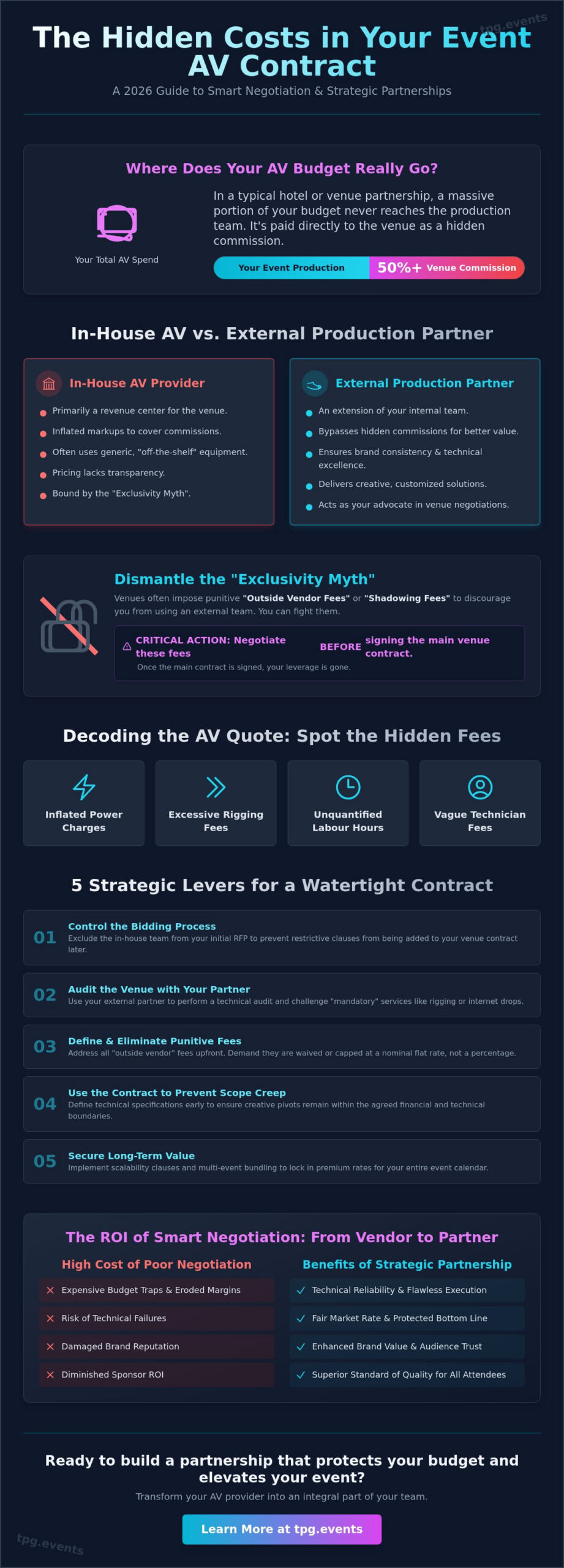
Many event organisers fall victim to the “Exclusivity Myth,” believing they’re contractually bound to use a venue’s preferred supplier. In reality, these in-house providers often operate as revenue centres for the hotel rather than technical partners for the client. Industry data indicates that venues frequently claim 50% or more of the AV revenue in commission, which naturally leads to inflated markups and generic, “off-the-shelf” equipment packages. Choosing a full-service event production partner allows you to bypass these hidden commissions and focus entirely on brand consistency and technical excellence.
To maintain control, you must negotiate “Outside Vendor Fees” or “Shadowing Fees” before the venue contract is signed. These are punitive charges venues apply when you bring in your own team. Implementing these av contract negotiation tips during the initial site visit is critical. Once the main contract is executed, your leverage vanishes. Demand that the venue waives these fees or caps them at a nominal flat rate, rather than a percentage of your production spend. If you’re looking for a team that prioritises your vision over venue kickbacks, partnering with an integrated production team is the most effective way to ensure every pound spent appears on the screen, not in the venue’s pocket.
Maintaining Leverage During the Bidding Process
Control the narrative from the start by excluding the in-house team from your initial RFP if you intend to use an external partner. This prevents the venue from “protecting” their revenue by building restrictive clauses into your contract later. Use your external partner to perform a technical audit of the venue. They can identify if “mandatory” services like rigging points or internet drops are truly exclusive or if they can be challenged. In many UK venues, rigging is often cited as a non-negotiable in-house service, but a seasoned partner can often negotiate “dry hire” rates for these infrastructure elements.
The Creative Edge of External Production
External teams offer a level of customisation that in-house departments simply cannot match. While an in-house team might offer a standard projector and screen, an external specialist can provide bespoke exhibition stand design and custom staging that transforms a generic ballroom into a brand-led environment. Having a dedicated technical director who travels with you across multiple venues ensures that your brand standards remain identical, regardless of the location’s native limitations.
| Feature | In-House AV Provider | External Production Partner |
|---|---|---|
| Primary Objective | Venue Revenue Generation | Client Brand Impact |
| Pricing Model | Commission-based Markups | Transparent Line-item Pricing |
| Equipment | Generic, Static Inventory | Custom, Cutting-edge Solutions |
| Relationship | Transactional Vendor | Integrated Team Member |
Decoding the AV Quote: Identifying Hidden Fees
The 2026 event landscape demands more than a cursory glance at your production quotes. While the equipment manifest might look impressive, the true financial impact of an agreement is often buried in the fine print. Understanding how to differentiate between standard line items and opportunistic surcharges is essential for maintaining budget integrity. One of the most effective av contract negotiation tips is to demand a line-item breakdown of every infrastructure charge before you commit to a venue. This transparency allows you to identify the “Power and Rigging” trap, where venues charge premium rates for basic access to their own ceiling points and electrical circuits.
Service Level Agreements (SLAs) must be an integral part of your technical contract. In a world where hybrid connectivity is the standard, you cannot afford to leave technical uptime to chance. Your contract should explicitly state the required uptime for internet streams and provide a clear protocol for backup equipment deployment. A partnership-based approach ensures that your technical production partner is held to a superior standard of quality, with pre-defined penalties for failures that impact your audience engagement or brand reputation.
Technical Infrastructure and Venue Exclusives
Venues often treat internet bandwidth as a high-margin exclusive service. For hybrid events in 2026, you must negotiate dedicated, symmetric bandwidth rather than relying on shared guest Wi-Fi. Similarly, rigging point charges can become an astronomical expense if not bundled into your initial deal. Always verify the age and condition of any “included” venue equipment. Outdated hardware often lacks the processing power required for modern high-resolution content, leading to a diminished sensory impact that can undermine your entire creative vision.
Labour Rates and Staffing Logistics
Staffing represents the most variable element of your production spend. When reviewing quotes, distinguish between “Day Rates” and “Hourly Rates” for your AV technicians to avoid unexpected overtime surcharges. It is also vital to negotiate travel, subsistence, and accommodation costs upfront to prevent these from becoming “pass-through” expenses with no cap. Labour usually accounts for 40-50% of an AV budget and requires strict contractual limits. By defining call times and crew rotations within the contract, you ensure that your technical team remains fresh, focused, and capable of delivering a flawless performance from the first rehearsal to the final keynote.
5 Strategic Levers for Better AV Terms in 2026
Negotiation in the 2026 event landscape isn’t about aggressive price-cutting. It’s about maximizing the value of every pound spent to ensure your technical production remains agile and impactful. By integrating these av contract negotiation tips into your procurement process, you can move from a reactive bidding cycle to a proactive strategic partnership. Success requires identifying levers that protect your budget while enhancing the sensory impact of your event. With 85% of event professionals reporting high optimism for 2026, the competition for premium equipment and expert talent is fierce. Securing your technical priority requires a sophisticated approach to contract terms.
- Multi-Year and Multi-Event Bundling: Lock in premium rates for your entire annual calendar. By committing to a series of events, you provide your partner with predictable volume, allowing them to offer significant cost efficiencies and equipment priority.
- Flexible Scalability Clauses: Delegate numbers fluctuate. Ensure your contract includes clauses that allow you to adjust tech requirements, such as headset counts or breakout room kits, without incurring heavy penalties as your attendance data matures.
- The “Value-Add” Negotiation: Instead of chasing small cash discounts that might compromise quality, negotiate for upgrades. Request high-resolution LED wall enhancements or creative lighting packages that add visible “wow” factor at a lower internal cost to the production partner.
- Early Payment and Deposit Incentives: Use your cash flow to your advantage. Offering a larger upfront deposit can often secure better equipment priority and lock in current year pricing for future dates.
- Ownership of Content and Recordings: Explicitly state that you own all digital assets, including raw footage and edited recordings, post-event. This prevents unexpected licensing fees when you repurpose content for marketing or internal training.
Negotiating for Hybrid and Virtual Scalability
The boundary between physical and virtual experiences has vanished. Your 2026 contracts must include “Pivot Clauses” that define exactly how an event shifts from a live format to a fully virtual one if external circumstances change. Negotiate platform licensing fees and streaming bandwidth as separate line items from your physical hardware. This transparency prevents the bundling of costs that often hides high markups. Ensuring your virtual event production team is integrated into the core contract from day one ensures a seamless experience for remote attendees and protects your message from technical fragmentation.
The Power of the Multi-Year Partnership
Consistency in technical production is a primary driver of long-term cost savings. When you work with the same team across multiple venues, you eliminate the need for expensive site visits and repetitive design phases. We recommend building a “Technical Rider” that acts as a blueprint for your brand standards. This document ensures that your stage design, audio quality, and lighting cues remain identical whether you’re in London, Dubai, or Singapore. A partner-led approach transforms your production team into an integral part of your internal staff, dedicated to bringing your most ambitious creative ideas to life with a superior standard of quality. To lock in your technical priority for the coming year, discuss your multi-event strategy with our expert production team.
Partnering for Success: The TPG Events Approach
TPG Events doesn’t see a contract as a simple transaction. We see it as the formal start of a collaborative partnership where we act as an integral extension of your own staff. While many vendors focus on equipment turnover, our primary objective is the sensory impact and measurable success of your event. This commitment starts with total transparency. We provide clear, line-item pricing for all our services, from custom staging to full-service event production. You’ll never find hidden surcharges or vague “service fees” in a TPG quote. By integrating AV, set design, and technical management, we eliminate the overlaps and communication gaps that often inflate budgets when using multiple disparate suppliers.
Our collaborative approach has saved clients significant venue-imposed costs through expert technical advocacy. In one recent instance, we challenged a venue’s “exclusive” rigging policy by providing a detailed technical audit that proved our independent safety protocols exceeded their requirements. This advocacy resulted in the venue waiving their punitive outside vendor fees, allowing the client to reinvest that budget into high-resolution LED video solutions. These av contract negotiation tips aren’t just theories; they’re the standard operating procedure we use to protect our partners’ interests and ensure every pound spent delivers maximum value.
Expert Technical Advocacy
We act as your internal technical department throughout the entire venue selection and negotiation process. Our team doesn’t just read venue contracts; we audit technical riders to identify every cost-saving opportunity. Whether it’s questioning inflated power drop charges or negotiating better internet bandwidth for hybrid streaming, we ensure your event management strategy is backed by a robust and fair technical agreement. This level of scrutiny ensures that your vision is never compromised by venue-imposed technical constraints or generic equipment packages.
The Future of Event Production with TPG
As we move through 2026, the technology required to captivate audiences is becoming more complex and demanding. TPG Events continues to invest in the latest production hardware, including immersive lighting rigs and global virtual reach capabilities. Our “zero-failure” technical culture means we don’t just plan for success; we engineer it through redundant systems and rigorous technical rehearsals. You deserve the peace of mind that comes from working with a seasoned expert who treats your brand with the same respect as their own. Ready to secure better terms? Contact TPG Events for a transparent AV quote today.
Elevate Your Event Production Strategy for 2026
Mastering the technicalities of your agreement is the only way to ensure your creative vision remains uncompromised by venue limitations. By applying these av contract negotiation tips, you transform your production from a line-item expense into a strategic engine for audience engagement. The most successful organisers in 2026 don’t just hire equipment. They cultivate integrated partnerships that provide technical advocacy, transparent pricing, and the flexibility to scale as requirements evolve. Protecting your budget starts with scrutinising the fine print and ends with a contract that prioritises your brand’s impact above all else.
As a proud member of the Technical Production Group, TPG Events provides full-service, UK-wide coverage for high-impact corporate conferences. We are dedicated to delivering a superior standard of quality that brings your most ambitious ideas to life without the hidden surcharges common in the industry. It’s time to demand more from your technical agreements and secure the reliability your audience expects.
Partner with TPG Events for transparent, expert event production and take the first step toward a flawless, budget-conscious event delivery. Your vision deserves a technical foundation as ambitious as your goals. We look forward to helping you create a lasting impression.
Frequently Asked Questions
How far in advance should I start negotiating my AV contract?
You should ideally begin negotiations six to twelve months before your event date. With the 2026 event calendar filling up faster than in previous years, early engagement is the only way to secure premium equipment and the most experienced technical talent. Starting early also ensures you have maximum leverage to remove punitive clauses before you are committed to a specific venue contract.
Can a venue legally force me to use their in-house AV team?
A venue cannot typically force you to use their in-house team, but they can enforce “outside vendor fees” if those terms were agreed upon in your initial venue contract. These fees are often used as a deterrent to protect the venue’s commission revenue. You must negotiate the right to bring in an external production partner at no extra cost before you sign the main lease agreement for the space.
What is the most common hidden fee in an AV contract?
The most frequent hidden cost is the venue service charge, which can add 20% or more to your final bill. Another common “stealth” expense is the venue’s revenue-sharing commission, which is often baked into the unit price of in-house equipment. Always ask for a transparent breakdown to see exactly how much of your spend is going toward technical excellence versus venue kickbacks.
How do I compare two AV quotes that use different technical jargon?
Request a standardized line-item breakdown that focuses on performance outputs rather than specific model numbers. Instead of comparing brand names, look at the brightness (lumens) of projectors, the pixel pitch of LED walls, and the number of technicians assigned to the show. This allows you to see if one provider is cutting corners on technical reliability to present a lower headline price.
What should be included in a technical Service Level Agreement (SLA)?
Your SLA must define specific technical uptime percentages, backup equipment availability, and on-site response times for any hardware faults. It should explicitly state the protocol for immediate equipment replacement if a critical component fails. Including these terms ensures your technical production partner is contractually committed to a zero-failure culture and a superior standard of quality.
How can I negotiate AV costs for a hybrid event without doubling my budget?
Focus on integrated production where a single team manages both the physical and virtual feeds using shared infrastructure. By applying specific av contract negotiation tips, such as bundling streaming platform licenses with your physical hardware hire, you eliminate the redundancy of hiring two separate crews. This streamlined approach protects your budget while ensuring a seamless experience for all attendees.
What are “rigging points” and why are they so expensive?
Rigging points are the structural anchors in a venue’s ceiling used to suspend heavy lighting, audio, and video equipment. They are expensive because venues treat them as exclusive infrastructure, often requiring specialist in-house labour and high liability insurance. Negotiating a flat “dry hire” rate for these points early in the process can save you thousands in per-point surcharges during the build.
Is it better to sign a multi-year AV contract or bid for every event?
A multi-year partnership is significantly more cost-effective for recurring events as it eliminates the “discovery” costs associated with new vendors. Consistency in your production team means your technical riders, stage designs, and brand standards are already established, reducing the need for expensive redesigns. This long-term alignment allows you to lock in current rates and secures your priority during peak event seasons.