What if the most expensive visual setup actually costs you the audience’s attention? You’ve likely felt the anxiety of a high-stakes keynote losing its power because the screen looked washed out under bright venue lights. It’s a common frustration when choosing between led wall and projection; you want your vision to be clear, but technical jargon often creates more confusion than clarity. We believe your technology should act as a seamless extension of your brand, providing a superior foundation for your message.
This 2026 guide provides the strategic framework you need to ensure your next event delivers an unrivalled visual impact. We’ll strip away the jargon to compare brightness, cost, and venue constraints. You will gain the confidence to select the perfect canvas for your narrative, ensuring a polished and professional outcome that resonates with every attendee. Discover how to transform your venue into a high-impact environment through a collaborative and results-driven approach to technical production. By matching the right hardware to your specific creative goals, you can move forward with the certainty that your visual execution will be flawless.
Key Takeaways
- Understand how your choice of display technology dictates venue lighting and seating layouts to maximize audience engagement and brand retention.
- Master the technical nuances of nits and lumens to simplify the process of choosing between led wall and projection for any lighting environment.
- Identify high-impact scenarios where the vibrant contrast of LED walls provides a superlative visual experience for luxury brand activations.
- Evaluate practical constraints like rigging weight and power draw to ensure a seamless technical execution without budget surprises.
- Learn why a collaborative partnership with an integrated production team is essential for transforming hardware into a memorable event narrative.
The Visual Foundation: Why Your Screen Choice Defines the Event Experience
Visuals are the heartbeat of modern conferences. They do more than just show slides; they drive engagement and ensure your brand identity sticks with every attendee. Your screen choice dictates the room’s energy. It influences everything from the venue’s lighting requirements to the specific layout of the seating. When you’re choosing between led wall and projection, you aren’t just picking equipment. You’re designing the physical environment where your message lives.
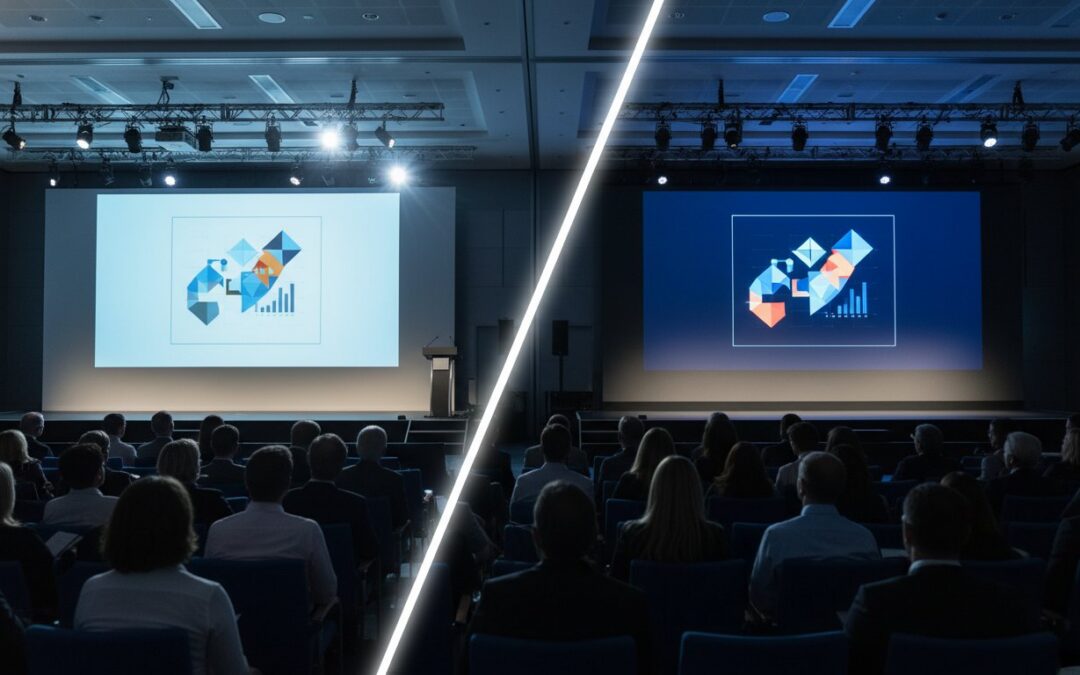
LED walls offer self-emissive brilliance. They create their own light, allowing them to compete with bright windows or intense stage lighting. Projection relies on the physics of reflected light, which requires a more controlled, darker environment to maintain clarity. Deciding between the ‘wow factor’ of high-contrast color and the ‘functional clarity’ of a massive backdrop is essential for your 2026 event goals. To truly master the nuances of display technologies like LED and projection, you must look at how light interacts with the space. At TPG Events, we prioritize this technical harmony to ensure a superlative outcome.
Understanding LED Video Wall Technology
LED technology relies on modular panels. These consist of thousands of light-emitting diodes that form a seamless, high-impact display. Pixel pitch is the most critical technical factor to consider:
- Pixel Pitch (e.g., P2.6): This measurement determines the optimal viewing distance for your delegates.
- Resolution: A smaller pitch, like a P2 indoor panel, provides a much sharper image for close-up viewing than a P10 panel.
- Visual Depth: We’ve seen an industry-wide shift toward high-refresh rates and HDR, ensuring broadcast-quality event feeds that look perfect on camera.
The Evolution of Modern Projection Systems
Modern projection has evolved significantly. Laser projection technology represents a major leap in brightness and colour accuracy compared to older lamp-based models. High-lumen projectors remain a staple for massive-scale cinematic backdrops where an LED wall might be too heavy or power-intensive for the venue’s infrastructure. Projection mapping adds another layer of creative potential. It allows you to transform non-traditional surfaces and architectural features into dynamic staging elements. This versatility makes it a powerful tool for ambitious creative ideas that require a unique visual canvas.
The strategic process of choosing between led wall and projection requires a deep understanding of how each format interacts with your content. We focus on creating lasting impressions by bringing these technical solutions to life. As your integrated production partners, we ensure the hardware serves your narrative perfectly. Our goal is to provide a seamless technical execution that leaves your audience inspired and your brand remembered.
Technical Performance: LED Video Walls vs. Projection Systems
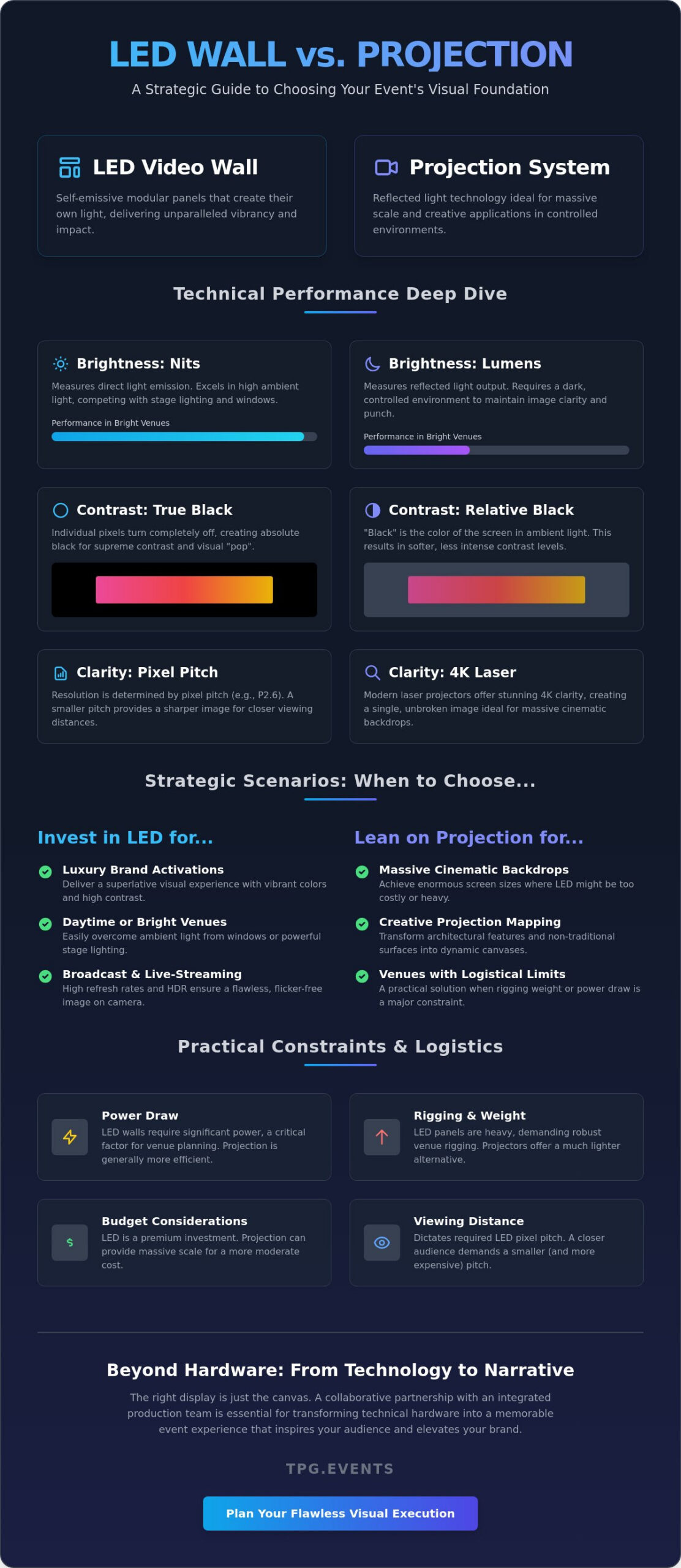
Understanding the difference between Nits and Lumens is vital when choosing between led wall and projection. LED walls use Nits to measure light intensity emitted directly from the screen surface. In contrast, projectors are rated in Lumens, measuring the total light output from the lens before it hits a surface. This distinction matters because an LED wall with high Nit ratings maintains a superlative image even in high-glare environments. Projectors require significantly higher Lumen counts to combat ambient light, as the image can easily lose its punch if the room isn’t sufficiently dark.
Contrast ratios define the perceived depth of your content. LED panels achieve “True Black” by simply turning off individual pixels. This creates a level of visual pop that projection struggles to match, as a projected “black” is essentially just the color of the screen under existing room light. When evaluating technical performance and practical constraints, resolution also comes into play. Modern 4K workflows are now standard for high-end productions. While laser projectors offer stunning 4K clarity, LED walls require careful consideration of pixel pitch to ensure that the 4K canvas remains sharp for the front row of your audience.
Efficiency has seen a major leap recently. Modern dvLED technology in 2026 consumes up to 30% less power than models from just three years ago, thanks to common cathode advancements. This reduction in power draw also means less heat dissipation, which keeps your stage and your presenters comfortable during long event days. Our team focuses on these operational details to ensure a flawless experience. If you need help calculating the power requirements for your next setup, our experts in full-service event production can provide a precise technical breakdown.
Ambient Light: The Ultimate Deciding Factor
LED walls thrive in glass-walled venues and daylight-heavy exhibitions. They remain vibrant where traditional projection would appear washed out. If you lean toward projection in a bright space, we manage the environment using high-contrast screens and physical shielding to protect the image. However, the technical reality is that outdoor or high-glare environments almost always favor the emissive power of LED to maintain visual excellence.
Seamlessness and Aspect Ratios
Modular LED panels eliminate the distracting bezels found in tiled monitor walls, allowing for ultra-wide, continuous canvases. This modularity also enables custom shapes like curved or corner-wrapped displays. Projection achieves a similar scale through edge-blending. This technique overlaps multiple projector beams to create massive, continuous panoramic images. While both offer impressive scale, LED provides a more dependable physical structure for creative staging that demands a unique geometry.
Strategic Scenarios: When to Invest in LED and When to Lean on Projection
Success in event production depends on viewing your screen as a strategic asset rather than a simple rental item. The decision is rarely about hardware alone; it’s about the narrative you intend to build. When you’re choosing between led wall and projection, the decision should be driven by the specific energy and emotional response you want to elicit. For high-impact brand activations, the vibrancy of LED is the superlative choice. Luxury brands often require the deep blacks and saturated colors that only self-emissive technology can provide, ensuring the product remains the undisputed star of the show.
Large-scale plenary sessions often demand a different approach. Projection excels here, offering a cost-effective way to create massive, continuous backdrops that span the entire width of a stage. While LED offers punch, multi-projector edge-blending allows for a cinematic scale that feels expansive and inclusive for thousands of delegates. Exhibition stands present a unique challenge where space is at a premium. High-resolution LED panels with a tight pixel pitch allow for clear, legible content even when delegates are standing inches away, maximizing your small footprint with high-quality visuals.
Hybrid events require a specific technical focus. Visuals must be flawless for both in-room and remote viewers. LED walls with high refresh rates prevent the flickering or banding effects often seen on camera, making them a safer bet for broadcast-quality feeds. Choosing between led wall and projection becomes simpler when you define the primary goal of each room and how it will be viewed by your digital audience.
The Corporate Conference Environment
In a conference setting, LED walls allow for dynamic stage sets that shift mood instantly between speakers. You can transition from a high-energy morning keynote to a sophisticated afternoon panel with a simple content change. Projection remains a reliable tool for traditional, text-heavy presentations where scale is the priority. Many successful events use a hybrid model: LED for the main stage to provide a high-end feel and high-lumen projection for breakout rooms to manage budget and space efficiently.
Creative Staging and Immersive Experiences
For truly immersive experiences, projection mapping is an incredible tool. It turns venue architecture into a living part of your narrative, wrapping content around columns or complex surfaces. Conversely, interactive LED floors and tunnels create high-engagement brand journeys. The choice hinges on whether you want to transform the room’s architecture or provide a tactile, high-brightness path for your audience to follow. We act as your integrated production partners to help you weigh these options against your creative vision, ensuring a result that exceeds expectations.
Practical Constraints: Budgeting, Venue Logistics, and Content Requirements
Logistics often dictate the final outcome when you’re choosing between led wall and projection. While the visual goal is paramount, the physical reality of your venue and the specifics of your content will define what is actually achievable. Content creation must be tailored to the native resolution of your chosen hardware. Stretching a standard 1080p graphic across a high-resolution LED wall results in pixelation that undermines your brand’s authority. Our approach ensures every pixel is mapped precisely to the display’s geometry for a sharp, superlative finish.
Space is another non-negotiable factor. Projectors require a specific throw distance, which is a clear path between the lens and the screen. This footprint can be difficult to maintain in crowded exhibition halls or venues with low ceilings where delegates might block the beam. LED walls are essentially zero-depth displays. They don’t require a throw path, making them the ideal solution for tight spaces or unusually shaped rooms where every square meter of floor space is valuable. We focus on these spatial dynamics to ensure your technical execution is flawless and unobstructed.
Budgeting for Impact, Not Just Equipment
A common mistake is looking only at the base rental price. When calculating the total cost of ownership for a multi-day conference, you must account for the infrastructure required to support the tech. Industry data indicates that hidden costs for LED installations, including specialized rigging, power distribution, and dedicated on-site technicians, can add 30-60% to the initial quote. This is why hiring professional AV equipment through an integrated partner is vital. We provide a transparent breakdown that focuses on long-term production value rather than just equipment hire fees.
Venue and Rigging Considerations
The structural integrity of your venue is a critical safety consideration. A large-scale LED wall can easily weigh several tonnes. You must verify if the venue’s ceiling rigging points can support such a concentrated load; it’s not uncommon for a massive display to exceed a 5-tonne limit. Power draw is equally important. LED panels require a significant amount of electricity, often necessitating dedicated three-phase power drops that projectors don’t require. Conversely, projection setups require clear sightlines. You must ensure that hanging lights, decor, or even the presenters themselves won’t cast shadows on the screen. If you’re unsure about your venue’s capacity, our experts in venue AV management can conduct a full site survey to guarantee a seamless and safe technical execution.
Beyond the Hardware: Partnering with TPG Events for Flawless Execution
TPG Events operates on a philosophy of deep partnership. We don’t view ourselves as mere equipment suppliers; we are problem-solvers who integrate directly into your organizational structure. The complex process of choosing between led wall and projection is simply the starting point of a much larger creative journey. Our commitment to superlative quality ensures that every technical decision serves your ultimate goal: a lasting impression on your audience. By leveraging our expertise in full-service event production, you gain more than a technician. You gain a dedicated ally committed to your success from the initial concept to the final load-out.
We help you navigate the nuances of choosing between led wall and projection by analyzing your content and venue constraints side-by-side. This ensures the technology you select is the most effective tool for your specific narrative. Our team focuses on the quality and impact of the services provided, aiming to inspire trust through competence and creativity. We treat your event as our own, ensuring that the final visual outcome is nothing short of excellent.
The Integrated Team Advantage
Our technicians don’t just show up to flip switches. They work as an active extension of your internal event staff, anticipating needs and mitigating risks before they ever impact the live show. Whether we’re calibrating a high-resolution LED wall for a broadcast feed or fine-tuning the edge-blend of a massive projection system, we focus on absolute precision. This proactive approach to on-site problem-solving is what separates a standard vendor from a professional production partner. Every cable run and every power drop is executed with a level of care that reflects our high-end expertise.
Calibration is where technical hardware becomes a visual narrative. A projector might have the lumens, and an LED wall might have the nits, but without professional color-matching and geometric alignment, the visual impact is diluted. We treat every surface as a canvas for excellence. Our site surveys are exhaustive, ensuring that the logistics of rigging points and power draws are handled with surgical accuracy long before your guests arrive. From the first technical drawing to the final standing ovation, our process is designed to be seamless and results-driven.
Ready to Elevate Your Next Event?
Deciding on the right technology requires a specific blend of technical insight and creative vision. We invite you to consult with us to determine the most effective strategy for your specific venue and engagement goals. With an extensive track record of delivering unforgettable experiences across the UK, we possess the industry experience to turn ambitious ideas into flawless reality. Our team is ready to act as your integrated production partner, ensuring your next event delivers an unrivalled visual impact. Contact us today for a bespoke technical production proposal and discover the confidence that comes with professional reliability.
Mastering the Art of Visual Impact
Mastering the nuances of choosing between led wall and projection ensures your event’s narrative is never compromised by technical limitations. By prioritizing ambient light management and native content resolution, you create a foundation for an unrivalled visual impact. We’ve explored how the right decision balances your high-end aesthetic goals with the practical realities of venue logistics, weight limits, and power infrastructure. These strategic choices define the energy of the room and the retention of your brand’s message.
TPG Events provides the seasoned, dependable creative experts you need to transform hardware into a memorable experience. Our full-service technical production expertise is trusted by leading venues across the UK to deliver consistently professional outcomes. We don’t just provide equipment; we act as your integrated production partner to ensure every detail is perfectly calibrated and every risk is mitigated. Partner with TPG Events for your next world-class production and experience the confidence that comes with high-end expertise. We’re ready to bring your vision to life with a superlative standard of quality and a commitment to your absolute success.
Frequently Asked Questions
Is an LED wall always better than a projector for corporate events?
No, an LED wall isn’t the universal solution for every corporate setting. While they offer unmatched brightness, high-lumen laser projectors remain a superlative choice for creating massive, cinematic backdrops in large plenary sessions where you can control the ambient light. The decision depends entirely on your venue’s lighting conditions and the specific energy you want to cultivate for your audience.
How much space is needed for a rear-projection setup vs. an LED wall?
Rear-projection setups typically require several meters of dedicated “throw distance” behind the screen to allow the image to expand to the correct size. This can significantly reduce the usable floor space in smaller venues. LED walls are modular and incredibly thin, requiring minimal depth. This makes them the ideal choice for tight spaces or exhibition stands where maximizing your physical footprint is a priority.
Can I use projection in a room with a lot of windows?
Using projection in a room with significant natural light is technically difficult because the ambient light washes out the reflected image. If your venue has floor-to-ceiling glass, choosing between led wall and projection usually results in selecting LED. Its self-emissive technology allows it to remain vibrant and clear even in direct sunlight, whereas a projector would struggle to maintain visible contrast.
What is pixel pitch and why does it matter for LED walls?
Pixel pitch is the distance in millimeters between the center of each LED cluster on a panel. This measurement is vital because it determines the minimum viewing distance for your delegates. A tight pitch, such as P2.6, is excellent for indoor conferences where the audience is close to the stage. A larger pitch, like P10, is better suited for outdoor festivals where the crowd is much further away.
Do LED walls consume significantly more power than projectors?
Yes, LED walls generally have a higher power draw than standard projection systems. A large-scale installation often requires dedicated three-phase power drops to handle the load safely and prevent circuit overloads. While modern 2026 common cathode technology has improved efficiency by up to 30% compared to older models, the power infrastructure of your venue remains a critical logistical consideration during the planning phase.
Which technology is better for outdoor events in the UK?
LED walls are the definitive choice for outdoor events in the UK due to their high brightness and weather resistance. They can compete with daylight and are built to operate safely in unpredictable weather. Projection is rarely viable outdoors during the day and requires complex environmental protection for the hardware, making it a less reliable and more complicated option for open-air productions.
What kind of content looks best on an LED video wall?
High-contrast graphics and vibrant video content perform exceptionally well on LED walls. Because these screens achieve true black levels by turning off pixels, visuals with deep shadows and saturated colors appear incredibly sharp and punchy. When choosing between led wall and projection for brand activations, LED’s ability to make motion graphics and logos stand out is a significant creative advantage.
How do I decide between hiring equipment and a full-service production?
Equipment hire is suitable if you have an in-house technical team capable of managing the setup, calibration, and live operation. For high-stakes events, full-service production provides an integrated team that handles everything from the initial site survey to the final standing ovation. This collaborative approach ensures a professional outcome and mitigates technical risks, allowing you to focus on your guests while we handle the execution.