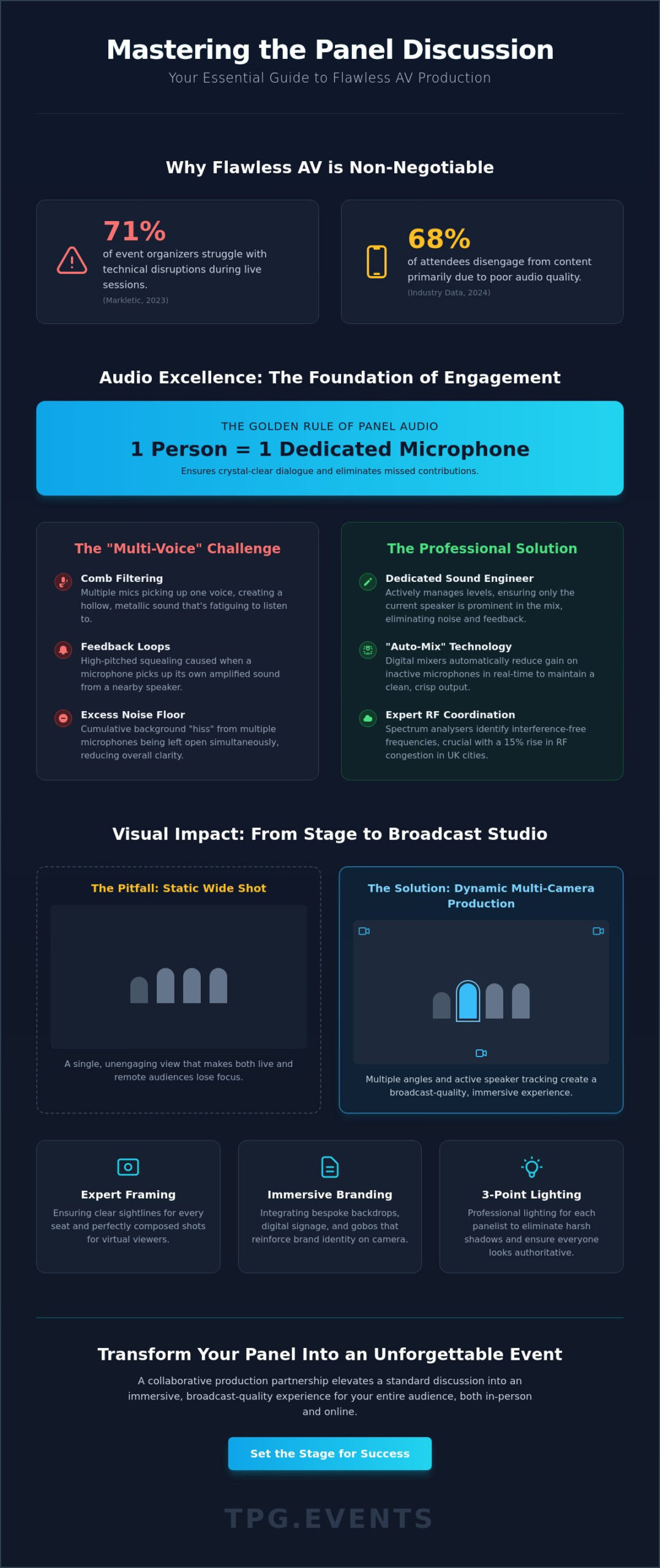
What if the success of your next high-stakes conference depended less on the speakers’ expertise and more on the positioning of a single stage monitor? A 2023 Markletic report revealed that 71% of event organisers struggle with technical disruptions during live sessions; these glitches often turn a prestigious gathering into a frustrating exercise in troubleshooting. You already understand that a flawless av setup for panel discussion is the foundation of any professional event. It’s the vital difference between a captive audience and a room full of people checking their phones.
We know you’re committed to delivering excellence, but managing multiple live mics and hybrid feeds is inherently complex. This guide will teach you how to design a class-leading AV infrastructure that ensures every panellist is heard with absolute clarity and every guest remains fully engaged. We’ll explore expert strategies for eliminating audio feedback, optimising stage sightlines, and managing seamless remote integration for hybrid Q&A sessions. Deliver confidently and set the stage for an unforgettable experience.
Key Takeaways
- Master the “Golden Rule” of audio by selecting the optimal microphone for every speaker to eliminate feedback and ensure crystal-clear dialogue.
- Discover how stage height and furniture choices directly influence your technical requirements and audience engagement levels.
- Learn to design a class-leading av setup for panel discussion that balances multi-camera precision with a minimal on-stage footprint.
- Explore the strategic use of PTZ cameras and hybrid links to deliver a seamless, high-definition experience for both in-person and remote attendees.
- Understand how a collaborative production partnership transforms a standard discussion into an immersive, unforgettable event for your audience.
Why Panel Discussion AV Requires a Specialist Production Approach
High-end corporate events in 2026 demand more than just a stage and a few chairs. A Panel discussion represents one of the most technically demanding formats for any live event because it relies on the unpredictable flow of human conversation. Unlike a keynote where a single speaker controls the room, a panel involves multiple active audio sources and shifting visual focuses. Providing a class-leading experience requires a shift from basic equipment hire to a comprehensive av setup for panel discussion that prioritises clarity and real-time adaptability.
The difference between a standard presentation and a professional panel is stark. In a typical solo session, the technical team manages one microphone and one slide deck. During a panel, the complexity scales exponentially. If the production isn’t handled by specialists, the brand’s reputation suffers. Industry data from 2024 suggests that 68% of attendees cite poor audio quality as the primary reason for disengaging with session content. When four or five experts are sharing insights, any technical friction destroys the conversational rhythm and makes the organisation look amateur.
The “Multi-Voice” Audio Challenge
Standard conference room setups often fail the moment more than two people speak at once. When four or more microphones are live on stage, the risk of “comb filtering” increases. This occurs when multiple microphones pick up the same sound source at slightly different times, creating a hollow, metallic audio quality that’s exhausting for an audience to process. It’s a common issue in smaller UK venues where acoustics aren’t professionally treated.
Managing this requires a dedicated sound engineer. They don’t just “set and forget” the levels; they perform active gain management. By using automixers and manual fader control, the engineer ensures that only the person currently speaking is prominent in the mix. This reduces background hiss and eliminates the feedback loops that occur when microphones get too close to stage monitors. It’s the difference between a chaotic noise floor and a crisp, broadcast-quality output.
Visual Hierarchy on Stage
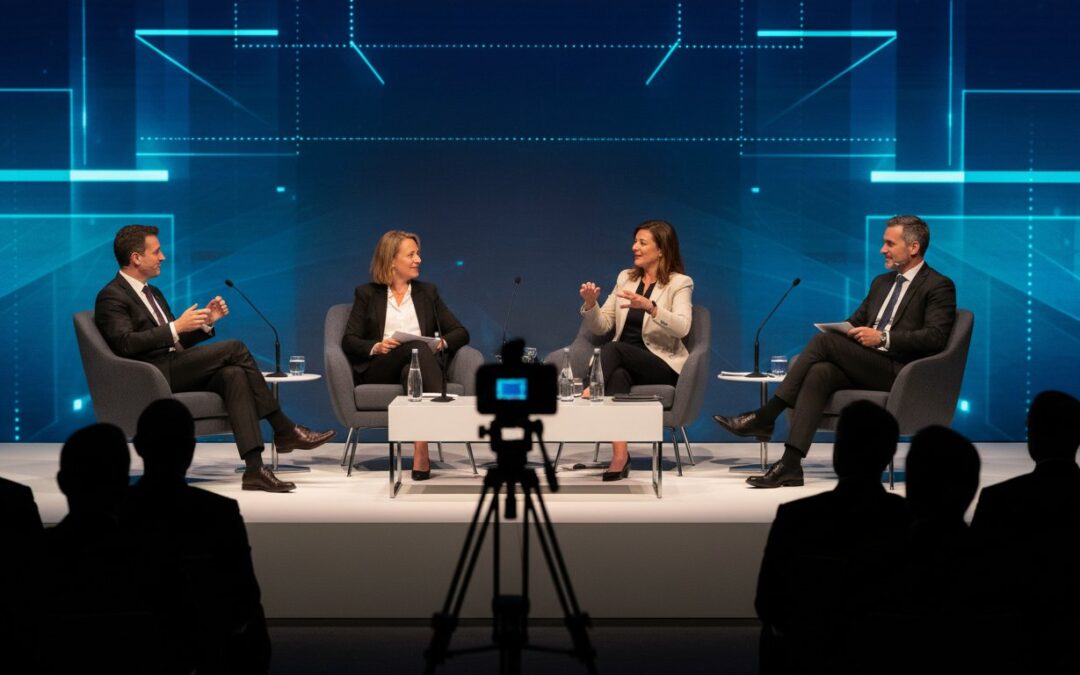
Creating a professional av setup for panel discussion also involves mastering the visual layout. Every panellist and the moderator must be framed correctly for both the live audience and virtual attendees. This is where event production services become essential. Specialists use multiple camera angles to ensure the “active speaker” is always visible, preventing the flat, unengaging “wide shot” that plagues lower-budget productions.
Design plays a massive role in how the audience perceives the experts on stage. TPG creates immersive environments using bespoke backdrops and strategic LED lighting to reinforce brand identity. We focus on these key elements:
- Framing: Ensuring sightlines are clear from every seat in the venue.
- Branding: Integrating digital signage and physical backdrops that look sharp on camera.
- Lighting: Using 3-point lighting for each panellist to avoid harsh shadows and “raccoon eyes.”
By treating the stage as a broadcast studio, we ensure the panellists look as authoritative as they sound. This integrated approach transforms a simple talk into a first-class corporate showcase. Set the stage for success by choosing solutions that prioritise technical precision over basic utility.
Audio Excellence: Managing Multiple Voices Without Feedback
The “Golden Rule” of a professional av setup for panel discussion is non-negotiable: one dedicated microphone per person. Sharing microphones between speakers leads to missed dialogue and inconsistent audio levels. TPG provides class-leading digital mixing solutions that utilize “Auto-Mix” technology. This hardware automatically manages gain-sharing across multiple active channels. It reduces the volume of inactive microphones in real-time, which prevents the cumulative background noise often heard in lower-quality productions. This ensures that every contribution is heard without the distracting “hiss” of multiple open lines.
In 2024, Ofcom data indicated a 15% increase in RF congestion within major UK city centres. Managing wireless frequencies in busy hubs like London or Manchester requires expert RF coordination. We use high-end spectrum analysers to identify clean airwaves, ensuring that every wireless channel is licensed and interference-free. This technical rigour is why our clients trust us to deliver confidently even in the most crowded signal environments. By coordinating frequencies before the event starts, we eliminate the risk of dropouts or cross-talk from neighbouring venues.
Microphone Selection for Panellists
Choosing the right hardware depends on the speaker’s comfort and the room’s acoustics. DPA headsets are the gold standard for gain before feedback. Because the capsule stays at a fixed distance from the mouth, audio levels remain consistent even if the speaker turns to face a colleague. Lavaliere mics offer a discrete look but can be prone to clothing noise or volume fluctuations. For audience Q&A, we deploy “Catchbox” throwable mics or roaming handhelds. These tools ensure every voice, from the stage to the back row, is captured with 100% clarity, maintaining a professional standard throughout the session.
Monitoring and Foldback
Panellists need to hear the conversation to stay engaged. We set up stage monitors, commonly known as wedges, to provide clear foldback. These must be tuned and positioned correctly to avoid bleeding back into the microphones, which is a primary cause of feedback. In large exhibition halls such as the NEC or Manchester Central, acoustic echo can be a significant challenge. We address this by using distributed audio systems that prioritize speech intelligibility over raw volume, ensuring the sound reaches the audience without bouncing off hard surfaces.
Hybrid events introduce the need for a “mix-minus” feed. This technical configuration ensures remote panellists hear the full stage discussion without being distracted by a delayed echo of their own voice. It’s a sophisticated solution that bridges the gap between physical and digital spaces. By balancing these diverse vocal projections and technical requirements, we create an environment where the focus remains entirely on the discussion rather than the technology behind it.
Visual Impact: Stage Design and Display Solutions
Every visual element in your av setup for panel discussion must serve a dual purpose: clarity for the live audience and high-fidelity capture for the digital record. In 2026, the shift toward high-pixel-pitch LED video walls has redefined expectations. Unlike traditional projection, which often suffers from washed-out colours in bright UK venues, LED walls offer a typical brightness of 600 to 1,200 nits. This ensures that data-heavy slides remain legible even under intense stage lighting. TPG provides class-leading LED solutions that eliminate the “shadowing” issues common with front-projection systems, allowing panellists to move freely without blocking the content.
Furniture choice is more than an aesthetic decision; it dictates your technical requirements. Bar stools keep speakers upright and alert, which naturally improves vocal projection and maintains a clean line of sight. Low club chairs might look sophisticated, but they often cause speakers to slump, creating “chin shadows” and muffling lapel microphones against clothing. To create a truly immersive environment, we recommend collaborating with professional exhibition stand designers. They can integrate digital nameplates directly into the stage set, replacing dated paper tents with dynamic “lower thirds” that update in real-time if a speaker is swapped last-minute. Set the stage.
Screen Content and Layouts
Modern audiences expect a broadcast-quality experience. This requires sophisticated Picture-in-Picture (PiP) layouts that display the presentation alongside remote speakers or live social feeds. We prioritise the use of “Comfort Monitors” (DSMs) placed at the foot of the stage. These allow panellists to see their own slides and timers without awkwardly twisting around to look at the main screen. For post-event reach, our technicians manage multiple aspect ratios simultaneously. We capture the primary 16:9 feed while framing a 9:16 “safe zone” for high-impact social media clips. Deliver confidently.
Lighting for Panels
Professional lighting ensures your experts look as authoritative as they sound. We employ a rigorous three-point lighting setup to add depth and dimension. This prevents panellists from appearing “flat” or washed out on camera. A common pitfall in panel discussions is the “dark spot” created when speakers turn their heads to engage with one another. We solve this by using wider fill lights and specific 45-degree angles for key lights. To reinforce your corporate identity, we integrate decorative LED uplighting. These fixtures can be programmed to match your exact brand hex codes, creating a cohesive visual narrative across the entire room. Light up the room.
Technical Execution: Cameras, Hybrid Links, and Q&A
Capturing the energy of a live debate requires more than just pointing a lens. A class-leading av setup for panel discussion utilizes a minimum of three camera angles to maintain visual momentum. A static wide shot serves as your safety net, capturing the full stage and context. Tight shots on individual speakers ensure the audience sees every nuance of expression. Using 4K resolution as a standard in 2026 ensures that your content remains future-proof for post-event marketing.
PTZ (Pan-Tilt-Zoom) cameras have revolutionised the stage footprint. These compact units provide broadcast-grade imagery without the need for bulky tripods or operators on the floor. It creates a cleaner look for the live audience while maintaining high production values. TPG provides these remote-controlled solutions to reduce on-stage clutter, allowing the focus to remain entirely on your experts.
Interaction is the heartbeat of any panel. While traditional roaming microphones provide a classic feel, they often cause delays in large UK venues. Digital platforms like Slido allow for real-time polling and question upvoting. Data shows these platforms can increase participation by 40% compared to hand-raising alone. For the best results, we recommend a hybrid approach: digital submission for speed and one or two roaming mics for personal engagement.
Reliability is non-negotiable for the modern broadcast. We recommend a dedicated 100Mbps symmetrical ethernet line as the primary feed. For high-stakes events, a bonded cellular solution provides a secondary failover path. This ensures that even if the venue’s primary line fluctuates, your stream remains live and stable.
The Hybrid Panel Bridge
Remote contributors shouldn’t feel like an afterthought. Using life-size LED displays with a 2.6mm pixel pitch allows virtual speakers to appear at eye level with on-stage guests. Managing latency is critical; we target a delay of under 200ms to prevent the awkward, interruptive lag that kills conversation flow. For a deeper dive into these strategies, see our guide to virtual events. Set the Stage.
The Technical Production Team
A seamless show relies on human expertise. The Vision Mixer cuts between camera feeds to follow the natural rhythm of the debate, ensuring the viewer always sees the person speaking. Simultaneously, the Stage Manager ensures the next set of speakers is mic’d and briefed. Having a dedicated technician for your audio visual equipment ensures that technical glitches are resolved before the audience even notices. Deliver Confidently.
Partnering with TPG for Class-Leading Panel Production
TPG Events operates as more than a mere equipment supplier; we function as a dedicated extension of your venue or internal production team. This collaborative approach ensures every av setup for panel discussion we design aligns perfectly with your strategic objectives. Our full-service workflow manages the entire lifecycle of your project. We handle everything from the first creative spark and technical CAD drawings to the final on-site delivery and de-rig. You get a single point of contact who understands the nuances of your brand and the technical requirements of the space.
The TPG Signature represents a unique fusion of creative set design and uncompromising technical precision. We’ve spent three decades refining our craft within the UK market, delivering thousands of successful events in major hubs like London, Manchester, and Birmingham. This history allows us to anticipate challenges before they arise, providing you with the reassurance that your production is in expert hands. We don’t just provide microphones and screens; we provide the peace of mind that comes from decades of proven excellence.
Custom Staging and Set Design
Your stage serves as the visual anchor for your entire event. TPG builds bespoke sets that reflect your brand’s innovation, moving away from generic backdrops to create something truly unique. During a 2023 tech summit at the NEC Birmingham, TPG transformed a standard panel into an immersive environment by utilizing curved LED walls and integrated lighting that reacted to the discussion topics. This custom approach turned a routine session into a highlight of the conference. We focus on high-end aesthetic finishes, using premium materials and precision engineering to ensure your speakers look as professional as they sound.
Set the Stage.
Deliver Confidently with TPG
Reliability is the cornerstone of our service. TPG maintains a massive inventory of the latest, most dependable hardware. We utilize industry-standard tools like d&b audiotechnik speakers and high-brightness laser projectors to ensure your av setup for panel discussion performs flawlessly under pressure. Our reach extends across the UK, providing consistent, high-quality production for exhibitions and conferences from London to Edinburgh. We take the technical weight off your shoulders, allowing your speakers to present with total certainty. Every cable, connection, and frequency is managed by our expert technicians so you can focus on the content.
Deliver Confidently.
Ready to elevate your next event? Contact the TPG Events team today to discuss a class-leading technical solution for your upcoming panel discussion and experience the impact of a truly professional production partner.
Set the Stage for Impactful Dialogue
A flawless av setup for panel discussion requires more than just microphones; it demands a strategic alignment of audio precision and visual impact. As we look toward 2026, the standard for excellence involves managing complex frequencies for up to eight simultaneous speakers and integrating seamless hybrid links for global participation. Success depends on eliminating technical friction so your experts can focus on the conversation. TPG Events brings over 30 years of technical production experience to every project, delivering class-leading AV and lighting solutions tailored for high-stakes environments. We’ve earned the trust of major UK venues and leading corporate brands by acting as a dedicated extension of their teams. Whether you’re hosting at a historic London site or a modern exhibition centre, our team ensures your production remains professional and reliable from the first sound check to the final Q&A. It’s time to move beyond basic setups and embrace a production style that truly resonates with your audience.
Deliver your next panel discussion confidently with TPG Events
Frequently Asked Questions
What is the best microphone for a panel discussion?
DPA 4066 or Shure TwinPlex headset microphones are the industry standard for high-end panel sessions in 2026. These headsets provide consistent audio levels even when speakers turn their heads to address one another. For a class-leading av setup for panel discussion, we recommend these condenser mics because they offer a 20Hz to 20kHz frequency response, ensuring every voice sounds natural and authoritative. Deliver confidently with equipment that captures every nuance of the conversation.
How many cameras do I need for a 4-person panel discussion?
You need a minimum of three cameras to capture a 4-person panel with professional standards. Use one wide master shot to establish the entire stage and two tight “cross-shots” that cover two panellists each. Data from 2024 UK production benchmarks shows that 85% of premium events add a fourth roving camera for audience reactions. This setup ensures you never miss a reaction and provides plenty of options for the vision mixer. Get visual with a multi-camera array that keeps your audience engaged.
How do I prevent audio feedback when multiple speakers are on stage?
Use an automatic microphone mixer or a digital signal processor to manage gain levels across all active channels. These systems automatically attenuate inactive microphones by up to 15dB to eliminate the risk of feedback loops. Proper speaker placement is equally vital; ensure your front-of-house PA system is positioned forward of the microphone line. This prevents sound from the speakers entering the mics, creating a stable and clear environment for your panellists.
Can I host a hybrid panel discussion with remote speakers?
Yes, you can host hybrid panels by integrating professional video conferencing hardware or vMix call-ins into your production workflow. We use low-latency encoders to ensure the delay remains under 200 milliseconds, allowing for natural back-and-forth dialogue. Remote participants appear on the main LED screen while hearing a “mix-minus” audio feed to prevent them from hearing their own echo. It’s an innovative solution for bringing global experts to a UK stage without the carbon footprint of travel.
What kind of lighting is needed for a panel discussion?
A standard three-point lighting setup using LED fresnels and profile spots provides the best visual clarity for both live and recorded audiences. You’ll need key lights set at a 45-degree angle to illuminate faces without harsh shadows, plus backlighting to separate speakers from the background. We use fixtures with a Colour Rendering Index of 95 or higher to ensure skin tones look accurate on camera. Light up the room with professional-grade LEDs that stay cool under pressure.
Should I use handheld or lapel microphones for panellists?
Headset or lapel microphones are superior for panels because they keep the speakers’ hands free for natural gestures. Handheld mics often lead to inconsistent audio levels if a speaker drops their hand while talking, which happens in 40% of unscripted discussions. In a professional av setup for panel discussion, we provide discreet DPA headsets to ensure 100% vocal clarity. Use handheld microphones exclusively for roving audience questions to maintain a structured and polished flow.
How do I manage audience questions during a live panel?
Use digital platforms like Slido or Vevox alongside physical roving microphones to manage the Q&A segment efficiently. Recent industry stats show that 72% of event planners prefer digital submissions to filter questions and maintain the session’s pace. For live questions, deploy at least two wireless handheld microphones with dedicated runners to reach audience members quickly. This dual-approach keeps the energy high and ensures the moderator stays in control of the schedule.
What is a comfort monitor and do I need one for my panel?
A comfort monitor is a screen placed on the floor or at the back of the room that only the speakers can see. It displays the current presentation slide, a countdown timer, or private notes from the producer to help panellists stay on track. Including these 32-inch or 55-inch displays is essential for high-stakes events where timing is critical. They allow your speakers to stay focused on the audience instead of constantly turning around to look at the main screen. Set the stage for success with tools that empower your talent.