The vision for your event is clear: an unforgettable experience that captivates every guest. Yet, transforming that vision into a seamless reality involves a thousand moving parts, and the path from concept to execution can feel overwhelming. This is where the true power of strategic event management comes into play. It’s more than just planning; it’s the art and science of orchestrating every detail, from creative direction and supplier logistics to the critical technical production that ensures your message is delivered flawlessly.
Feeling uncertain about where to start or how to choose the right partners? This comprehensive guide is designed to demystify the entire process. We provide a class-leading framework that takes you from initial concept and strategic planning right through to seamless on-site execution and insightful post-event analysis. Prepare to gain the confidence and clarity needed to deliver a professional, impressive, and truly memorable event. Let’s set the stage for your success.
Key Takeaways
- Adopt a structured five-phase lifecycle to move your event from a creative concept to a successful, measurable outcome.
- Elevate your approach beyond simple logistics by treating event management as a strategic discipline focused on the entire project lifecycle.
- Discover how to develop a technical production blueprint that ensures seamless execution and creates an unforgettable audience experience.
- Learn a proven framework for selecting class-leading creative partners and suppliers who can transform your vision into an immersive reality.
What is Event Management? More Than Just a Checklist
Many mistake event management for simple event planning-a common misconception. While planning focuses on logistics like venue booking and catering, true professional event management is the strategic application of project management principles to the creation and development of large-scale events. It encompasses the entire lifecycle, from the initial creative concept and financial planning to on-site execution and post-event analysis. At its core, Event Management is a results-driven discipline that transforms a vision into a tangible, unforgettable experience.
The ultimate objective extends far beyond a smoothly run day. It’s about designing an immersive environment that directly serves key business goals. Whether the aim is to launch a class-leading product, foster client relationships, or boost team morale, every decision is made with strategic intent. This process turns a gathering into a powerful and measurable tool for marketing, communication, and brand building.
Types of Events You’ll Manage
The scope of professional event production is vast, requiring a versatile and creative approach. A dedicated team provides class-leading solutions across a diverse spectrum of events, including:
- Corporate Events: High-impact conferences, seminars, trade shows, and product launches designed to inform and inspire.
- Brand Activations: Immersive experiential marketing and promotional events that create lasting brand connections with your audience.
- Ceremonies and Galas: Flawlessly executed award shows, fundraisers, and formal dinners that feel truly special and prestigious.
- Virtual and Hybrid Events: Innovative technical solutions that extend your reach and engage audiences anywhere in the world.
The Strategic Importance of Professional Management
Partnering with an expert team provides more than just an extra pair of hands; it delivers strategic value that underpins success. A robust management framework is essential for:
- Ensuring alignment with your wider marketing and business objectives from day one.
- Mitigating risks and navigating complex logistics with confidence and proven expertise.
- Maximising ROI through meticulous budget control, supplier negotiation, and resource management.
- Delivering a consistent and high-quality brand experience for every single attendee, reinforcing your reputation for excellence.
The 5 Core Phases of the Event Management Lifecycle
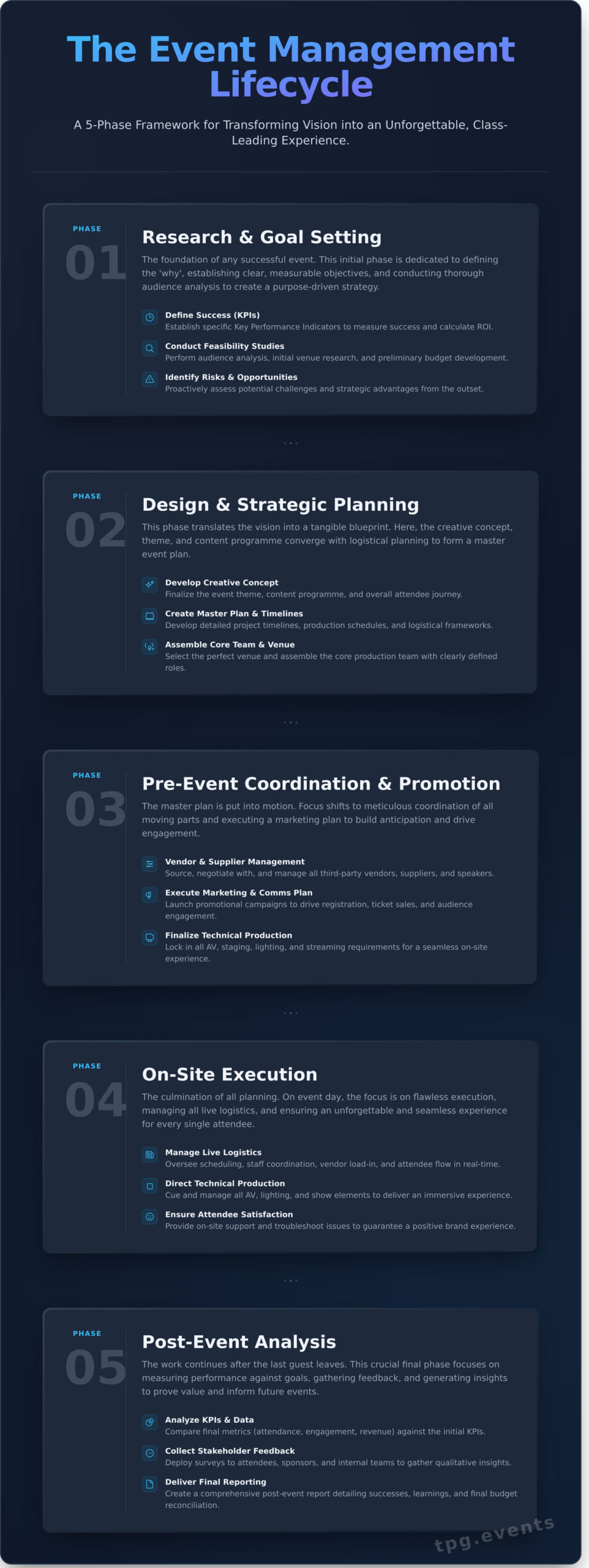
Delivering a class-leading event is not a matter of chance; it is the result of a structured, strategic process. At the heart of successful event management lies a five-phase lifecycle that provides a reliable framework for transforming a creative concept into a flawless, unforgettable experience. This methodical approach ensures every decision is intentional and every detail is aligned, moving from initial idea to final report with confidence and precision. Understanding this cycle is the key to proactive, not reactive, management, ensuring a seamless journey for you and your attendees.
Phase 1: Research and Goal Setting
The foundation of any successful event is a deep understanding of its purpose. This initial phase is dedicated to defining the ‘why’ behind your event. It involves establishing clear, measurable objectives, conducting thorough audience analysis to tailor the experience, and developing a realistic preliminary budget. Key activities include:
- Defining specific KPIs to measure success.
- Performing feasibility studies and initial venue research.
- Identifying potential risks and opportunities.
Phase 2: Design and Strategic Planning
With clear goals established, this phase translates vision into a tangible blueprint. Here, we develop the creative event concept, theme, and content programme that will captivate your audience. It is where logistical and creative solutions converge. Core components of this stage are creating the master event plan and detailed timelines, selecting the perfect venue, and assembling the core team with clearly defined roles to ensure accountability and drive momentum.
Phase 3: Pre-Event Coordination and Promotion
This is where the master plan is put into motion. Our focus shifts to meticulous coordination and building anticipation. This involves sourcing and managing all third-party vendors, suppliers, and speakers, ensuring they align with our first-class standards. A comprehensive marketing and communications plan is executed to drive registration and engagement, while all technical production, AV, and staging requirements are finalised for a seamless on-site experience.
Phase 4 & 5: On-Site Execution and Post-Event Analysis
The final phases cover the live event and the crucial evaluation that follows. On-site, our team manages all logistics, from scheduling to staff coordination, overseeing every technical detail to deliver a flawless show. Immediately after, we transition to analysis. This involves gathering vital attendee feedback through surveys and social listening, then analysing performance against the KPIs set in Phase 1. This data-driven approach, detailed in resources like A Practical Guide to Event Management, culminates in a comprehensive final report, providing clear ROI and invaluable insights for future events.
Assembling Your Event Team: Key Roles and Partners
No successful event is a one-person show. Behind every seamless conference, immersive product launch, or unforgettable gala is a skilled and coordinated team. Effective delegation is the bedrock of professional event management, and understanding the distinct roles required is the first step. Adhering to established Event Management Best Practices often starts with building a robust team structure tailored to your event’s scale and complexity, blending in-house talent with specialist external partners.
Core In-House and Agency Roles
Your internal team forms the command centre of your event strategy. While the exact structure varies, these core roles are fundamental to delivering a first-class experience:
- The Event Manager/Producer: The project lead, central point of contact, and ultimate decision-maker. They oversee the entire lifecycle, from budget to execution, ensuring every component aligns with the core vision.
- Marketing & Communications: This team drives awareness and attendance. They manage promotional campaigns, social media engagement, PR, and all attendee communications before, during, and after the event.
- Registration Coordinator: The gatekeeper of your event. This role handles ticketing platforms, attendee data management, badge production, and the all-important check-in process, ensuring a smooth welcome for every guest.
- On-site Volunteers/Staff: The frontline ambassadors for your brand. They assist with wayfinding, answer questions, and manage session rooms, directly shaping the attendee experience on the day.
Essential External Partners: The Specialists
While your core team manages the strategy, specialist partners provide the dedicated expertise and resources needed to bring your vision to life. For a truly class-leading result, you must collaborate with trusted experts:
- Venue Management: More than just a space, the venue team are your partners in logistics, health and safety, and on-the-ground operations. A strong relationship is crucial.
- Catering and Hospitality Services: The culinary experience is a powerful part of any event. Your caterer crafts menus that complement your event’s tone and satisfy your guests’ dietary needs.
- The Technical Production Partner: Your expert for creating an immersive atmosphere. They manage all audio-visual (AV) equipment, lighting, sound, and staging to deliver a flawless, high-impact production. Discover how a technical partner elevates your event.
The Technical Production Blueprint: Crafting an Immersive Experience
If your event concept is the creative soul, then technical production is the powerful engine that brings it to life. This is where vision becomes reality-the art and science of creating a specific mood, ensuring every message is heard clearly, and delivering those unforgettable “wow” moments. Professional execution in this area is what separates an adequate event from a class-leading one. That’s why integrating technical planning into the earliest stages of your event management process is not just recommended-it’s essential for a flawless outcome.
Audio-Visual (AV): The Foundation of Engagement
Your message is paramount, and AV is the medium through which it’s delivered with impact. This means deploying professional-grade systems for crystal-clear audio and high-definition visuals that capture and hold attention. We create immersive environments using:
- Dynamic Visuals: Seamless LED walls, creative projection mapping, and strategically placed display screens for maximum impact.
- Flawless Audio: Professional PA systems and microphones ensuring every word is heard, from the front row to the back.
- Broadcast Capabilities: Multi-camera systems for professional live streaming and high-quality event recording to extend your reach.
Lighting Design: Setting the Stage and Atmosphere
Lighting does more than just illuminate a space; it paints an emotional landscape. A strategic lighting design can transform a standard venue, focus audience attention, and powerfully reinforce your brand identity using colour and texture. We differentiate between functional stage lighting that keeps presenters perfectly visible, ambient lighting that sets the overall mood, and architectural lighting that highlights unique venue features. For added impact, intelligent lighting systems create dynamic effects and truly memorable moments.
Staging and Set Design: Creating Your World
The stage is your event’s focal point-a physical platform for your message. Our approach to set design goes beyond simple construction; we create a branded world for your content. This involves designing and building custom sets and backdrops that are safe, fully functional, and visually stunning. Every element, from branded lecterns to integrated digital displays, is meticulously planned, always considering crucial factors like audience sightlines and accessibility to ensure an inclusive experience for all attendees.
A cohesive technical blueprint is a cornerstone of modern event management. To see how expert production can elevate your next event, explore our class-leading technical solutions.
Choosing Your Event Partners: A Framework for Success
Your event’s success is deeply intertwined with the partners you choose. This is one of the most critical decisions in the entire event management process. Beyond a simple supplier relationship, you need a team that acts as a seamless extension of your own. Look for partners with a proven track record, relevant experience backed by glowing client testimonials, and a communication style that fosters a true partnership. Most importantly, they must demonstrate a clear understanding of your brand, your audience, and your core objectives.
A great partner doesn’t just execute a brief; they enhance it with creative and technical solutions that deliver an unforgettable experience.
Evaluating a Full-Service Event Agency vs. Specialist Suppliers
A full-service agency manages every detail, offering a single point of contact for simplicity. In contrast, specialist suppliers provide deep, class-leading expertise in one critical area, such as technical production. The best choice depends on your in-house capacity; if you have a strong internal team, a specialist partner can elevate key components. For large-scale events, a hybrid approach often yields the most innovative and successful results.
Key Questions to Ask a Potential Technical Production Partner
When vetting a potential partner, asking the right questions is crucial to understanding their capabilities and collaborative spirit. A first-class team will welcome this scrutiny. Be sure to ask:
- Can you share case studies of events with a similar scale and complexity to ours?
- What is your process for collaborating with our in-house team and other suppliers?
- How do you handle on-site troubleshooting and what contingency plans do you have in place?
- What creative or technical ideas can you bring to our concept to make it truly stand out?
Ultimately, the goal is to build a team of partners who are as invested in your event’s success as you are. The right technical and creative partners don’t just provide equipment or services; they provide peace of mind and innovative solutions that transform a good event into a class-leading experience. To see how a dedicated technical production partner can elevate your next project, explore the creative solutions at tpg.events.
Your Partner in Flawless Event Execution
As we’ve explored, exceptional event management is a strategic discipline, not just an operational task. It moves beyond a simple checklist to embrace a structured lifecycle, from initial concept to post-event analysis. Building a skilled team and selecting the right creative and technical partners are the cornerstones of this process, providing the foundation for crafting a truly unforgettable experience that resonates with your audience long after the final curtain.
Of all your partners, your technical production team is where vision becomes a tangible, immersive reality. With decades of industry experience, TPG provides full-service creative and technical solutions that transform ambitious concepts into class-leading live events. We are proud to be trusted by the UK’s leading brands and venues, acting not as a supplier, but as a seamless extension of your team to ensure every detail is executed with precision and creative flair.
Ready to elevate your next project? Bring your event vision to life with class-leading technical production. Contact TPG today. Your audience is waiting to be amazed.
Frequently Asked Questions About Event Management
What is the difference between an event manager and an event planner?
An event manager oversees the entire project lifecycle, focusing on strategy, budget, and achieving key objectives. They direct the master plan. An event planner, conversely, executes the logistical details within that plan-booking venues, coordinating suppliers, and managing schedules. While the roles collaborate closely, the manager’s scope is strategic and holistic, whereas the planner’s is tactical and task-oriented, ensuring every detail is flawlessly executed on the day.
How do you create a budget for an event?
A robust budget begins with your event goals. First, list every potential line item, from venue hire and catering to technical production and marketing. Research realistic costs for each and, crucially, allocate a contingency fund of 10-15% for unforeseen expenses (e.g., £2,500 on a £25,000 budget). Use a detailed spreadsheet to track all spending against your projections, ensuring complete financial control from concept to completion.
What are the most common challenges in event management?
The most common challenges in event management include adhering to strict budgets, navigating last-minute changes from clients, and ensuring seamless vendor coordination. Other significant hurdles can be technical failures and lower-than-expected attendance. Overcoming these requires a proactive strategy built on meticulous planning, clear communication, and comprehensive contingency plans that transform potential problems into manageable situations, safeguarding the event’s success.
How do you measure the success or ROI of an event?
Measuring event success requires analysing data against your initial goals. Quantitatively, track metrics like ticket revenue, leads generated, website traffic, and social media engagement. Qualitatively, use post-event surveys to gauge attendee satisfaction and brand perception. Combining these key performance indicators (KPIs) provides a clear, comprehensive picture of your return on investment (ROI) and the true impact of the experience.
What skills are essential to become a successful event manager?
A successful event manager must possess exceptional organisational and time-management skills to orchestrate complex schedules. Strong interpersonal and negotiation abilities are vital for liaising with clients, venues, and suppliers. Furthermore, creative problem-solving under pressure, meticulous attention to detail, and robust financial acumen are non-negotiable. These core skills ensure every project is delivered on time, on budget, and to a class-leading standard.
Why is technical production so important for corporate events?
Class-leading technical production is the backbone of an impactful corporate event. It is essential for creating an immersive atmosphere and ensuring your message is delivered with clarity and professionalism through flawless audio, lighting, and video solutions. High-quality production prevents technical glitches that can undermine your brand’s credibility and is the key to transforming a standard presentation into an unforgettable experience that engages and inspires your audience.
What should be included in a thorough event management plan?
A thorough event management plan is a master blueprint that must include clearly defined goals and measurable objectives. It should contain a detailed line-item budget, a target audience profile, and a comprehensive project timeline with key milestones. Other critical components include a marketing and communications strategy, a risk assessment with contingency actions, and a framework for post-event reporting and analysis to measure success.