Juggling multiple platforms for video conferencing, live streaming, and audience engagement can quickly turn a high-stakes corporate event into a chaotic technical minefield. The challenge of creating a seamless, broadcast-quality experience is precisely where unified communications (UC) provides a class-leading solution, yet many planners are still grappling with the complexities. A single dropped connection or audio glitch can derail months of careful planning, leaving remote attendees feeling disconnected and undermining your brand’s professionalism.
Imagine a single, integrated ecosystem where every communication tool works in perfect harmony. This is the power of a well-executed UC strategy: transforming disparate, conflicting technologies into an immersive and professional environment that captivates every participant, regardless of their location. It’s the key to moving from technical stress to flawless execution.
In this complete guide, we explore how to leverage UC to eliminate technical headaches, boost audience engagement, and deliver an unforgettable experience. Discover how to find the right technical partner and ensure your next conference or meeting is executed with first-class precision.
What is Unified Communications (UC)? A Clear Definition for Event Professionals
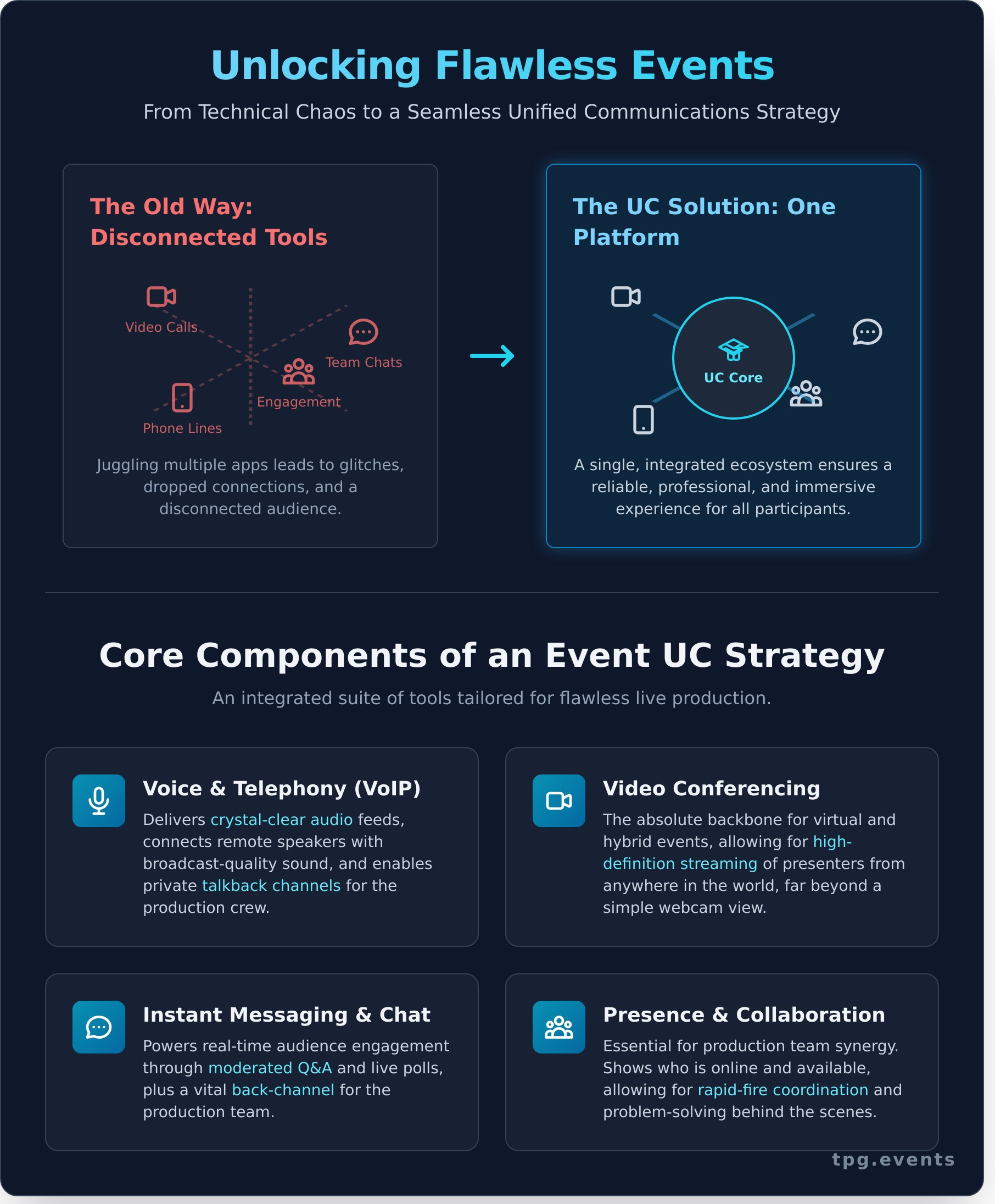
In essence, Unified Communications (UC) is an integrated suite of communication tools brought together on a single, manageable platform. Forget juggling separate apps for video calls, team chats, and phone lines. Instead, think of it as the central nervous system for your event’s communication-a single point of control that ensures every interaction is seamless, reliable, and professional. While many businesses use UC for daily operations, an event-focused setup is a far more robust, mission-critical solution designed for the unique demands of live production.
From connecting the production team to remote speakers and a global audience, a well-designed UC framework is the invisible architecture behind a flawless event experience.
The Key Components of a UC Platform
A class-leading unified communications strategy for events is built from several core technologies, each tailored for flawless execution:
- Voice and Telephony (VoIP): Delivers crystal-clear audio feeds, connects remote speakers with broadcast-quality sound, and enables private talkback channels for the production crew.
- Video Conferencing: The absolute backbone of modern virtual and hybrid events, allowing for high-definition streaming of presenters from anywhere in the world.
- Instant Messaging & Chat: Powers real-time audience engagement through moderated Q&A sessions and live polls, while also providing a vital back-channel for discreet communication between event managers and technicians.
- Presence and Collaboration Tools: Essential for production team synergy, these tools show who is online and available, allowing for rapid-fire coordination and problem-solving behind the scenes.
UC vs. UCaaS: What’s the Difference?
It’s crucial to understand the distinction between the strategy and its delivery. UC refers to the overall concept of integrating your communication tools. UCaaS (Unified Communications as a Service), on the other hand, is the cloud-based model for delivering these tools, often through a subscription service like Zoom or Microsoft Teams. For a high-stakes corporate event, a truly first-class experience demands a bespoke UC strategy-one that integrates these powerful platforms with professional-grade AV hardware, dedicated networks, and expert on-site support to guarantee an unforgettable and technically flawless event.
Beyond the Office: Why UC is a Game-Changer for Modern Corporate Events
While many associate UC with boardroom calls, its true power is unleashed in the dynamic world of corporate events. It’s the technology that solves the primary challenge of modern event production: connecting disparate audiences and transforming a simple broadcast into a truly interactive, unforgettable experience. TPG provides class-leading unified communications solutions to make this a reality, moving beyond passive viewing to active participation.
Powering Seamless Hybrid Events
A successful hybrid event is more than just a camera pointed at a stage. A robust UC architecture is the digital bridge between your physical venue and your virtual audience. It ensures remote attendees are not passive viewers but active participants, with equal access to live Q&A sessions, real-time polls, and dedicated virtual networking rooms. Our technical teams expertly manage multiple audio and video feeds, seamlessly integrating remote speakers with in-person presenters to create one cohesive, engaging event for everyone.
Delivering Flawless Virtual Conferences
For fully virtual events, the platform is the venue. A professional UC strategy elevates your online conference from a standard webinar to a polished, broadcast-quality production. We create immersive digital environments complete with main keynote stages, interactive breakout rooms, and virtual sponsor booths. This provides a single, intuitive interface for all attendees, simplifying navigation and focusing their attention on your content, ensuring a first-class experience from start to finish.
Connecting Multi-Location and Global Events
Imagine linking several venues across the country-or the globe-into a single, unified event. This is where a sophisticated unified communications framework truly shines. It allows keynote speakers to present from anywhere in the world without compromising on audio-visual quality, ensuring their message is delivered with impact. Critically, this technology guarantees consistent branding across all locations while ensuring every connection is stable. Adhering to expert guidance on securing unified communications systems is paramount in these complex setups to protect data and maintain event integrity.
The Core AV Technologies in an Event-Based UC Strategy
While standard video conferencing platforms are suitable for internal meetings, a high-stakes corporate event demands a far more robust and reliable technical infrastructure. Moving beyond basic tools is the first step in creating a professional event-based unified communications strategy. Here, quality and reliability are non-negotiable, forming the foundation of an unforgettable delegate experience, whether in-person or online. This is where TPG’s class-leading technical production comes into play.
Professional-Grade Video and Audio Integration
A flawless broadcast begins with pristine source material. We replace the single-webcam view with a dynamic, broadcast-quality production that captures every important moment with clarity and impact. Our approach ensures every element works in perfect harmony.
- High-Definition Video: We utilise multi-camera setups with professional 4K broadcast cameras, operated by experienced technicians to capture engaging angles of your speakers and stage.
- Crystal-Clear Audio: We integrate professional microphones, digital audio mixers, and high-fidelity sound systems to guarantee every word is heard perfectly by every attendee.
- Seamless Content Management: TPG’s systems ensure perfect audio-video sync and seamlessly switch between live speakers, presentation slides, pre-recorded video content, and lower-third graphics.
Interactive Tools for Audience Engagement
True engagement goes beyond a simple chatbox. To foster a genuinely interactive environment, we integrate specialised platforms directly into the event stream. This allows us to facilitate live polling, moderated Q&A sessions, and real-time surveys that connect the audience directly with the presenters. For collaborative sessions, virtual whiteboards and shared documents can be integrated, creating a dynamic space for brainstorming and discussion that mirrors the in-person experience.
Backend Production and Control Systems
The core of a professional event is our technical mission control. Here, a Technical Director oversees the entire production, using a vision mixer to choreograph the live feed. This structured approach to managing multiple technical feeds is central to professional unified communications, a principle echoed in large-scale frameworks like the official Unified Communications (UC) Overview used by government bodies. We use robust streaming encoders for stable delivery and build in full redundancy-from backup internet connections to failover power systems-to guarantee your event runs without a hitch.
Need a flawless technical setup for your next event? Explore our AV services.
Strategic Benefits of Using Unified Communications for Your Event
Beyond the technical specifications, a well-executed unified communications strategy delivers powerful, measurable business outcomes. It’s about transforming your event from a one-way broadcast into an immersive experience that boosts your brand, satisfies your audience, and delivers a clear return on investment. By integrating these class-leading solutions, you unlock tangible advantages that resonate long after the final session ends.
Dramatically Increase Attendee Engagement
Modern audiences expect more than a passive viewing experience. Unified communications tools break down the barriers between the stage and the seat, turning attendees into active participants. This creates a more dynamic and unforgettable event atmosphere, both for in-person and remote delegates.
- Interactive Participation: Empower your audience with live polls, real-time Q&A moderated through a seamless interface, and interactive digital whiteboards. For hybrid events, this ensures remote attendees feel just as involved as those in the room.
- Collaborative Breakouts: Facilitate smaller, more focused discussions by creating virtual breakout rooms where attendees can network, brainstorm, and collaborate on specific topics.
- Post-Event Value: Extend the life of your event by offering on-demand access to session recordings and content, allowing attendees to revisit key moments and share valuable insights with their colleagues.
Extend Your Event’s Reach and Accessibility
Geographical and physical limitations no longer need to restrict your event’s potential. By leveraging a robust hybrid or virtual platform, you can open your doors to a global audience, significantly increasing attendance, brand exposure, and overall impact.
- Overcome Geography: Attract delegates from across the UK and the world who may be unable to travel, instantly expanding your potential audience and market reach.
- Enhance Accessibility: Provide a first-class experience for all attendees with features like automated live captioning and multi-language audio streams, ensuring your message is clear and inclusive.
Gather Valuable Data and Analytics
One of the most powerful benefits of integrating your event technology is the ability to capture actionable data. These insights are crucial for demonstrating value to stakeholders and intelligently shaping your future event strategy.
- Prove Event ROI: Track key metrics like session popularity, attendee dwell time, and engagement levels to provide sponsors and executives with concrete proof of success.
- Inform Future Strategy: Analyse which topics resonated most, what questions were asked, and how attendees interacted to make data-driven decisions for your next event, ensuring continuous improvement.
Harnessing these strategic benefits requires a partner with deep technical expertise and creative vision. Discover how TPG’s solutions can elevate your next corporate event.
How to Implement a UC Solution for Your Next Corporate Event
Adopting a UC strategy is more than choosing software; it’s about creating a seamless, engaging experience for every attendee, whether they are in the room or online. The most innovative technology is only as effective as the expert team managing it. This three-step process ensures your investment in unified communications delivers a flawless and memorable event.
Step 1: Define Your Event’s Communication Goals
Before any technical decisions are made, you must clarify your objectives. Are you broadcasting a one-way keynote, or do you require a fully interactive Q&A and multi-room breakout sessions? Understanding your audience-their location, tech-savviness, and expectations-is critical. Clearly defining the desired outcomes for attendees (knowledge), speakers (impact), and sponsors (ROI) will shape every subsequent choice and provide a clear measure of success.
Step 2: Assess the Technical and Venue Requirements
A successful hybrid or virtual event depends on a robust technical foundation. This begins with a professional on-site audit of the venue’s internet connectivity and power infrastructure, as standard provisions are rarely sufficient. From there, your plan must account for all AV hardware and software, including:
- Professional cameras, microphones, and lighting for the main stage.
- High-quality remote presenter kits to ensure a consistent broadcast standard.
- The right virtual event platform and software to host your online audience seamlessly.
Step 3: Choose an Expert Technical Production Partner
This is the most critical step. Look for a partner, not just an AV supplier. An expert production company brings strategic insight, verifying that your goals are technically achievable and managing all complexity behind the scenes. They must demonstrate extensive experience with high-stakes hybrid events and provide dedicated on-site technicians and remote support to pre-empt any issues.
Ultimately, the right partner becomes an extension of your team, managing the intricate web of unified communications so you can focus on your content and guests. By entrusting the technical execution to seasoned professionals, you ensure a polished, engaging, and unforgettable experience for everyone. To see how a class-leading technical partner can elevate your next event, explore the creative production solutions at tpg.events.
Unify Your Event Technology for an Unforgettable Experience
As we’ve explored, the right technology is the backbone of any successful corporate event. The key takeaway is clear: integrating your core AV technologies under a single, cohesive strategy creates a seamless and more engaging experience for every attendee, whether they are in the room or joining remotely. By moving beyond disparate systems, you unlock new levels of collaboration and production efficiency that define modern, class-leading events.
Harnessing the full potential of unified communications requires a partner with deep technical expertise and creative vision. With decades of production experience, TPG Events is trusted by leading brands and venues across the UK to deliver full-service solutions for live, virtual, and hybrid events. We are more than a supplier; we are an extension of your team, dedicated to flawless execution.
Ready to deliver a class-leading, technically flawless event? Contact TPG Events today. Let’s create something unforgettable together.
Frequently Asked Questions
What is the difference between unified communications and a platform like Zoom or Microsoft Teams?
Think of platforms like Zoom or Teams as powerful tools in a larger toolbox. Unified communications is the entire integrated system-the toolbox itself. It seamlessly combines video conferencing, instant messaging, telephony, and content sharing into a single, cohesive ecosystem. While a platform offers a specific function, a true UC solution ensures all these elements work together flawlessly, providing a superior, streamlined experience for every user, whether in the room or across the globe.
How does UC improve the experience for remote attendees at a hybrid event?
UC transforms the remote attendee from a passive viewer into an active participant. By integrating features like live Q&A, interactive polling, and virtual breakout rooms directly into the event stream, it ensures they are fully immersed. This class-leading integration breaks down the barrier between physical and virtual attendees, fostering a shared, collaborative environment that feels cohesive and engaging for everyone, regardless of their location, creating a truly unforgettable hybrid experience.
What are the biggest technical challenges when setting up a UC solution for an event?
The primary challenges are ensuring platform interoperability, maintaining robust network stability, and guaranteeing high-quality audio and video. Different systems must communicate without glitches, which requires expert configuration. Sufficient, uncontended bandwidth is critical to prevent dropouts or latency. Finally, professional-grade microphones and cameras must be correctly integrated to capture crystal-clear sound and visuals, ensuring a first-class experience for all participants. These are challenges our technical teams solve every day.
Can unified communications be scaled for a small internal meeting as well as a large international conference?
Absolutely. Scalability is a core strength of a well-designed unified communications strategy. The same foundational principles of integrating communication tools can be applied to any event size. For a small internal meeting, this might mean a simple, high-quality video call with screen sharing. For a large international conference, the solution scales up to include multi-language streams, thousands of virtual attendees, and complex breakout session management, all managed through a single, reliable framework.
How does a technical production company help implement a UC strategy for an event?
A technical production partner, like TPG, acts as the architect and engineer of your UC strategy. We design a bespoke solution, selecting the right platforms and class-leading AV hardware to meet your event’s specific goals. Our team manages the entire technical implementation, from network configuration and system integration to live event monitoring and support. This ensures a seamless, professional production and allows you to focus on delivering your content with confidence.
What kind of internet bandwidth is required to run a smooth hybrid event with UC?
For a smooth hybrid event, a dedicated, uncontended internet connection is non-negotiable. As a baseline, we recommend at least 10-20 Mbps upload speed per high-definition stream. For events with significant remote interaction and multiple presenters, a dedicated fibre line of 100 Mbps (both upload and download) is a much safer benchmark. It is not just about speed; it is about reliability, which is why a dedicated, business-grade service is essential for flawless execution.