The success of your next conference, exhibition, or corporate gathering hinges on a single, critical decision: choosing the right partner. The landscape of event management companies can be complex, leaving you to navigate a sea of specialists, full-service agencies, and production houses. This uncertainty can be overwhelming, especially when the pressure is on to deliver an unforgettable experience. The fear of making the wrong choice-and jeopardising the outcome of your event-is a very real concern.
This guide is designed to provide clarity and confidence. We will demystify the different types of event partners available, from creative agencies to technical production specialists, helping you understand precisely what services you need. By the end, you will be equipped with the knowledge to identify and select the perfect partner to bring your vision to life, ensuring your event is not just successful, but truly class-leading.
What is an Event Management Company? (And What It’s Not)
At its core, an event management company is a strategic partner dedicated to designing, planning, and executing live, virtual, and hybrid events. From corporate conferences and award ceremonies to product launches and exhibitions, their primary value is to save you invaluable time, eliminate stress, and deliver a polished, professional result that aligns perfectly with your objectives. The discipline of Event management is a complex field, requiring a unique blend of creativity, meticulous planning, and technical know-how.
However, the landscape of event management companies is diverse, and it’s crucial to understand that not all providers offer the same services. Matching your specific needs to a company’s specialism is the first step toward a successful and unforgettable event. To ensure you find the right fit, it’s vital to distinguish between two primary types of partners.
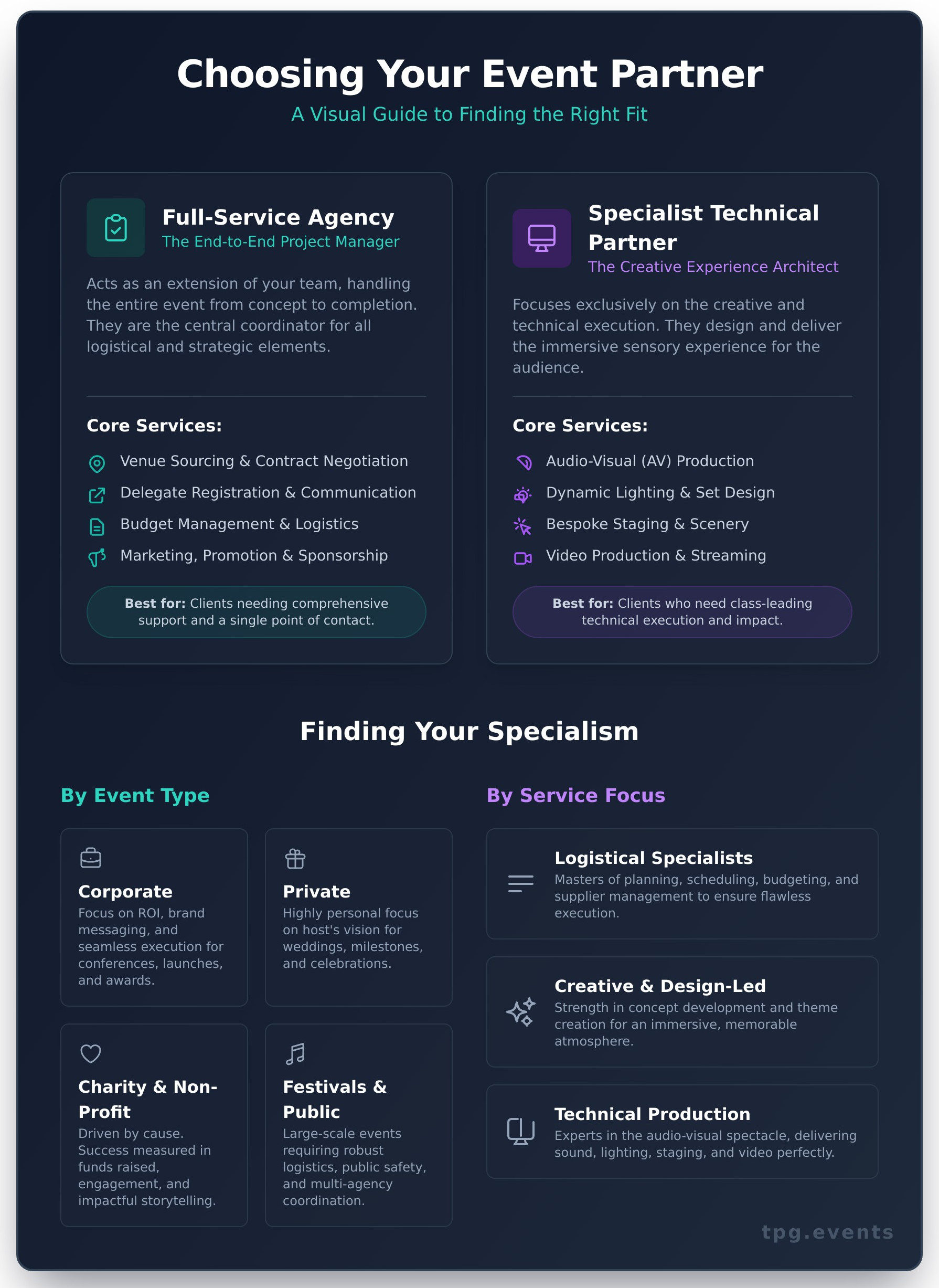
The Full-Service Event Management Agency
A full-service event management agency acts as an extension of your team, shouldering the immense logistical burden of event planning. They are the central project manager for your entire event, handling a vast array of tasks from concept to completion, including:
- Venue sourcing and contract negotiation
- Delegate registration and communication
- Marketing, promotion, and sponsorship
- Budget management and logistics
- Catering and speaker coordination
They are the perfect solution for clients who need comprehensive, end-to-end support and a single point of contact to orchestrate every moving part. While they manage the overall project, they often collaborate with and outsource highly specialised elements, like AV and staging, to a dedicated technical partner to ensure every detail is class-leading.
The Specialist Technical Production Partner
In contrast, a specialist technical production partner concentrates exclusively on the creative and technical execution that brings an event to life. They are the architects of the audience experience, transforming a vision into a tangible, immersive reality. Their expertise lies in creating powerful atmospheres through class-leading audio-visual (AV) services, dynamic lighting, bespoke staging, set design, and seamless video production.
Think of them as the ‘behind-the-scenes’ innovators who craft the unforgettable sensory experience for your audience, ensuring your message is seen and heard with maximum impact. This type of partner is ideal for clients or venues that have the logistical elements handled but require first-class technical solutions to make a powerful statement.
Types of Event Management Companies: Finding Your Specialism
The world of event management is far from a one-size-fits-all industry. It is a vast spectrum of specialists, each with a unique skill set, supplier network, and creative approach. To find a partner capable of delivering a class-leading experience, you must first identify the category of expertise your event requires. Professional bodies like the Meeting Professionals International (MPI) recognise this diversity, offering distinct development paths for different sectors. Understanding these specialisms is the first step to a successful partnership.
Categorisation by Event Type
The most common way to segment event management companies is by the nature of the events they produce. Each type demands a different focus, from stakeholder management to emotional resonance.
- Corporate Events: This is a broad category focused on business objectives. It includes conferences, product launches, award ceremonies, and exhibitions where ROI, brand messaging, and seamless execution are paramount.
- Private Events: A distinct market covering weddings, milestone birthdays, and private celebrations. The focus here is highly personal, centring on the host’s vision and creating unforgettable guest experiences.
- Charity & Non-Profit: These events, such as fundraisers, galas, and awareness campaigns, are driven by a cause. Success is measured by funds raised and public engagement, requiring expertise in donor relations and impactful storytelling.
- Festivals & Public Events: This involves large-scale live music, cultural festivals, and public gatherings. It requires robust expertise in logistics, public safety, ticketing, and complex multi-agency coordination.
For private events especially, success often depends on collaborating with specialized creative partners who capture the personal nature of the day. For instance, in the wedding sector, the choice of a photographer is paramount. To get a sense of what a dedicated, award-winning team provides, you can learn more about One Vision Photography | South Wales Wedding Photographer.
Categorisation by Service Focus
Beyond the type of event, companies often specialise in a particular aspect of delivery. A company’s focus dramatically impacts its team structure, creative process, and pricing.
- Logistical Specialists: These are the masters of planning, scheduling, budgeting, and supplier management. They ensure every component runs flawlessly, from venue sourcing to on-the-day coordination.
- Creative & Design-Led Agencies: Their primary strength is in concept development, theme creation, and brand experience. They focus on aesthetics and creating an immersive, memorable atmosphere.
- Technical Production Companies: These are the experts in delivering the audio-visual spectacle. They provide class-leading solutions for sound, lighting, staging, and video to ensure your message is seen and heard perfectly.
Boutique Agencies vs. Global Firms
Finally, consider the scale of the company. A boutique agency often provides a highly personalised, hands-on service with a niche specialism, making them an excellent fit for clients seeking a close partnership. In contrast, large global firms offer extensive resources, a worldwide network, and the capacity to handle massive, multi-location events. The right choice depends on your event’s scale and your company’s culture. Before committing, always review a company’s portfolio to see tangible proof of their experience in your specific area of need.
Core Services: What to Expect from Your Event Partner
To truly understand the value of an event partner, it’s essential to look beyond the event day itself. The most effective event management companies operate across the entire event lifecycle, from the initial spark of an idea to the final post-event analysis. This comprehensive approach is central to the process; in fact, a leading institution, Johnson & Wales University, defines event management as the strategic application of project management to create and develop events. Understanding these core service pillars will help you build a clear brief and select the right partner for your needs.
Strategy, Concept, and Budgeting
This foundational stage transforms your vision into a viable, impactful plan. It begins with creative brainstorming to develop an unforgettable concept aligned with your brand objectives. From there, we work with you to define clear Key Performance Indicators (KPIs) to measure success and event ROI. A detailed budget is meticulously crafted and managed, ensuring full financial transparency and control over every pound spent from start to finish.
Logistics and Supplier Management
Flawless execution relies on expert logistical planning. This involves sourcing the perfect venue, negotiating class-leading contracts, and managing a complex network of trusted suppliers-from catering and security to transportation and staffing. On the day, your event partner oversees every detail, from the master schedule to attendee flow and on-site troubleshooting, guaranteeing a seamless and professional experience for every guest.
Creative and Technical Production
This is where an event truly comes to life, turning a standard conference or awards ceremony into an immersive experience. The best event management companies provide in-house technical and creative expertise to design and deliver a complete sensory environment. Key technical solutions include:
- Custom Stage and Set Design: Creating a visually stunning focal point that reinforces your brand and message.
- Professional Audio: Ensuring crystal-clear sound with class-leading microphones, speakers, and expert sound engineering.
- Creative Lighting Design: Using light to build atmosphere, direct attention, and create dramatic, memorable moments.
- High-Definition Visuals: Deploying impactful solutions like LED walls, projection mapping, and multi-camera live feeds to captivate your audience.
How to Choose the Right Event Management Company
Selecting the right partner is one of the most critical decisions in your event’s lifecycle. The best event management companies act as a true extension of your team, bringing technical expertise and creative vision to deliver an unforgettable experience. This structured, three-step framework will help you move from a long list of potential suppliers to a confident final decision.
Step 1: Define Your Event Goals and Scope
Before you begin your search, you must establish a clear brief. This internal clarity is the foundation for a successful partnership. Define your core objectives: are you generating leads, launching a product, or delivering essential training? You must also determine your audience, budget in GBP (£), timeline, and any non-negotiable elements. A detailed scope ensures you are comparing potential partners on a like-for-like basis.
Step 2: Research, Shortlist, and Review Portfolios
With your brief in hand, start your research using online searches, industry awards, and professional recommendations. Look for firms with proven, specific experience in your event type and sector. Scrutinise their portfolios and case studies for evidence of creativity and flawless execution. Client testimonials are invaluable for gauging reliability, problem-solving skills, and a collaborative spirit. Your goal is to find a team whose work resonates with your brand’s standards.
Step 3: Key Questions to Ask Potential Partners
Once you have a shortlist, it’s time to dig deeper. A polished proposal is just the start; you need to understand their process and crisis management capabilities. Prepare a list of critical questions to ask during your initial meetings:
- How do you handle unforeseen challenges or last-minute changes on-site?
- Who will be my dedicated point of contact throughout the project?
- Can you walk me through your process from the initial brief to post-event delivery?
- How do you measure the success of an event and what KPIs do you track?
A truly great event partner offers more than just logistics; they provide peace of mind and innovative solutions. Their answers will reveal their expertise and suitability as a long-term partner. When your event demands technical excellence, you need an expert team you can trust. Need an expert technical partner? Discover TPG’s class-leading solutions.
The TPG Difference: Partnering for Technical Excellence
While many event management companies offer a broad range of services, the success of a modern corporate event often hinges on one critical element: flawless technical production. This is where a specialist partner becomes not just an advantage, but a necessity. Whether you have an in-house team or a trusted event planner, TPG provides the class-leading technical expertise to elevate your vision from concept to an unforgettable reality.
Our focus is on delivering the powerful audio-visual solutions that create atmosphere, deliver your message with impact, and ensure a seamless experience for every attendee, whether they are in the room or joining online.
When a Technical Production Partner is Your Priority
While a general event manager handles logistics, a technical partner is essential for ambitious productions. Consider partnering with a specialist like TPG in the following scenarios:
- Your event’s success hinges on its audio-visual impact. From crystal-clear sound for keynotes to dynamic video content, the technical delivery must be perfect.
- You have complex staging, lighting, or video requirements. Ambitious designs require expert engineering and execution to be both safe and spectacular.
- You need to create a truly immersive and professional atmosphere. We use technology to transform spaces and build environments that captivate your audience.
- You’re running a hybrid event with demanding streaming needs. Flawless broadcast quality and reliable connectivity are non-negotiable for engaging a remote audience.
Seamless Integration with Your Team
At TPG, we don’t replace your team; we empower it. We operate as a seamless extension of your existing staff or chosen event agency, bringing decades of specialised technical knowledge to the table. Our role is to translate a creative vision into a technical reality. We handle all technical supplier management, logistics, and on-site execution, ensuring every microphone, screen, and light works in perfect harmony to achieve your goals.
This collaborative approach allows your team to focus on strategy, content, and guest experience, confident that the production is in the hands of seasoned experts. Ready to ensure your event’s technical execution is second to none? Let’s discuss the technical vision for your next event.
Your Partner for Unforgettable Events
Navigating the world of event management companies is the most critical step in transforming your vision into a successful event. The right partnership is built on a clear understanding of your goals, a specialist skill set that matches your needs, and a collaborative approach to execution. It’s about finding a team that doesn’t just manage, but elevates.
At TPG, we are that partner. With decades of industry experience, we deliver class-leading creative and technical event solutions, making us a trusted choice for leading brands and venues across the UK. We move beyond simple logistics to provide the immersive production that makes an event truly memorable.
Ready to create an experience that captivates your audience? Your next successful event starts with a conversation.
Bring your event to life with class-leading technical production. Contact TPG today.
Frequently Asked Questions
What’s the difference between an event planner and an event management company?
An event planner typically focuses on the logistical and coordination aspects of an event, such as venue booking and supplier management. In contrast, an event management company offers a comprehensive, end-to-end solution. We act as a strategic partner, providing creative direction, class-leading technical production, brand integration, and flawless on-site execution. We are an extension of your team, managing every facet of the experience to deliver truly unforgettable results and a measurable return on investment.
How do event management companies typically structure their fees?
Fee structures vary but typically fall into three models. A percentage-based fee, often 15-20% of the total event budget, is common for large-scale productions. A fixed project fee provides cost certainty from the outset, agreed upon after a detailed scope of work. For specific consultancy or on-site support, a day rate may be applied. We provide a transparent, detailed proposal outlining all costs, ensuring there are no surprises and you receive first-class value for your investment.
How far in advance should I hire an event management company?
For large-scale conferences or exhibitions, we recommend engagement 9-12 months in advance. This allows ample time for strategic planning, venue sourcing, and securing key suppliers. For smaller corporate events or awards dinners, 4-6 months is usually sufficient. Engaging us early ensures we can act as a true creative partner, securing the best resources and developing an innovative concept that aligns perfectly with your objectives, delivering a seamless and impactful experience from start to finish.
What should I include in my initial event brief to a potential company?
A strong brief is the foundation for a successful partnership. Please include your core objectives (e.g., lead generation, team building), target audience, and estimated number of attendees. Also, provide your ideal event dates, potential locations, and a clear budget range. Finally, share any initial creative ideas or specific brand messaging you wish to incorporate. This essential information allows us to develop a tailored, creative proposal that precisely meets your strategic and financial requirements.
Can I hire a company for just one part of my event, like technical production?
Absolutely. While we provide complete end-to-end management, our services are entirely modular. Many clients partner with us specifically for our class-leading technical production, hiring our expert teams to deliver immersive AV services, innovative lighting design, or complex staging solutions. We seamlessly integrate with your in-house team or other suppliers, acting as a dedicated extension to your team to ensure your chosen element is executed with technical precision and creative flair.
What are the key benefits of hiring an event management company vs. doing it in-house?
Hiring professional event management companies provides access to industry expertise, established supplier networks, and significant purchasing power, often leading to cost savings. We manage all logistical complexities, contractual negotiations, and on-site risks, freeing your team to focus on your guests and core business objectives. Ultimately, the key benefit is a higher ROI through a more strategic, creative, and flawlessly executed event that delivers an unforgettable and measurable impact.