
The success of your conference, exhibition, or gala often hinges on one critical decision: selecting the right creative and technical partner. With countless options available, the process of finding the perfect event production company can feel overwhelming. The fear of choosing an unreliable team for a high-stakes occasion is real, leaving many unsure of what questions to ask beyond price or how to properly evaluate complex technical capabilities.
This is where confidence replaces uncertainty. This guide provides a definitive, step-by-step framework designed to eliminate the guesswork and empower your decision-making. We’ve created the ultimate checklist to help you systematically evaluate potential partners on everything from creative vision and technical expertise to transparency and collaborative spirit.
Follow our class-leading advice, and you’ll be equipped to select a partner who acts as a true extension of your team, ready to bring your vision to life and deliver a truly unforgettable, seamless event.
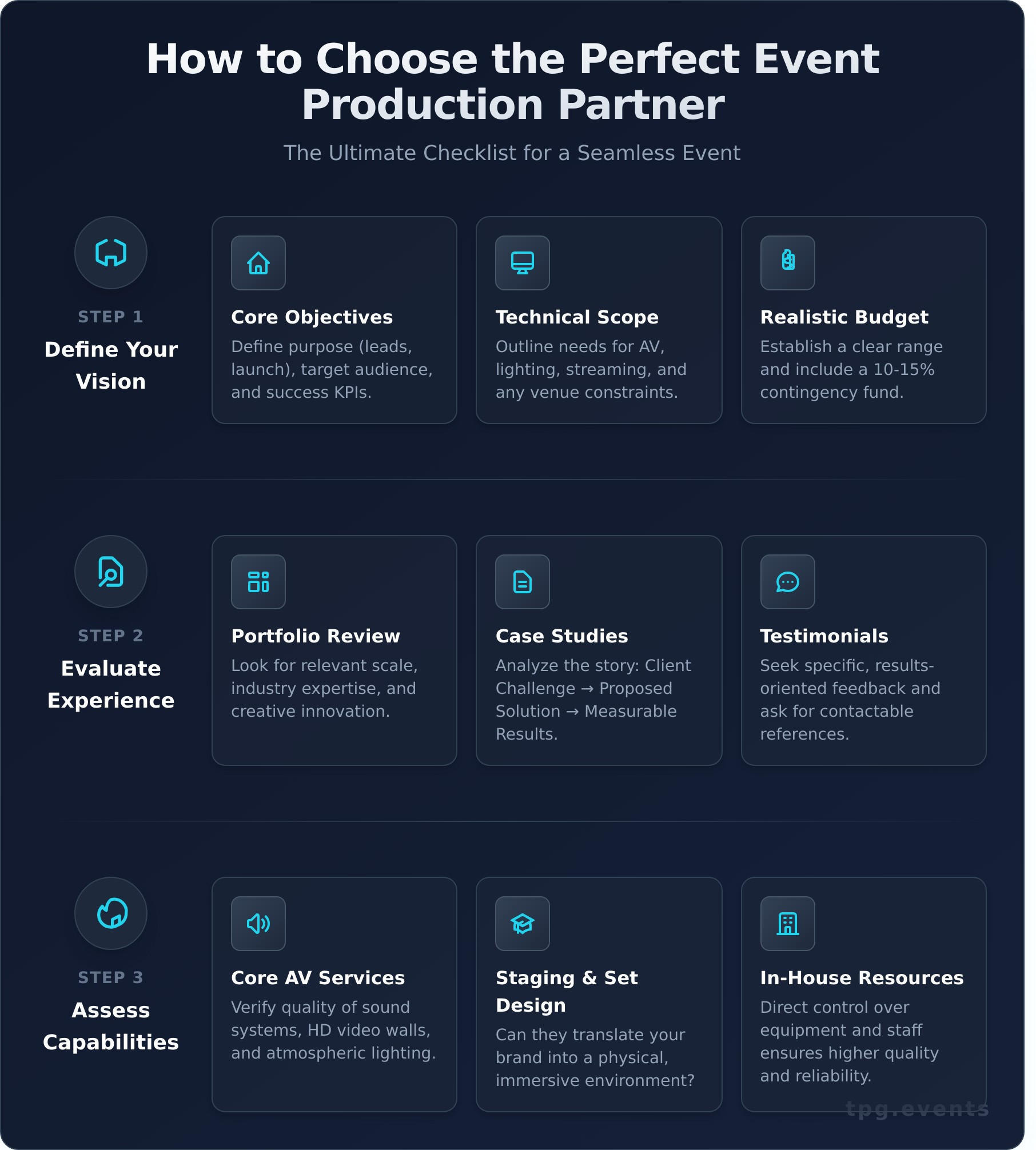
Step 1: Define Your Event Vision and Technical Needs
Before you begin your search for the ideal event production company, the most critical step is internal: creating a comprehensive event brief. This document is the foundation for a successful partnership, translating your abstract ideas into a concrete plan. A well-defined brief acts as your North Star, guiding every decision and ensuring that potential partners understand your vision from the very first conversation. This clarity prevents misalignment, saves valuable time, and empowers you to evaluate proposals with precision.
Clarifying Your Core Objectives
At its core, your brief must answer the fundamental “why” behind your event. This strategic planning is a cornerstone of professional event management and ensures every decision, from lighting design to content delivery, serves a distinct purpose. Before approaching any company, be prepared to define:
- Primary Purpose: Is the goal to generate leads, launch a product, boost team morale, or educate an audience? A clear objective shapes the entire event strategy.
- Target Audience: Who are you trying to reach? Define their expectations and the key takeaways you want them to leave with to create an unforgettable experience.
- Key Performance Indicators (KPIs): How will you measure success? This could be anything from attendee numbers and social media engagement to post-event sales figures.
Outlining the Technical Scope
With your objectives set, you can start mapping out the technical solutions required to bring your vision to life. You don’t need to be an AV expert, but a general outline helps an event production company understand the scale of your project. Consider your initial requirements for audio, video, lighting, and staging. Think about whether you need live streaming capabilities for a hybrid audience or specific digital platforms for a fully virtual event. Note any known venue constraints, such as power limitations or rigging points.
Setting a Realistic Budget
A transparent and realistic budget is not a limitation; it is a vital tool for effective collaboration. Establish a clear budget range before you start requesting proposals. A professional partner can deliver far more creative and effective solutions when they understand the financial framework. Be sure to allocate funds not only for production but also for venue hire, marketing, and a contingency of 10-15% for unforeseen costs. Communicating a range, such as £30,000 – £40,000, allows for a more productive and realistic discussion from the start.
Step 2: Evaluate a Company’s Portfolio and Relevant Experience
A portfolio is the ultimate proof of an event production company’s capabilities. It goes beyond attractive photos and slick videos; it’s a direct reflection of their experience, creative problem-solving, and ability to deliver class-leading results. Scrutinising their past work is a critical step in ensuring they are not just a supplier, but a strategic partner capable of bringing your vision for an unforgettable event to life.
Analysing Past Projects
Start by looking for direct relevance. Have they produced events at a similar scale to yours? A company excelling at intimate corporate dinners may not have the logistical framework for a multi-day international conference. Equally, consider their industry experience. A team that understands the nuances of the tech sector will approach a product launch differently than one specialising in high-fashion galas. Look for versatility and evidence of innovative thinking. Does their portfolio showcase an understanding of current priorities, such as expertise in sustainable event planning, or does their work feel repetitive?
Reading Between the Lines of Case Studies
While a portfolio shows the final product, case studies reveal the process. The most insightful ones don’t just show success; they detail the journey. Look for a clear narrative that outlines:
- The Client’s Challenge: What was the initial problem or objective?
- The Proposed Solution: How did they plan to tackle it creatively and technically?
- The Results: What measurable impact did their work have on the client’s goals?
This demonstrates a strategic, results-driven approach, which is the hallmark of a truly professional partner.
Checking Testimonials and References
Client feedback is your window into the real-world experience of working with a company. Look past generic praise and seek out specific, results-oriented testimonials. A comment like, “Their team seamlessly managed a last-minute venue change, saving the event,” is far more valuable than, “They were great to work with.” Don’t hesitate to ask for contactable references for recent, relevant projects. A reputable event production company will be transparent and proud to connect you with satisfied clients.
Step 3: Assess Technical Capabilities and In-House Resources
An ambitious creative vision is only as good as the technical team and technology executing it. The difference between a memorable event and a frustrating one often comes down to flawless technical production. A truly professional event production company invests heavily in its equipment and people, ensuring they have direct control over every critical element.
Core AV (Audio Visual) Services
First-class audio visual (AV) delivery is the foundation of any successful event. Your message must be seen and heard with perfect clarity. When evaluating a potential partner, ask specific questions about the quality of their core AV solutions:
- Audio: What brand and quality are their sound systems, speakers, and microphones? Can they guarantee crisp, intelligible audio for every attendee, from the front row to the back?
- Visuals: Do they offer high-definition projectors, seamless LED video walls, and repeater screens to ensure maximum visual impact?
- Lighting: How do they approach lighting design? A great partner uses lighting not just for illumination, but to create atmosphere, guide focus, and build an immersive brand environment.
Staging, Rigging, and Set Design
The physical environment sets the stage for your entire event. Look for a company that can translate your brand identity into a tangible, impressive reality. Can they design and build custom sets that go beyond generic pipe and drape? Assess their capabilities for complex staging and rigging, which are essential for creating dynamic, multi-layered presentations. A company with in-house fabrication and set-building workshops holds a significant advantage, offering greater creative flexibility, quality control, and faster turnaround times.
Virtual and Hybrid Event Technology
In today’s landscape, technical proficiency must extend to the digital realm. An expert event production company will have a proven track record in delivering seamless virtual and hybrid experiences. Enquire about the platforms they use and, more importantly, how they ensure a cohesive and engaging experience for both in-person and remote audiences. Their team should be adept at managing live streams, integrating remote presenters flawlessly, and providing the robust technical backbone required to eliminate glitches and deliver a professional broadcast-quality production.
The In-House vs. Outsource Question
This is a critical point of differentiation. Does the company own its core inventory of equipment, or do they sub-hire it from third-party suppliers? Is their technical team composed of full-time, trained staff, or do they rely on a rotating roster of freelancers? In-house resources provide unparalleled reliability and quality control. When a company owns its gear and employs its technicians, you benefit from a team that knows its equipment inside and out. This integrated approach makes it far easier to uphold event production best practices and minimises the risk of communication gaps, equipment failure, or unexpected cost increases associated with outsourcing. Explore our class-leading technical production services.
Step 4: Gauge Communication, Collaboration, and Culture Fit
Beyond the portfolio and technical specifications lies a critical factor: the working relationship. You are not simply hiring a supplier; you are choosing a partner to bring your vision to life. The best event production company will operate as a seamless extension of your own team. Their communication style, responsiveness, and project management rigour are just as important as their creative or technical capabilities. From your very first interaction, you should be assessing whether they are the right cultural fit for a high-stakes, high-pressure project.
The Initial Consultation
The initial consultation is your first and best indicator of a company’s approach. Pay close attention to the questions they ask. Are they digging deep into your event objectives, audience demographics, and desired outcomes? A truly collaborative partner demonstrates a genuine interest in your vision first, listening intently before proposing their own creative solutions. Their communication should be clear, professional, and consistently timely, setting a precedent for the entire project.
Understanding Their Project Management Process
A flawless event is the product of a class-leading process. To understand how a potential partner collaborates, you must ask about their operational framework. A transparent and structured approach is non-negotiable for delivering an unforgettable experience. Key questions include:
- Who will be our dedicated point of contact throughout the project?
- What project management tools and software do you use to ensure transparency and track progress?
- How do you document and manage last-minute changes or unforeseen challenges on-site?
Their answers will reveal their level of organisation and ability to perform with confidence under pressure.
Evaluating the Team and Culture
Finally, assess the people and their principles. A successful event is built on a foundation of trust and mutual respect. Do their company values-whether a commitment to sustainability, innovation, or meticulous detail-align with yours? Whenever possible, ask to meet the key team members who would be assigned to your event, from the project manager to the technical director. This human connection is the bedrock of a strong and effective partnership.
Step 5: Scrutinise the Proposal and Pricing Structure
Once you receive proposals, the final stage of your selection process begins. A proposal is more than a list of costs; it’s a direct reflection of an event production company‘s understanding of your vision and their professional diligence. It provides the blueprint for your partnership. While budget is always a key consideration, remember that for a critical event, the cheapest quote rarely represents the best value. Look for a document that demonstrates expertise, transparency, and a genuine investment in your success.
What a Great Proposal Includes
A class-leading proposal moves beyond basic pricing to provide a comprehensive overview of the proposed solution. It should act as a clear and reassuring statement of intent, demonstrating that the company has listened carefully to your brief. Look for these key elements:
- A Strategic Summary: A clear overview of their understanding of your event goals, target audience, and desired outcomes.
- Itemised Breakdown: A detailed, line-by-line list of all equipment, technical services, and labour costs. Vague terms like “AV Package” should be a red flag.
- Logistical Clarity: Specific details on crewing (including roles and numbers), transport arrangements, and the setup/derig schedule.
- Clear Terms: A straightforward payment schedule, cancellation policy, and comprehensive terms of service.
Comparing Apples to Apples
To make a fair comparison, ensure every company has quoted based on the exact same brief. If one proposal is significantly cheaper or more expensive, don’t be afraid to ask why. A lower price might indicate inferior equipment, less experienced crew, or a misunderstanding of the project’s scope. Evaluate the value being offered-does a higher price include more robust contingency planning, senior technicians, or more creative technical solutions? Focus on the overall value and potential ROI, not just the bottom-line figure.
Asking About Hidden Costs
A transparent partner will be upfront about all potential costs from the very beginning. It is crucial to clarify what is and is not included in the quoted price to avoid unwelcome surprises later. Proactively ask about charges for crew overtime, potential damages to equipment, and whether a contingency budget is included for unforeseen issues. A truly professional partner welcomes these questions as an opportunity to build trust. Ready for a transparent proposal? Let’s build your event.
Partnering for Perfection: Your Final Step to an Unforgettable Event
Choosing the right partner is the most critical decision in bringing your event vision to life. The process goes beyond comparing quotes; it’s about finding a team that aligns with your culture, demonstrates proven expertise, and possesses the technical resources to execute flawlessly. This crucial choice ensures your message is delivered with impact and your audience leaves with a lasting impression.
The ideal event production company acts as a true extension of your team, not just a supplier. At TPG, we are built on this collaborative philosophy. With decades of industry experience and our own suite of class-leading, in-house technical solutions, we become your dedicated partner-committed to turning ambitious concepts into polished, unforgettable realities. Your vision is our blueprint for success.
Let’s discuss your next unforgettable event.
Frequently Asked Questions
What is the difference between an event planner and an event production company?
An event planner typically manages the logistical framework of an event, such as guest lists, venue sourcing, and catering. In contrast, an event production company is the technical and creative partner responsible for executing the sensory experience. We deliver the class-leading staging, lighting, audio, and video solutions that transform a space and create an immersive, unforgettable atmosphere, bringing the planner’s vision to life with technical precision and creative flair.
How far in advance should I hire an event production company?
For large-scale conferences, exhibitions, or award shows, we recommend securing a production partner 6 to 12 months in advance. This lead time allows for comprehensive creative development, technical planning, and sourcing of specialised equipment. For smaller or more straightforward events, a 3 to 6-month window is often sufficient. Engaging early ensures a more collaborative process and a flawlessly executed, first-class result that meets your strategic objectives.
What are the biggest red flags to watch out for when choosing a company?
Key red flags include vague proposals that lack specific technical details, poor or slow communication, and an unwillingness to provide recent client references. Be cautious of any company without a strong, relevant portfolio that demonstrates their capabilities. A dependable partner will be transparent about their processes, confident in their expertise, and able to provide clear, detailed plans that inspire trust and align with your vision for a professional outcome.
Should I choose a local company or one that works nationwide?
While a local supplier may be suitable for a small, single-venue event, a nationwide partner offers significant advantages for larger or multi-location projects. A national event production company provides consistency in quality, access to a wider inventory of cutting-edge equipment, and the logistical expertise to deliver a seamless experience anywhere in the UK. This ensures your brand is represented with the same class-leading standard of excellence, regardless of the postcode.
What level of creative input should I expect from a production company?
You should expect a production company to act as a proactive creative partner, not merely a technical supplier. A top-tier firm will work closely with you to understand your goals and then propose innovative concepts to elevate your event. They should bring new ideas, suggest immersive technologies like projection mapping or interactive displays, and help shape the narrative of your event to ensure it leaves a lasting and powerful impression on your audience.
How do production companies handle health and safety regulations?
A professional production company treats health and safety with the utmost seriousness, adhering strictly to UK regulations like the Health and Safety at Work Act 1974. This involves creating detailed Risk Assessments and Method Statements (RAMS) for every project, ensuring all equipment is properly certified, and deploying qualified technicians. Expect your partner to hold comprehensive public liability insurance and to manage all on-site technical operations with precision to guarantee a safe environment.